
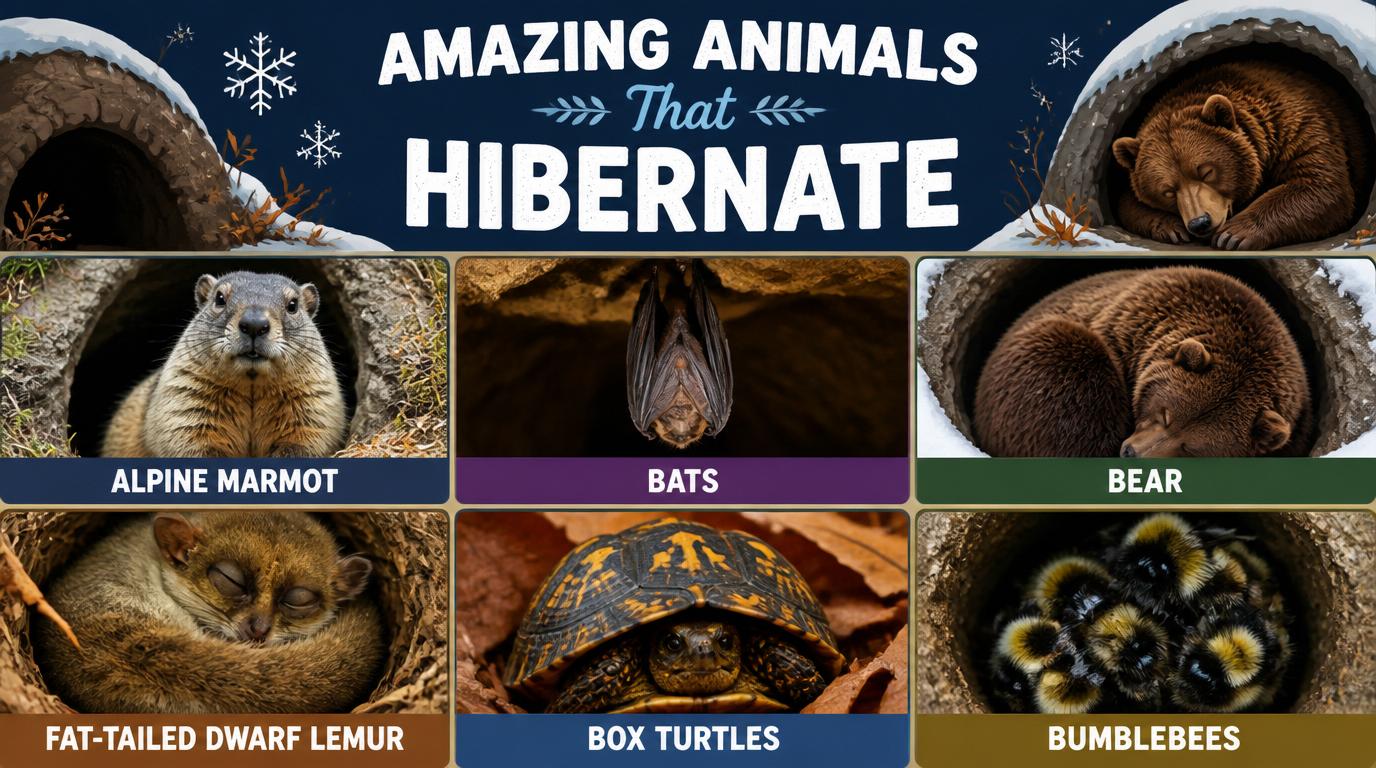
When Nature Sleeps: 10 Amazing Animals That Hibernate
As the cold season arrives, waking up in the morning becomes harder — not just for humans, but for many animals too. Some creatures have found remarkable ways to survive harsh winters. While some migrate to warmer climates, others simply slow down and slip into a deep sleep that lasts for months.
This long, inactive state is called hibernation — a natural survival strategy that helps animals endure freezing temperatures and food shortages.
Here are ten fascinating species that spend the winter fast asleep.
Alpine Marmot
The Alpine marmot lives high in the mountain ranges of Central and Southern Europe, at altitudes between 800 and 3,200 meters. Sensitive to temperature changes, these large ground squirrels spend up to nine months of the year in hibernation.
When summer arrives, marmots eat voraciously to build thick layers of fat, which serve as energy reserves during their long winter sleep. This fat keeps them warm and alive until the snow melts and spring returns.
Bats
Bats — the world’s second-largest group of mammals — make up around 20% of all mammal species, with more than 1,200 known types. During the cold months, many species form clusters in caves, hanging from ceilings like tiny, furry ornaments.
Not all bats hibernate, but those living in colder regions do. Their bodies enter an extreme state of torpor: heart rates drop from hundreds of beats per minute to about ten, and their body temperature plummets. In this suspended state, they can sleep for up to six months, barely breathing, while winter passes quietly above ground.
Bears
Few animals symbolize hibernation as strongly as bears. Found across the Northern Hemisphere (and even parts of the Southern), species like the American black bear and grizzly bear hibernate during winter to survive when food becomes scarce.
During this period, their heart rate slows dramatically — from about 55 beats per minute to just nine. Astonishingly, bears don’t eat, drink, urinate, or defecate throughout their hibernation. They can remain in their dens for months, emerging in spring slimmer but healthy and alert — true masters of metabolic control.
Fat-Tailed Dwarf Lemur
Native only to Madagascar, the fat-tailed dwarf lemur is the world’s only primate known to hibernate in the wild. For up to seven months a year, these tiny creatures sleep deeply, reducing their heart rate from 180 beats per minute to just four.
Their breathing slows to a single inhalation every 10 to 15 minutes. Stored fat in their tails keeps them nourished while they rest. This remarkable adaptation allows them to endure Madagascar’s dry season — and makes them one of the strangest hibernators on Earth.
Box Turtles
The box turtle, found across the eastern United States and Mexico, also hibernates to survive cold winters. When temperatures drop and food becomes scarce, these reptiles burrow into soil or leaf litter and enter a dormant state lasting three to five months.
Their heartbeat slows, digestion stops, and even their eyes remain closed. Many turtles don’t survive if they fail to find proper shelter, making hibernation a delicate and risky part of their life cycle.
Bumblebees
The humble bumblebee spends most of its life asleep. Found mainly in the Northern Hemisphere — particularly in cooler, high-altitude regions — bumblebees live in colonies ruled by a single queen.
When winter arrives, only the young queens survive by hibernating underground. Some queens sleep for up to nine months, which means they spend nearly three-quarters of their life in hibernation before emerging in spring to start a new colony.
Garter Snakes
Garter snakes, harmless and adaptable, hibernate communally during the cold months. They gather in underground dens, sometimes by the hundreds — or even thousands.
One Canadian den was recorded sheltering more than 8,000 snakes! Packed tightly together, they share body heat and remain motionless until the ground warms again. When spring returns, they slither out en masse in one of nature’s most spectacular awakenings.
Snails
Snails, being cold-blooded, cannot survive freezing weather without special adaptations. Many species seal themselves inside their shells with a mucus “lid” that traps warmth and moisture.
While in hibernation, their metabolism slows to almost nothing — even their tiny hearts beat only occasionally. Some snails live for years this way, reawakening each spring to continue their slow, deliberate lives.
In contrast, many slugs die after laying eggs in autumn, leaving the next generation to hatch when warmth returns.
Hedgehogs
Hedgehogs are among the most familiar winter hibernators. They retreat to piles of leaves, hollow logs, or burrows once the weather turns cold — usually around October or November.
Interestingly, hedgehogs don’t sleep continuously. They sometimes wake for a few days to forage before returning to their cozy dens. This pattern continues until spring, when insects become plentiful again and their nightly wanderings resume.
The Common Poorwill — The Sleeping Bird
Meet the common poorwill, North America’s only bird known to enter true hibernation. Found along the southern Rocky Mountains and deserts of the United States, this remarkable bird can remain motionless for weeks — even months — hidden among rocks.
During hibernation, its body temperature and metabolism drop sharply, allowing it to survive long, cold periods when insects are scarce. It’s the avian world’s answer to the bear — proof that even birds sometimes choose sleep over flight.
When Nature Presses Pause
Hibernation is one of the most fascinating survival strategies in the natural world. Whether it’s a bear in a snowy den, a lemur in a hollow tree, or a bat deep inside a cave, each creature has evolved a unique way to pause life itself — waiting patiently for the warmth of spring to return.
Очень люблю животных,и мне всегда было интересно,как же они переживают холодную зиму,как ведут себя после пробуждения)))очень хороший сайт много информации.