
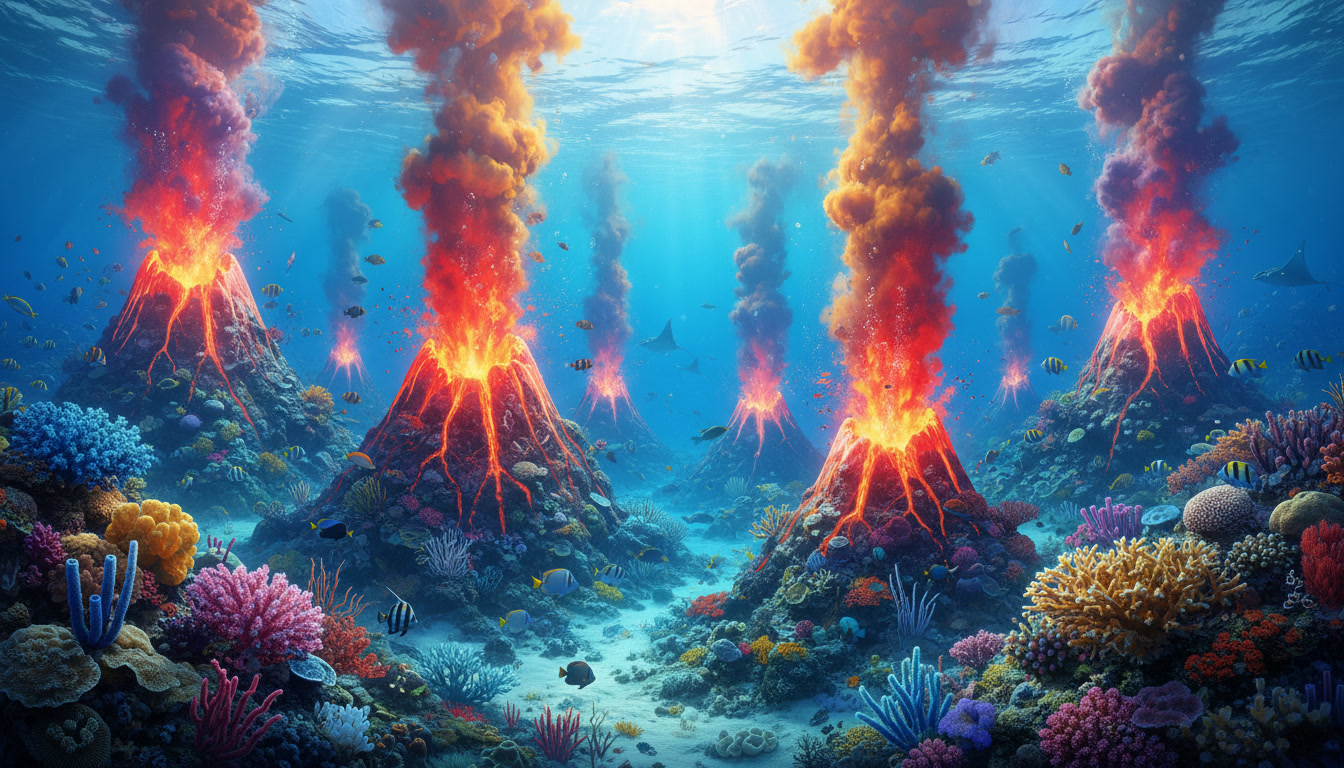
Incredible Underwater Volcanoes Around the World
Volcanoes are often associated with towering mountains and dramatic eruptions on land, but much of Earth’s volcanic activity occurs hidden beneath the waves. These underwater volcanoes remind us that fire, earth, and water can collide in spectacular ways, often far from human eyes. Here’s a look at some of the most astonishing submarine volcanoes across the globe.
Kick ‘em Jenny, Caribbean Sea
Nestled in the turquoise waters off the coast of Grenada, Kick ‘em Jenny is one of the Caribbean’s most notorious underwater volcanoes. Its summit lies about 200 meters below the ocean surface, rising from the seafloor at a depth of 1,300 meters. Since its discovery in 1939, Kick ‘em Jenny has erupted 14 times, prompting strict exclusion zones to keep boats and swimmers away.
The volcano sits on the edge of a steep underwater cliff, with parts of its cone forming a natural wall on the ocean floor. It is the only active submarine volcano in the Eastern Caribbean, a reminder of the hidden hazards beneath serene waters.
Mega Volcano Near Mayotte
In 2018, residents of Mayotte, a French island between Madagascar and Mozambique, reported hearing a strange hum. Scientists soon realized that the island had experienced the largest underwater volcanic eruption ever recorded. The eruption was so powerful that it caused the island itself to shift and sink by several centimeters.
This eruption is extraordinary because the region had been dormant for 4,000 years. Small earthquakes rattled the island daily before the event, highlighting the unpredictable power of underwater volcanism.
The Deepest Eruptions on Earth
Near Samoa, Fiji, and Tonga, a massive submarine volcano rises about one mile above the seafloor. Nicknamed the “Underwater Fourth of July,” it is one of the hottest known lava flows in the modern geological era.
Despite its colossal height, its base lies at extreme depth, making its eruptions the deepest ever recorded. In 2009, researchers captured stunning footage of boninite lava deposits, offering insight into how the Earth’s crust recycles during tectonic collisions. Even near the intense heat, extremophiles like shrimp survive, demonstrating life’s resilience in extreme environments.
Loihi Seamount, Hawaii
Off the coast of the Big Island of Hawaii, Loihi is an underwater mountain of immense scientific interest. Its summit sits 900 meters below the waves, rising from the side of Mauna Loa, the world’s largest shield volcano.
Although Loihi may seem new, its formation began about 400,000 years ago. Eventually, it is expected to breach the ocean surface, becoming a new Hawaiian island. Loihi currently rises 3 kilometers above the seafloor, making it larger than Mount St. Helens before its 1980 eruption.
Hidden Volcanoes of Alaska
Alaska, often associated with ice and glaciers, also hides volcanic surprises. In 2013, scientists discovered a dormant volcano just 45 meters beneath the surface that had been inactive for 10,000 years. Two years later, another deeper volcano was found at 900 meters below sea level, releasing methane gas rising through the water.
Researchers used advanced monitoring equipment to capture colorful images of the eruptions and gas plumes, offering a rare glimpse of volcanic activity beneath frozen waters.
Axial Seamount, Oregon
Located 500 km off the Oregon coast, Axial Seamount is an active underwater volcano and part of the Cobb–Eikelberg seamount chain. Lava cooling instantly in ocean water forms unusual pillow-like structures with a glassy texture.
Axial Seamount has erupted several times in recent decades, with lava flows traveling up to 1.6 km along the seafloor. Its regular activity makes it one of the most studied submarine volcanoes in the world.
Marsili, Italy
The Marsili volcano is the largest underwater volcano in Europe, stretching 70 km long and 30 km wide in the Tyrrhenian Sea. Its summit lies 450 meters below the surface, but it poses a significant risk: collapse of its walls could trigger a massive tsunami, threatening parts of Sicily and Calabria.
Despite its danger, Marsili remains largely unknown — a reminder that the Mediterranean still holds secrets beneath its calm waters.
Explorer Seamount, Canada
Near Vancouver Island, Explorer Seamount is Canada’s largest underwater volcano, covering 772 square miles. It rises 2.5 km above the seafloor, with its summit 800 meters below the surface.
Tectonic activity makes it a hotspot of submarine geology and biology. Researchers have discovered thriving ecosystems here, with sponges and other marine life forming something akin to an underwater tropical forest on this hidden mountain.
Underwater volcanoes are proof that Earth’s forces extend far beyond what we see on land. They shape our oceans, influence marine life, and occasionally remind us of the incredible power hidden beneath the waves.



 English
  Ukrainian