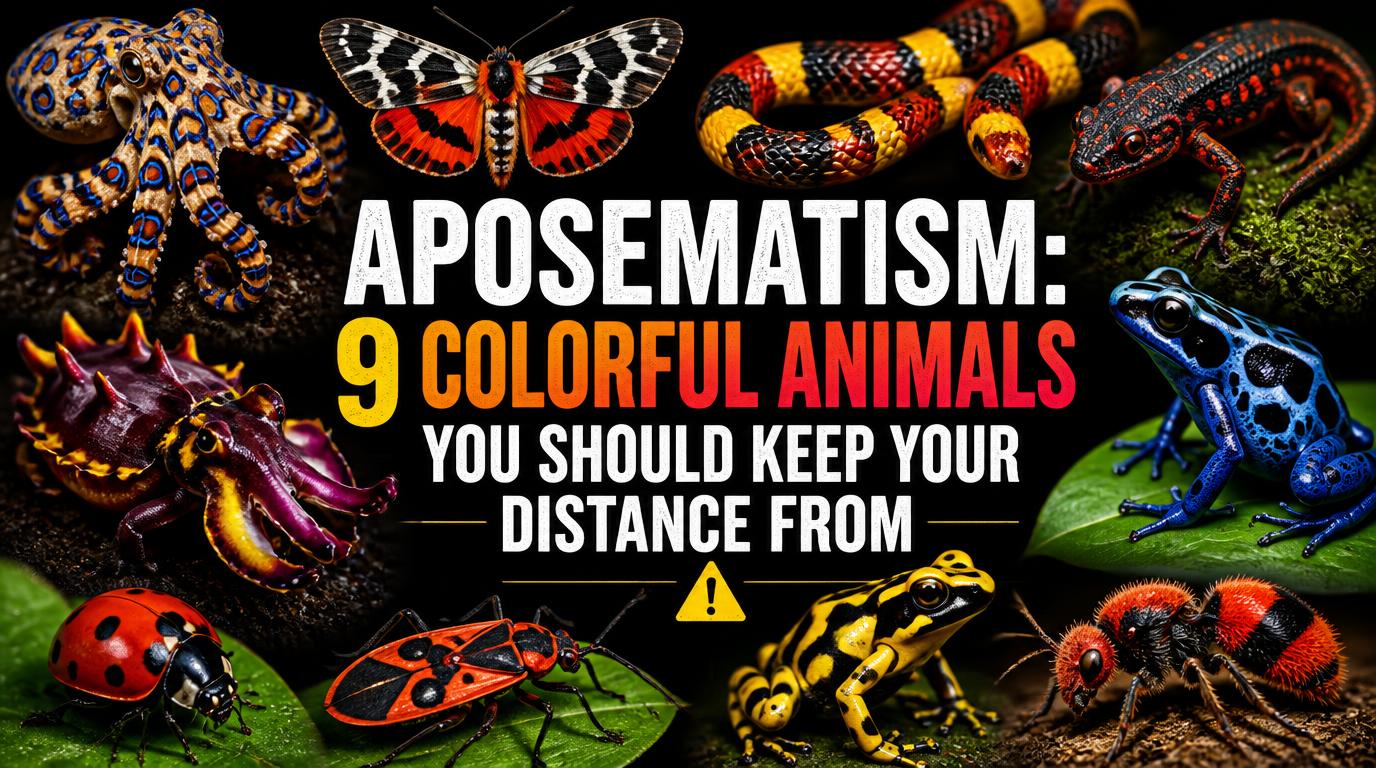
Aposematism: 9 Colorful Animals You Should Keep Your Distance From
Aposematism is a natural warning system that helps animals signal danger to potential predators. Bright colors, contrasting patterns, and sometimes distinctive sounds can indicate that an animal is poisonous, venomous, or capable of defending itself. These warning signals help predators recognize risky prey and avoid attacking.
From tiny marine predators to brightly colored insects and amphibians, many species use striking appearances to improve their chances of survival. Here are nine colorful animals that use warning signals as part of their defense strategies.
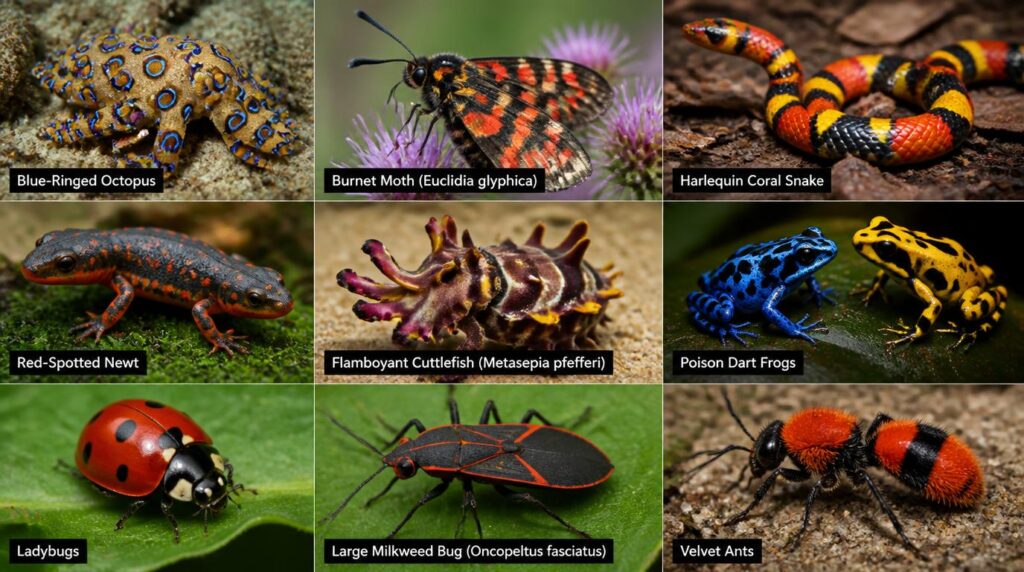
1. Blue-Ringed Octopus
The blue-ringed octopus is one of the most venomous marine animals in the world. Despite its small size, it carries tetrodotoxin, a powerful neurotoxin that can cause paralysis and respiratory failure.
When threatened, this octopus makes its brilliant blue rings more conspicuous. The display serves as a warning to potential predators. It may also change its overall coloration and adopt defensive behavior when it feels cornered.
Its bite can be painless, meaning a person might not immediately realize they have been envenomated. Severe poisoning can lead to breathing difficulties and paralysis. There is no specific antidote for tetrodotoxin, so avoiding contact with this animal is essential.
2. Burnet Moth (Euclidia glyphica)
The moth Euclidia glyphica has distinctive brown wings decorated with contrasting markings. Its appearance helps it stand out in certain environments, although the precise role of its coloration in predator defense requires further evidence.
Aposematism generally works by associating a recognizable signal with an unpleasant or harmful experience. Predators that have encountered toxic or distasteful prey may learn to avoid similar-looking animals in the future.
However, it would be misleading to claim without reliable evidence that Euclidia glyphica produces cyanide-based compounds or that the size and color of its wing markings reliably reveal its toxicity. Its inclusion in a discussion of warning coloration should not be treated as proof that it is dangerous to humans.
You may also like: Strange-Looking Animals in Australia
3. Harlequin Coral Snake
Coral snakes are known for their striking combinations of red, yellow, and black bands. These contrasting colors can function as warning signals, making the snakes recognizable to potential predators.
Coral snakes possess potent venom containing neurotoxins that can interfere with the nervous system. Severe envenomation may cause muscle weakness and respiratory failure, making prompt medical attention essential after a suspected bite.
These snakes are generally secretive and tend to avoid people. Depending on the species, they may inhabit forests, woodland areas, and places with abundant leaf litter.
The common name “harlequin coral snake” can refer to different species, so geographic range and identifying characteristics should be checked against the particular species being discussed. Regardless of the exact species, an unfamiliar brightly patterned snake should never be handled.
4. Red-Spotted Newt
The red-spotted newt is a North American amphibian known for its distinctive appearance during different stages of its life cycle. Its juvenile terrestrial stage, commonly called the red eft, typically has bright orange or reddish skin marked with darker spots.
This vivid coloration warns predators that the animal contains toxins. Red-spotted newts produce tetrodotoxin, which can make them dangerous to animals that attempt to eat them.
The bright warning signal is especially useful while juveniles move across the forest floor. Predators that recognize the coloration may learn to avoid them.
Although these newts are not generally considered a major danger to humans, they should not be eaten or handled unnecessarily. Wild amphibians are best observed without direct contact.
5. Flamboyant Cuttlefish (Metasepia pfefferi)
The flamboyant cuttlefish is a small marine cephalopod famous for its vivid and rapidly changing colors. Its body can display contrasting shades of yellow, white, purple, and brown, creating a striking pattern against the seabed.
Unlike many cuttlefish that rely primarily on camouflage, the flamboyant cuttlefish often walks along the ocean floor while displaying conspicuous colors. These displays are thought to serve as warnings about its chemical defenses.
The species is considered toxic, and consuming it can be dangerous. Its coloration is part of a broader defensive strategy that combines visual signals with distinctive movement.
Despite its unusual beauty, the flamboyant cuttlefish should be observed without touching or disturbing it.
6. Poison Dart Frogs
Poison dart frogs are among the most familiar examples of aposematism. Depending on the species, their skin may feature brilliant yellow, orange, red, blue, or green patterns that advertise their chemical defenses.
Some species possess potent toxins that can seriously harm predators. Certain Indigenous peoples in Central and South America have historically used secretions from particular poison frogs to coat hunting weapons.
Not all poison dart frogs are equally toxic. In many species, the compounds responsible for their toxicity are obtained through their natural diet. Frogs raised in captivity without access to the same dietary sources often lack comparable levels of defensive toxins.
Their bright colors are a warning, but toxicity varies by species and circumstances. Avoid handling wild frogs, and never assume that a colorful amphibian is harmless.
7. Ladybugs
Ladybugs, also known as lady beetles, are small insects whose bright coloration can help deter predators. Many species have red, orange, or yellow bodies with contrasting black spots.
When threatened, some ladybugs release a yellowish defensive fluid from joints in their legs. This secretion can have an unpleasant smell and taste, making the insects less appealing to predators such as birds and lizards.
Their conspicuous patterns may help predators learn to associate their appearance with an unpleasant meal. Once a predator has had a negative experience, it may avoid similar insects in the future.
Ladybugs are not generally dangerous to humans. Their defensive secretions are part of a survival strategy aimed primarily at discouraging predators.
8. Large Milkweed Bug (Oncopeltus fasciatus)
The large milkweed bug has a distinctive orange-red body with black markings across its wings. Its contrasting pattern makes it easy to spot on milkweed plants.
These insects feed mainly on milkweed seeds and can acquire defensive chemicals from their host plants. Such compounds can make them less palatable to certain predators, while their bright coloration may serve as a warning.
Large milkweed bugs do not normally pose a danger to people. They do not have a venomous sting, and their feeding behavior is primarily associated with milkweed plants and seeds.
Their appearance illustrates how warning coloration can advertise chemical defenses even in relatively small insects that present little risk to humans.
9. Velvet Ants
Despite their name, velvet ants are not ants. They belong to a family of wasps, and the wingless individuals commonly seen crawling across the ground are females.
Their bodies are covered in dense, velvety hairs that may be black, red, orange, white, or golden, depending on the species. These conspicuous colors can warn predators that the insects are well-defended.
Female velvet ants possess a powerful sting, while males generally lack one. Some species can also produce audible squeaks or chirps when disturbed, potentially providing an additional defensive signal.
Velvet ants are sometimes called “cow killers” because of their famously painful sting. The nickname is misleading, however: they do not routinely kill cattle. Their sting can cause considerable pain, so it is best to leave them undisturbed.
Why Do Animals Use Aposematism?
Aposematism helps animals communicate that attacking them may be a bad decision. Bright colors, contrasting patterns, and other warning signals can help predators recognize prey that is toxic, venomous, unpleasant to eat, or capable of defending itself.
The strategy can benefit both sides. Animals displaying warning signals may be attacked less frequently, while predators can learn to avoid prey that has caused them harm or discomfort.
However, colorful appearance alone does not prove that an animal is dangerous. Some species imitate the warning signals of genuinely toxic animals, while others use bright colors for communication, camouflage, or attracting mates.
The safest approach is to observe unfamiliar wildlife from a distance and avoid handling animals whose defensive mechanisms are unknown.