Dangerous Animals in South America
South America is a continent of extraordinary biodiversity. From the Amazon rainforest and vast river systems to tropical forests, grasslands, and wetlands, it is home to an impressive variety of wildlife.
Some of these animals are perfectly capable of defending themselves or seriously injuring a person. Others are dangerous mainly because of their venom, powerful bite, or specialized hunting abilities.
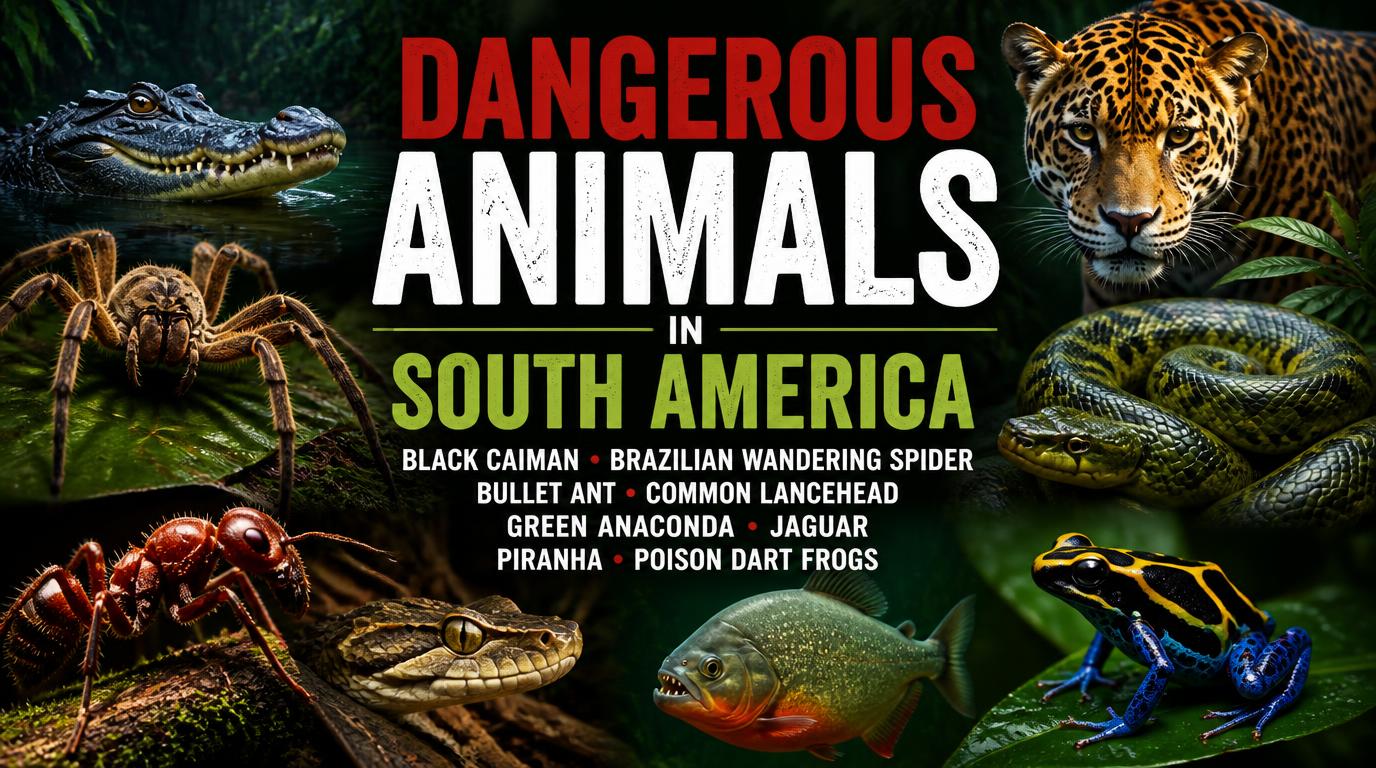
From enormous reptiles and stealthy predators to highly venomous insects and amphibians, here are eight dangerous animals found in South America.

1. Black Caiman
The black caiman is the largest member of the caiman family and one of the largest predators in the Amazon Basin. It spends much of its time in rivers, lakes, and flooded forests, where it hunts a wide variety of prey.
Black caimans are opportunistic predators and can take fish, birds, reptiles, and mammals. They generally avoid people, but their size and strength make them potentially dangerous when humans enter their territory.
Encounters can become particularly risky around nests or during periods of heightened territorial behavior. People swimming, fishing, crossing rivers, or traveling by canoe may be exposed to an unexpected encounter.
Although black caimans are not predators that routinely hunt humans, their powerful jaws mean that a close encounter should always be taken seriously.
2. Brazilian Wandering Spider
The Brazilian wandering spider is a group of large venomous spiders found in parts of South and Central America. They are sometimes called banana spiders because members of the group have occasionally been transported with shipments of bananas.
Unlike web-building spiders that wait for prey, wandering spiders actively move through the forest floor and vegetation while hunting. They are primarily nocturnal and can use both ambush tactics and direct pursuit to capture prey.
Their venom contains a complex mixture of biologically active compounds. A bite can cause intense pain and other systemic symptoms.
These spiders generally bite as a defensive response rather than deliberately attacking people. Nevertheless, their medical importance makes them one of the South American spiders that deserves particular caution.
You may also like: Dangerous Animals in Antarctica
3. Bullet Ant
The bullet ant is famous for producing one of the most painful insect stings known.
These large ants live in tropical forests of Central and South America. Their sting can cause intense, burning pain that may persist for many hours. The sensation has been compared to being shot, which explains the origin of the common name “bullet ant.”
Bullet ants are not normally interested in attacking humans. However, they can become highly defensive when their nest or colony is disturbed.
Their sting also releases chemical signals that can trigger defensive behavior in nearby ants, potentially causing multiple ants to sting the same intruder.
4. Common Lancehead
The common lancehead is a highly venomous pit viper found in parts of Central and South America. Its broad, triangular head and robust body are characteristic of lancehead snakes.
These snakes are primarily terrestrial and often become active at night. They can occur in forests as well as areas affected by human activity, which increases the possibility of encounters.
Their venom can cause severe tissue damage and other serious medical complications. Bites may occur when a snake is accidentally stepped on or disturbed.
Young lanceheads are venomous from birth, so their smaller size should never be mistaken for a lack of danger.
5. Green Anaconda
The green anaconda is one of the heaviest snakes in the world and one of the most powerful constrictors.
These enormous snakes spend much of their lives in or around water, where their muscular bodies are surprisingly agile. Their diet can include fish, birds, reptiles, and various mammals.
Rather than relying on venom, green anacondas use their powerful bodies to restrain prey. Once an animal is caught, the snake coils around it and applies immense pressure.
Despite their impressive size and strength, green anacondas generally avoid humans. Confirmed attacks are uncommon, and they are not animals that routinely hunt people.
6. Jaguar
The jaguar is the largest cat in the Americas and one of the most powerful predators in South America.
It inhabits a variety of environments, including tropical forests, wetlands, grasslands, and other wooded habitats. Jaguars are solitary hunters and usually rely on stealth rather than prolonged pursuit.
They are particularly effective ambush predators. A jaguar may approach prey quietly through dense vegetation, from the ground, or even from near water.
One of the species’ most remarkable features is its exceptionally powerful bite. Jaguars are capable of taking prey that is difficult for many other big cats to handle, including caimans and large mammals.
Encounters with people are uncommon, but a wild jaguar should always be treated as a potentially dangerous predator.
7. Piranha
Piranhas are freshwater fish native to South America and are famous for their sharp teeth and powerful bites.
Despite their frightening reputation, piranhas do not normally attack healthy humans in the dramatic manner often portrayed in movies. Many species feed on fish, insects, fruits, seeds, carrion, and other available food.
Risk can increase when fish are stressed, food is scarce, or large numbers gather around a food source. Bites can cause serious injuries, particularly to fingers and toes.
Their reputation as relentless human predators is exaggerated, but their teeth are certainly capable of inflicting painful wounds.
8. Poison Dart Frogs
Poison dart frogs are among the most colorful amphibians in the world. Their vivid yellow, blue, orange, and red patterns can serve as warning signals to potential predators.
Several species produce powerful alkaloid toxins. In nature, these chemicals are associated with the frogs’ diet, particularly certain small arthropods. The exact toxicity varies considerably between species and populations.
One of the best-known toxins associated with poison dart frogs is batrachotoxin, an extremely potent neurotoxin that interferes with normal nerve and muscle function.
However, the danger presented by these frogs should not be overstated. Not every poison dart frog is equally toxic, and captive individuals may lose much or all of their toxicity when their natural diet is changed.
The safest rule is simple: never handle wild poison dart frogs.