Mad Hatterpillar: The Unique Caterpillar with a Stack of Hats
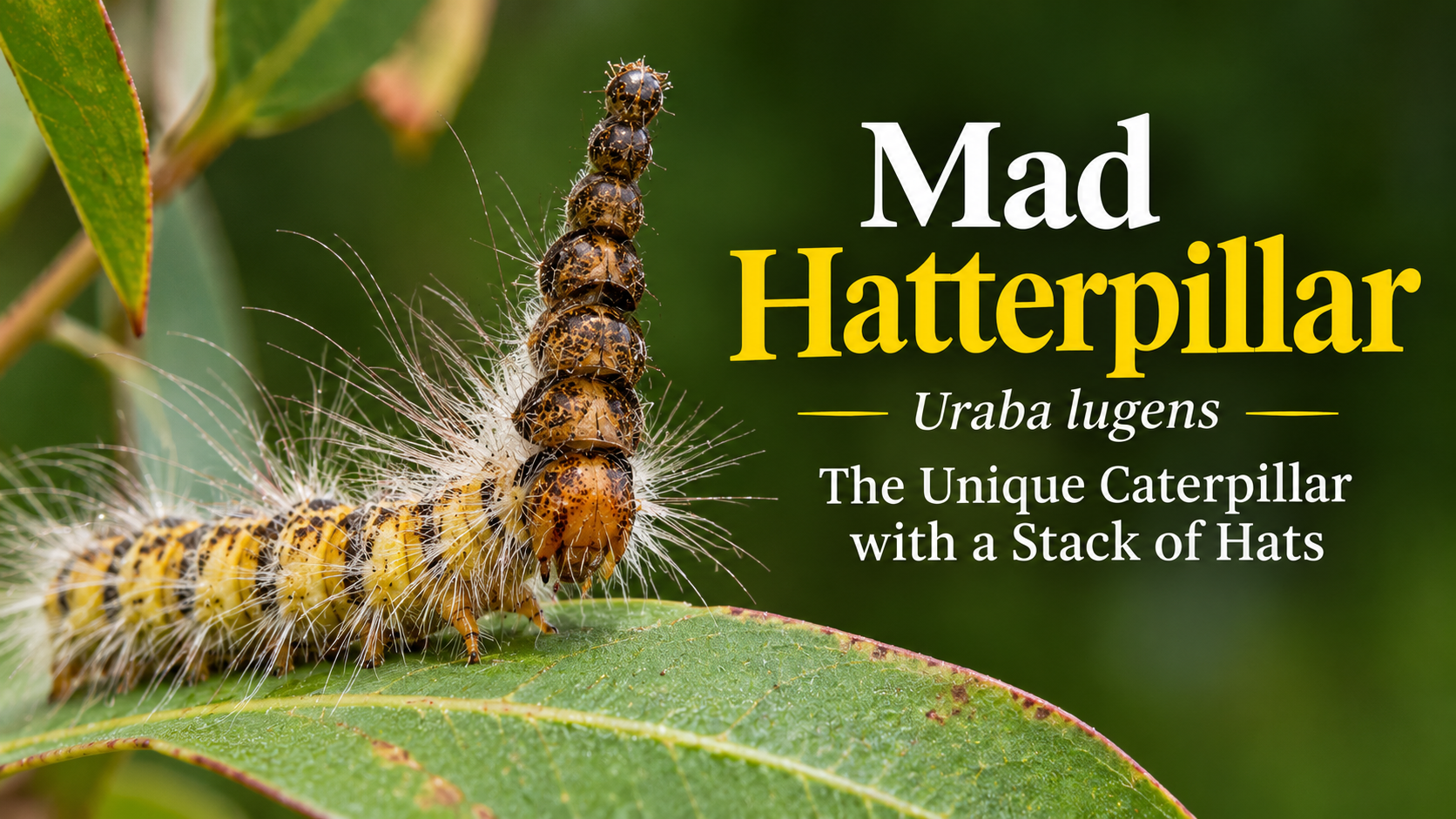
The Mad Hatterpillar (Uraba lugens) is a fascinating insect with an unusual structure on its head that looks remarkably like a stack of tiny hats. This peculiar feature is not just for decoration. The caterpillar uses it as part of its defense against predators.
Its name comes from the Mad Hatter, the eccentric character in Lewis Carroll’s Alice’s Adventures in Wonderland. With its unusual appearance and remarkable survival strategies, this caterpillar is certainly one of nature’s most distinctive insects.
Here are some interesting facts about the Mad Hatterpillar, Uraba lugens.
Appearance
The Mad Hatterpillar has a body that ranges from brown to yellow, with small black markings that help it blend in with the trunks of eucalyptus trees.
Like other caterpillars, it must periodically shed its exoskeleton as it grows. However, this species has an unusual habit: instead of discarding its old head capsules, it keeps them.
After its fourth molt, the caterpillar begins stacking these empty head capsules on top of its head. The species can molt as many as 13 times, and its head capsule becomes larger with each successive molt. Over time, the discarded capsules form a distinctive tower that resembles a tiny hat.
This unusual headgear serves a practical purpose. When threatened, the caterpillar vigorously moves its head, using the stack to make it more difficult for predators to grab and eat it.
The structure may also make the caterpillar appear larger and more intimidating. When birds, lizards, or other predators attack, they may end up biting or grabbing the stack of old head capsules instead of the caterpillar itself.
Its natural enemies include birds, jumping spiders, lacewings, parasitic flies, parasitic wasps, reptiles, and stink bugs.
The Mad Hatterpillar has another important defensive feature: its body is covered with irritating, bristle-like hairs. These can cause unpleasant reactions in animals and humans, so touching or handling the caterpillar is not recommended.
You may also like: Nature’s Creepiest Insects: A Look at the World Weirdest and Wildest Bugs
Behavior
Mad Hatterpillars are relatively social when they first hatch. Young caterpillars often gather in dense groups to feed, which may help reduce the risk of being eaten by predators.
As they grow older, they leave these groups and live more independently on eucalyptus trees.
Their tower of old head capsules and irritating body hairs are not their only defenses. When seized by a predator, a Mad Hatterpillar may regurgitate the contents of its digestive system.
It releases a green liquid that is likely unpleasant in taste and smell. The caterpillar may then twist and move its body, spreading the unpleasant substance toward the attacker while attempting to escape.
These unusual defensive behaviors make the Mad Hatterpillar a difficult target for potential predators.
Diet and Habitat
Mad Hatterpillars are also known as gum-leaf skeletonisers because they feed on eucalyptus leaves, commonly called gum leaves.
Their feeding habits explain this name. Rather than consuming an entire leaf, the caterpillars can eat away the softer tissue while leaving much of the vein structure behind. The result looks like a leaf skeleton.
Their appetite for eucalyptus foliage can be considerable. During population outbreaks, large numbers of caterpillars may defoliate trees and cause substantial damage to vegetation.
As they grow larger, their feeding activity can become particularly destructive. In severe outbreaks, they may strip entire trees of their leaves.
The Mad Hatterpillar is native to Australia but is also found in New Zealand, where it is considered a significant pest of eucalyptus plantations.
The species was first recorded in New Zealand in 1992, after eucalyptus plantations had become established there. The source article attributes its population growth partly to the lack of natural predators in its introduced range.
These caterpillars can cause considerable economic damage to eucalyptus plantations. The original article estimates annual crop losses in New Zealand at approximately $30 million.