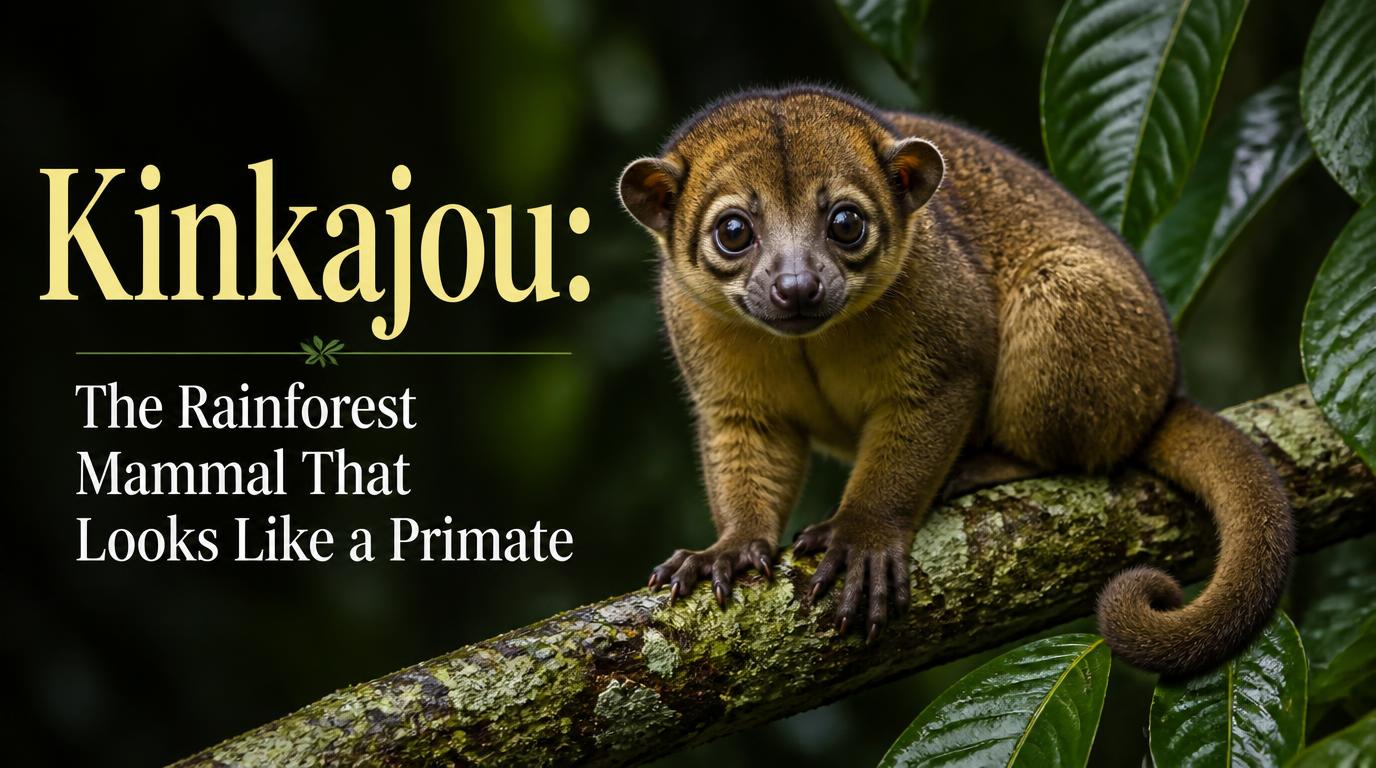
Kinkajou: The Rainforest Mammal That Looks Like a Primate
The kinkajou is sometimes called a “honey bear,” although it is not related to bears. Its unusual name has roots in Indigenous languages, and its appearance often reminds people of a small monkey. However, this fascinating mammal is actually a close relative of raccoons.
With enormous eyes, soft golden-brown fur, and a prehensile tail, the kinkajou is perfectly adapted to life high in the rainforest canopy. It spends most of its time in trees, searching for food and moving through the forest after dark.
Appearance
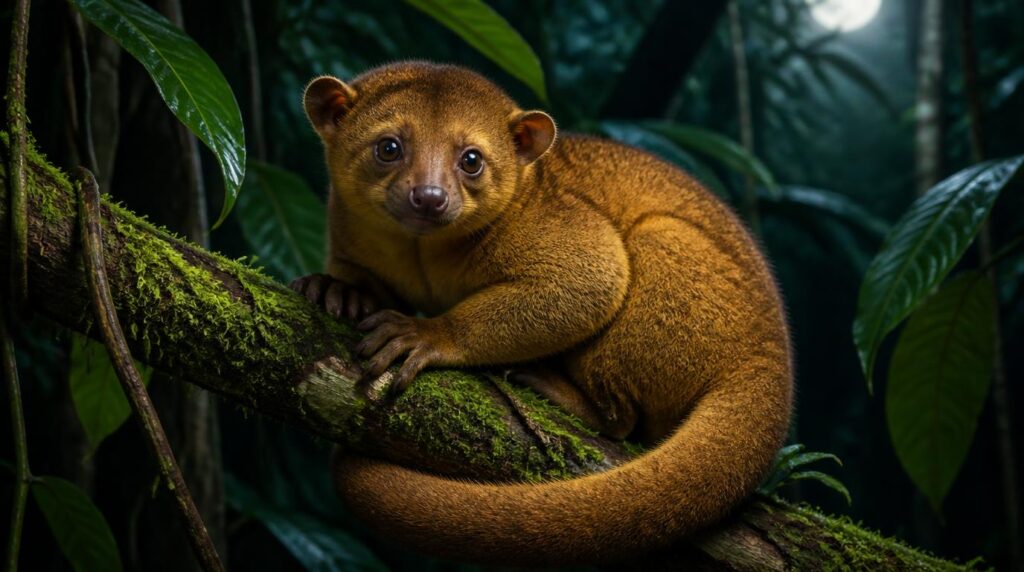
At first glance, kinkajous can easily be mistaken for primates. They have large, light-reflecting eyes, a small rounded face, and short, rounded ears. Their thick fur usually has a golden-brown outer coat and a darker brown or grayish undercoat.
Their hearing is highly developed, helping them detect sounds in the dense forest. Kinkajous also have sharp teeth suited to their varied diet.
One of their most remarkable features is their ability to rotate their hind feet considerably, allowing them to move headfirst down tree trunks and navigate branches in different directions. They can even move backward along branches with impressive agility.
Their long, prehensile tail is another important adaptation. It acts like an extra limb, helping them grip branches and maintain balance while climbing. Kinkajous may hang from branches using their tails, and they can curl their tails around their bodies while resting.
These physical adaptations make them exceptionally well suited to an arboreal lifestyle.
You may also like: Hyrax: 18 Fascinating Facts About This Remarkable Animal
Behavior
Kinkajous are primarily nocturnal, becoming active after sunset and spending much of the daytime sleeping in tree hollows or sheltered branches. In Belize, they have been called “nightwalkers” because of their activity after dark.
Although they often forage alone, kinkajous also engage in social interactions. They may gather in small groups to groom one another, play, or rest together. Such groups can include males, females, and their offspring.
These animals communicate through a range of sounds, including barking calls, high-pitched squeals, and hissing. They also use scent glands located around the abdomen, mouth, and throat to mark their territories.
Kinkajous tend to follow familiar routes through the forest, often using overlapping branches to travel from one tree to another. They rarely need to descend to the forest floor, which can make them difficult for researchers to observe.
During hot weather, they may expose less-furred areas of their bodies, such as the belly and palms, to help release heat. Although kinkajous are often described as gentle, they can bite or scratch if frightened, stressed, or handled improperly.
Diet and Habitat
Kinkajous are sometimes called honey bears because they use their long, slender tongues to reach nectar and honey inside flowers or beehives. Their tongues can also help them extract insects from narrow spaces.
However, fruit is a major part of their diet, especially figs. They also consume nectar, insects, eggs, and occasionally small vertebrates. By visiting flowers while feeding on nectar, kinkajous may contribute to pollination.
They obtain much of their moisture from food and from water collected on leaves, reducing the need to descend to the ground in search of drinking water.
Kinkajous inhabit tropical forests across Central and South America. They can also occur in other forest types, including evergreen, dry, and coastal forests, provided there is sufficient vegetation and tree cover.
Their strong climbing abilities allow them to move between trees along connected branches. Remaining high in the canopy helps them find food and avoid some ground-dwelling threats.
Because they spend so much time above the forest floor, studying kinkajous in their natural habitat can be challenging.
Predators and Threats
Kinkajous face threats from several predators, including jaguars, ocelots, margays, tayras, and large birds of prey such as harpy eagles.
Their agility, climbing skills, and nocturnal habits help them avoid danger. However, they are not immune to predation, particularly when resting or moving through exposed areas.
Human activity poses additional risks. Kinkajous are sometimes hunted for their fur or meat and captured for the exotic pet trade. Their appealing appearance can make them attractive to people seeking unusual pets, but they are wild animals with specialized needs.
A kinkajou can deliver a painful bite when frightened or restrained. Its nocturnal activity can also make it difficult to keep in a typical household, where its natural schedule may conflict with human routines.
Deforestation is another significant concern. As forests are cleared or fragmented, kinkajous lose feeding areas, shelter, and the connected tree canopy they rely on for movement.
Although the species is not currently classified as globally threatened, habitat destruction, hunting, and capture for the pet trade remain important conservation concerns. Protecting tropical forests is essential to preserving the ecosystems on which these unusual mammals depend.