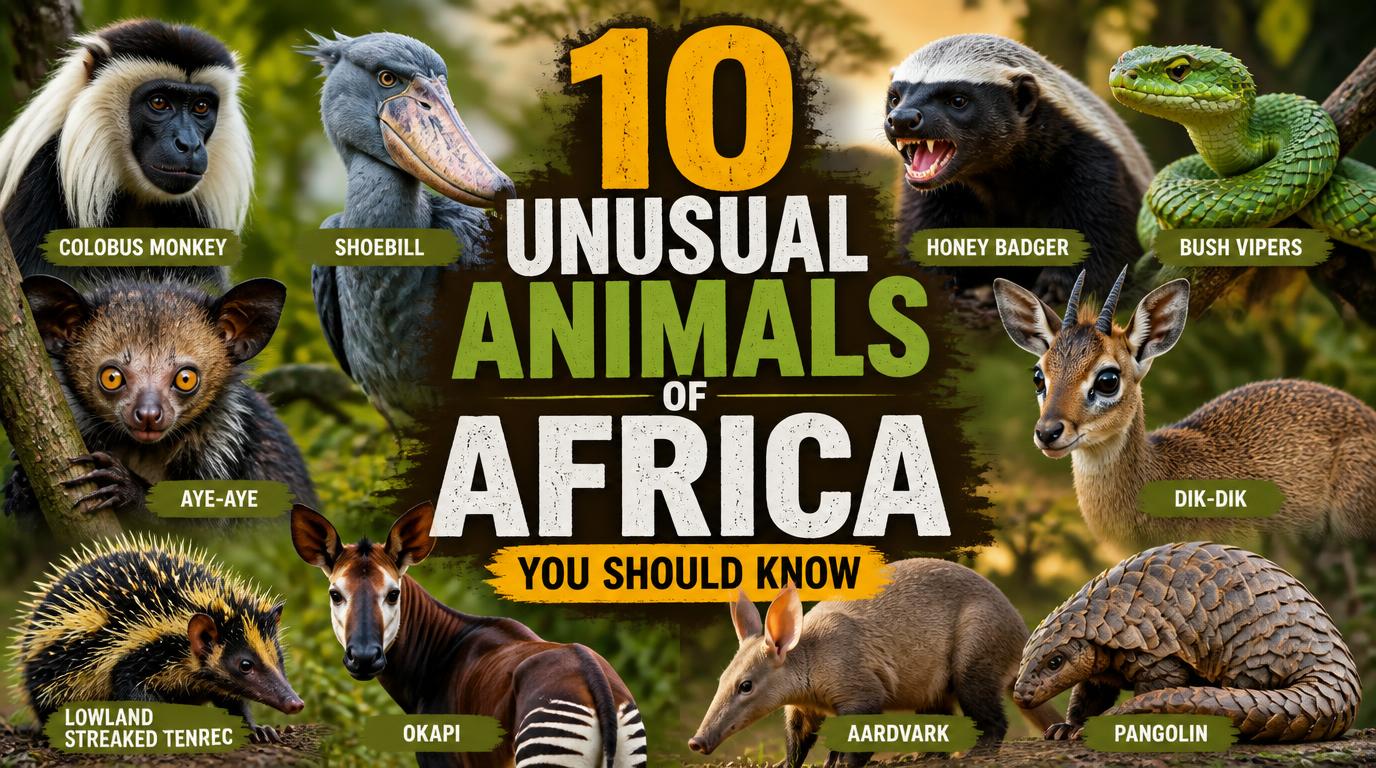
10 Unusual Animals of Africa
Africa is home to an extraordinary variety of wildlife. Some species are famous around the world, such as the members of the Big Five, while others are much less familiar and tend to stay away from people. Finding one of these unusual animals in the wild can be a memorable experience—although encountering a venomous bush viper is certainly not something you should seek out.
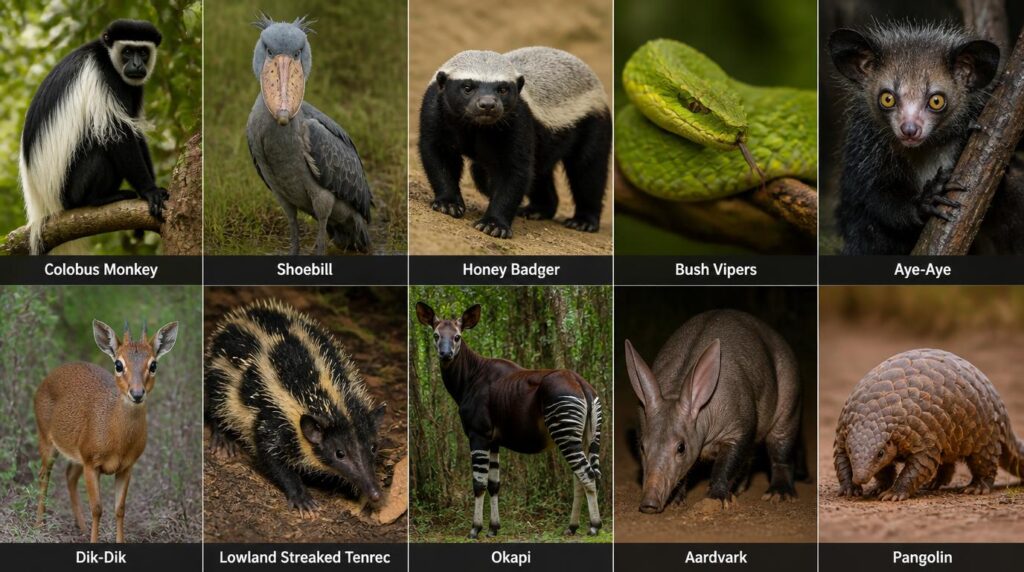
From strange-looking primates and armored mammals to elusive forest species, here are 10 unusual animals found in Africa.
1. Colobus Monkey
Black-and-white colobus monkeys spend much of their lives high in the trees of African forests. They usually live in groups, and their striking appearance makes them easy to distinguish from many other primates.
One of their most unusual features is their long white hair, which forms a beard-like fringe around the body and extends along the back. Colobus monkeys also lack thumbs, an unusual adaptation among primates.
Their diet consists mainly of leaves. They have a specialized digestive system that allows them to process large quantities of foliage, including some leaves that would be difficult for other animals to digest. Colobus monkeys communicate with a variety of vocalizations, including loud calls that carry through the forest.
2. Shoebill
The shoebill is one of Africa’s most distinctive birds. Its enormous bill, long legs, gray plumage, and imposing posture give it an almost prehistoric appearance.
Shoebills inhabit wetlands and swamps in parts of eastern and central Africa. Their huge bills are particularly well suited to catching prey, including fish and other aquatic animals. They can also produce remarkably loud bill-clattering sounds, especially during interactions with other birds.
Despite their intimidating appearance, shoebills are patient hunters. They can remain almost motionless for long periods before suddenly striking at prey.
You may also like: The Most Dangerous Animals in Africa
3. Honey Badger
The honey badger is a small but remarkably robust mammal found across parts of Africa, as well as southwestern Asia and the Indian subcontinent. Its contrasting coloration makes it instantly recognizable, with a lighter back and darker lower body.
Honey badgers have powerful claws, strong jaws, and exceptionally thick, loose skin. Their skin can move somewhat independently of the body, making it difficult for predators or attackers to get a secure grip.
They are opportunistic feeders and eat a wide range of food, including insects, reptiles, amphibians, small animals, fruit, and honey. Despite their name, honey is only one part of their varied diet.
4. Bush Vipers
Bush vipers, belonging to the genus Atheris, are venomous snakes found in tropical regions of sub-Saharan Africa. They are particularly striking because of their vivid colors and strongly keeled scales.
Most species are relatively small, generally measuring around 40–80 centimeters long. Many spend much of their lives in trees and shrubs, where their coloration can provide effective camouflage.
Their diet includes lizards, rodents, birds, amphibians, and other small animals. Despite their beautiful appearance, bush vipers are venomous and should never be approached or handled in the wild.
5. Aye-Aye
The aye-aye is a highly unusual primate found only on Madagascar. Its enormous eyes, large ears, dark fur, and elongated middle finger give it an appearance unlike that of most other primates.
Aye-ayes are nocturnal and spend much of their time in trees. They use a remarkable feeding technique known as percussive foraging: an aye-aye taps on a branch or tree trunk with its long middle finger and listens for signs of insects hidden beneath the bark.
Once it detects prey, it uses its specialized teeth and elongated finger to extract the larvae. Aye-ayes also feed on fruit and other plant material.
The species has been surrounded by negative traditional beliefs in parts of Madagascar. Hunting and habitat loss have contributed to its conservation concerns, and the aye-aye is legally protected in Madagascar.
6. Dik-Dik
Is it a tiny deer or a miniature antelope? Neither. Dik-diks are small antelopes that live in the savannas and scrublands of eastern and southern Africa.
Their compact bodies and dusty-colored coats help them blend into dry vegetation. One of their most distinctive features is their elongated snout, which helps them regulate body temperature in hot conditions.
Dik-diks feed on leaves, shoots, fruits, and other vegetation. Their small size also makes them vulnerable to predators such as lions, leopards, hyenas, and birds of prey.
Despite their size, these little antelopes are fast and alert, with excellent eyesight that helps them detect danger quickly.
7. Lowland Streaked Tenrec
The lowland streaked tenrec is a small mammal found in the lowland rainforests of Madagascar. It has a long snout, relatively long limbs, and a body covered with black fur and contrasting yellow stripes.
Sharp spines cover parts of its body and can help protect it from predators. When threatened, the animal can use these specialized spines defensively.
The lowland streaked tenrec feeds mainly on earthworms and other invertebrates. It is also notable for its ability to produce sounds through stridulation—a method of communication more commonly associated with insects. These faint, clicking or rasping sounds can help individuals communicate with one another.
8. Okapi
At first glance, the okapi may look like an unusual combination of a giraffe and a zebra. In reality, it is the closest living relative of the giraffe.
Okapis have dark brown coats and distinctive horizontal stripes on their legs and hindquarters. Their appearance provides effective camouflage in the dense forests where they live.
The species is found in the Democratic Republic of the Congo, particularly in the country’s forested regions. Okapis feed on leaves, buds, grasses, fruits, and other vegetation.
They are generally quiet animals and are difficult to observe in their natural habitat. Their main natural predator is the leopard, while human activities also pose a significant threat to their survival.
9. Aardvark
The aardvark looks somewhat like a pig with an unusually long snout, but it is not closely related to pigs. Its name comes from Afrikaans and can be translated as “earth pig.”
Aardvarks spend the daytime in underground burrows that they excavate with their powerful claws. They become active at night and travel across grasslands and woodland in search of food.
Their diet consists primarily of ants and termites. When an aardvark finds an insect colony, it uses its strong front claws to break into the mound and then captures insects with its long, sticky tongue.
Its unusual appearance is matched by several specialized adaptations that make it particularly well suited to a diet based on social insects.
10. Pangolin
Pangolins are among the most distinctive mammals in Africa. Their bodies are covered with overlapping scales made of keratin, the same structural protein found in human hair and nails.
Several pangolin species occur in central, eastern, and southern Africa, inhabiting habitats ranging from forests to savannas. They are primarily nocturnal and use their highly developed sense of smell to locate ants and termites.
Like aardvarks, pangolins have long, sticky tongues designed for extracting insects from nests. When threatened, they curl into a tight ball, using their hard scales as armor.
Unfortunately, pangolins have been heavily targeted by illegal wildlife trafficking. Their meat and scales have made them a major target for poaching, and conservation efforts are important for protecting the remaining populations.