
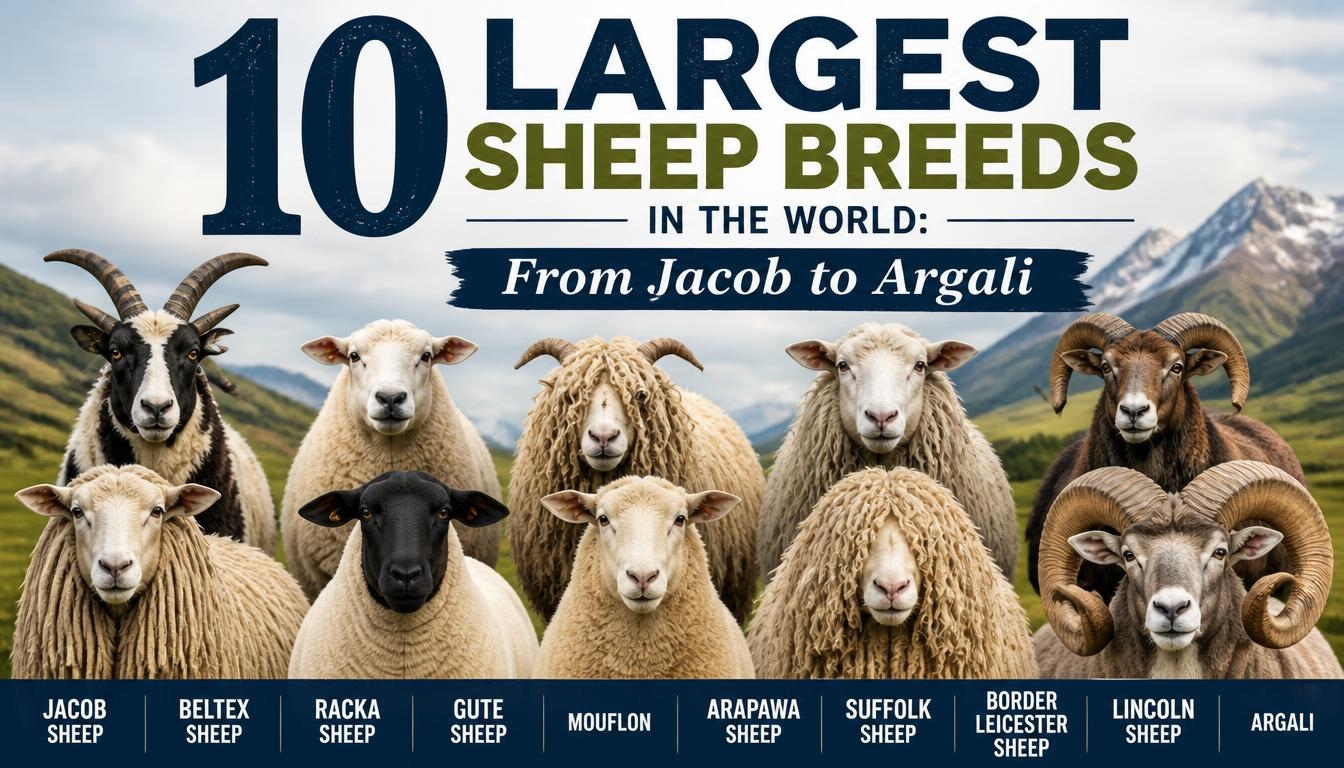
10 Largest Sheep Breeds in the World
Sheep are valuable farm animals, providing people with wool, meat, milk, and other useful products. In many cases, larger sheep are especially prized for their size, strong build, or wool production. However, not all large sheep are raised for the same purpose. Some are traditional domestic breeds, while others are wild sheep known for their impressive horns and ability to survive in challenging environments.
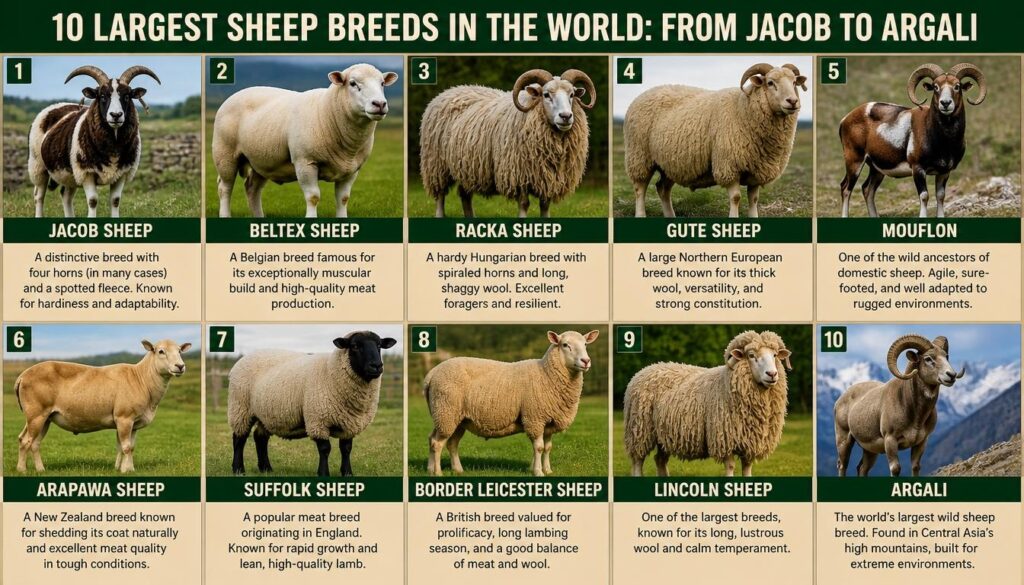
Let’s take a closer look at 10 of the largest sheep breeds and wild sheep found around the world.
1. Jacob Sheep
Average height: 45–60 cm
Jacob sheep, also known as Jacob’s sheep, are a British domestic breed with two unusual characteristics. First, they have a distinctive piebald appearance, with dark coats marked by patches of white wool. Second, both males and females usually have four horns, although rams generally have larger and more impressive ones.
The number of horns can vary between individuals. Some Jacob sheep have only two, while others may have as many as six. Their horns are typically black, smooth, and well-balanced, although some have black-and-white stripes. They grow firmly attached to the skull and are positioned so that they do not interfere with the animals’ vision or ability to graze.
Jacob sheep have narrow, triangular heads with little or no wool on the forehead and cheeks. Both ewes and rams have long bodies, straight backs, and rumps that slope toward the base of the tail. Their long, woolly tails can reach almost to the hocks, while their legs are relatively slender and free of wool below the knees.
For centuries, Jacob sheep were kept as ornamental animals on large estates, where their unusual appearance made them popular additions to parkland. Today, they serve several purposes, including meat, wool, and skin production. Like many traditional sheep breeds, they are generally known for their calm and docile temperament.
2. Beltex Sheep
Average height: 50–60 cm
Originally developed in Belgium, the Beltex is a domestic sheep breed known for its strength, hardiness, and ability to adapt to local climates. In Europe, Beltex sheep have traditionally been used as terminal sires in breeding programs designed to produce high-quality meat lambs.
The breed has a compact, muscular appearance. At first glance, Beltex sheep may look short and stocky, but their most distinctive feature is their heavily muscled hindquarters. They also have relatively fine bones and small skeletal frames compared with their muscular bodies.
These characteristics make Beltex sheep particularly valuable for meat production. Their body structure helps produce a high proportion of lean meat, which is why the breed has become popular in specialized sheep-breeding programs.
Although Beltex sheep are also associated with wool production, their primary purpose is meat production.
3. Racka Sheep
Average height: 72 cm
Originating in Hungary, the Racka sheep is famous for its unusual spiral-shaped horns. Both ewes and rams have long, corkscrew-like horns that can grow up to 60 centimeters in length, giving the breed one of the most distinctive appearances among domestic sheep.
Racka sheep are medium-sized animals that commonly occur in two main color varieties, although brown is the most widespread. Their wool covers the head and legs and can range from dark brown to light brown and white. Some individuals are completely black.
Their double-coated fleece is long, coarse, and curly. The breed typically sheds its wool once a year.
Beyond their unusual appearance, Racka sheep are versatile farm animals raised for meat, milk, and wool. Their average milk production is approximately 60 liters, making them useful for both commercial and small-scale farming.
4. Gute Sheep
Average height: 64–84 cm
Sometimes described as a true Viking sheep, the Gute is a domestic breed from the Swedish island of Gotland. It is considered one of the most primitive sheep breeds.
Both rams and ewes have horns, and their wool comes in a variety of colors and patterns. Gray is the most common color, while the head and legs may have brown or white markings. Their coarse fleece contains a mixture of fine wool and kemp fibers, which can be either straight or wavy.
Male Gute sheep develop a long, thick mane around the neck and throat. Females also have this feature, although it is usually less pronounced. The breed sheds its fleece once a year, generally during the summer months.
Size is not the only notable characteristic of Gute sheep. They are seasonal breeders, with their breeding season usually beginning in late October or early November. The breed is primarily raised to preserve its genetic characteristics, but it is also valued for its hardiness and active nature.
Gute sheep are relatively easy to raise and can live for up to 12 years. Their attractive fibers and high-quality wool make them popular among people who practice felting. They also grow quickly, with lambs reaching a suitable slaughter size at around five to seven months of age. Their meat is described as tender and flavorful.
Read also: The World’s Largest Goat Breeds
Average height: 65–90 cm
The mouflon is a wild sheep native to the Caspian region and is often considered an ancestor of modern domestic sheep breeds. It has a short coat that is usually dark brown or reddish-brown, with darker markings along the back and lighter patches around the saddle.
Male mouflons have large, curved spiral horns, while females usually have no horns or only very small ones. The rams’ horns grow backward over the head and can form almost a complete spiral. Males are also generally larger and more powerfully built than females.
Mouflons are social animals with excellent walking and running abilities. They can move across steep, rocky terrain with ease. In the wild, they prefer dry, open mountain habitats near woodland areas, where they can find enough food.
As herbivores, mouflons eat a varied diet that includes leaves, grass, young shoots, acorns, bark, fruits, lichens, moss, and fungi.
One of the most interesting aspects of mouflon behavior is the dominance hierarchy among males. Before the breeding season, known as the rut, rams compete with one another for access to females. They may fight to establish dominance, and the strongest males gain better mating opportunities.
Female mouflons have a gestation period of approximately five months and usually give birth to one or two lambs. In the wild, wolves are among their natural predators, while eagles and lynxes may prey on young lambs.
6. Arapawa Sheep
Average height: 70–78 cm
Despite being considered one of the larger sheep breeds, Arapawa sheep have a relatively light build and long legs, which make them agile and active. They have narrow faces, fine heads, and slender ears. Their fleece is often completely black, although black sheep with white markings are also common. Completely white individuals exist but are rare.
Both males and females have horns, but rams develop much longer spiral horns that can reach approximately one meter in length.
The breed is primarily found on Arapawa Island in the Marlborough Sounds region of New Zealand. In their natural environment, these sheep prefer rugged, steep terrain. They are well adapted to these conditions and are known for their strength and hardiness.
Arapawa sheep are a feral breed valued for their high-quality wool.
They have also attracted attention from trophy hunters, who pursue the animals for their impressive horns. During trophy hunts, guides may assess the horns according to their mass and the number of curls.
Because Arapawa sheep are intelligent and move quickly, hunting them can be challenging. The breed has become a sought-after trophy in some hunting circles. However, excessive hunting has contributed to population declines in various regions. New Zealand remains one of the few places where these sheep can still be found and hunted.
7. Suffolk Sheep
Average height: 74–80 cm
The Suffolk is one of the largest sheep breeds and has a distinctive appearance that makes it easy to recognize. This British domestic breed has a white body, black face, and black legs. Both males and females share this characteristic coloring.
Suffolk sheep are primarily raised for meat, which is exported to many countries. The breed itself has also been introduced to numerous parts of the world, including Australia, Brazil, New Zealand, South Africa, and the United States. As a result, Suffolk has become one of the most widespread sheep breeds.
These animals have large frames and muscular bodies, making them particularly suitable for meat production. They also produce a thick fleece, although wool is not their primary commercial purpose.
Suffolk rams are commonly used as sires in crossbreeding programs. Their carcasses are valued for producing lean lamb, which is popular among consumers who prefer meat with less fat.
Ewes have strong maternal instincts and produce plenty of milk to feed their lambs. The breed is also adaptable to a wide range of climatic conditions, which has helped make Suffolk sheep popular among farmers around the world.
8. Border Leicester Sheep
Average height: 81 cm
The Border Leicester is described as the largest native sheep breed in the British Isles and is among the largest domestic sheep in the world.
This breed has an elegant appearance, with long, upright ears and a distinctive Roman nose. Its body is covered in white wool, while the head and legs remain free of fleece. These features make Border Leicester sheep popular at agricultural shows as well as useful animals on farms.
The breed is also valued for crossbreeding programs designed to improve productivity. Border Leicester ewes are known for their fertility and maternal abilities. They can produce strong lambs and provide plenty of milk to support their growth.
Border Leicester sheep are particularly appreciated for their hardiness and rapid development. Their characteristics make them suitable for a wide range of farming systems.
Although they are large animals, they are generally docile and manageable. Ewes are regarded as good mothers, producing healthy lambs and sufficient milk.
The breed also provides high-quality meat and wool. Its long, white fleece is especially attractive to spinners because of its natural crimp and luster. Border Leicester sheep are therefore suitable for commercial farming, meat production, and specialized wool markets.
Compared with other sheep of similar size, they have a longer loin and leaner meat.
9. Lincoln Sheep
Average height: 80–81 cm
No list of large sheep breeds would be complete without the Lincoln sheep from England. It is one of the largest British breeds and was developed specifically to produce exceptionally heavy, long, and lustrous wool.
Its fleece is one of its most recognizable features. The wool grows in heavy curls that often form spiral-shaped locks toward the ends. It is valued both for its quality and for the large quantities the animals can produce.
Lincoln sheep have been exported to many countries, including Australia, various European nations, and parts of South America.
Their coats are usually white, but black, charcoal, gray, and silver-colored individuals can also occur.
In addition to wool production, Lincoln sheep are raised for meat because of their large size and the quality of their carcasses. Their meat is often described as lean and juicy.
Despite their substantial build, Lincoln sheep are generally hardy and docile, making them relatively easy to manage. They can adapt to both cold and dry environments.
Their lambs also grow comparatively quickly, allowing farmers to raise them efficiently for meat production.
10. Argali
Average height: 85–135 cm
The argali is the largest living wild sheep and can reach an impressive height of 135 centimeters. It is native to the mountainous regions of Central Asia. Its name comes from the Mongolian word for wild sheep.
There are nine recognized argali subspecies, which inhabit a range of environments, from harsh Arctic and alpine tundra to grassy mountain landscapes.
Their coat color varies from dark grayish-brown and reddish-brown to pale yellow. Both rams and ewes have horns, although those of males are considerably longer and more impressive.
The Pamir argali, also known as Marco Polo sheep, is the best-known subspecies. It is particularly famous for its enormous horns, which can exceed 190 centimeters in length.
Male argali use their massive horns to compete with one another, while females have much smaller horns. Adult males and females generally live in separate groups, coming together for the relatively short breeding season.
Argali have long legs and are capable runners, but their size and speed do not protect them from every threat. For many years, trophy hunters have targeted these animals because of their impressive horns.
The argali is threatened by several factors, including competition with domestic livestock, habitat loss, and hunting for its horns and meat. The use of its horns in traditional Chinese medicine has also been identified as a threat to the species.
Protecting the argali requires addressing these pressures and conserving the mountain habitats on which these remarkable wild sheep depend.