Jumping Giants: 9 of the Largest Frogs in the World
Have you ever wondered just how big a frog can grow? While many people find amphibians unusual or even a little intimidating, some species are truly fascinating because of their extraordinary size, strength, and hunting abilities.
The world’s largest frogs are found in different parts of the globe, from tropical rainforests in South America to mountain streams in Asia and Africa. Some are powerful ambush predators, while others spend almost their entire lives underwater.
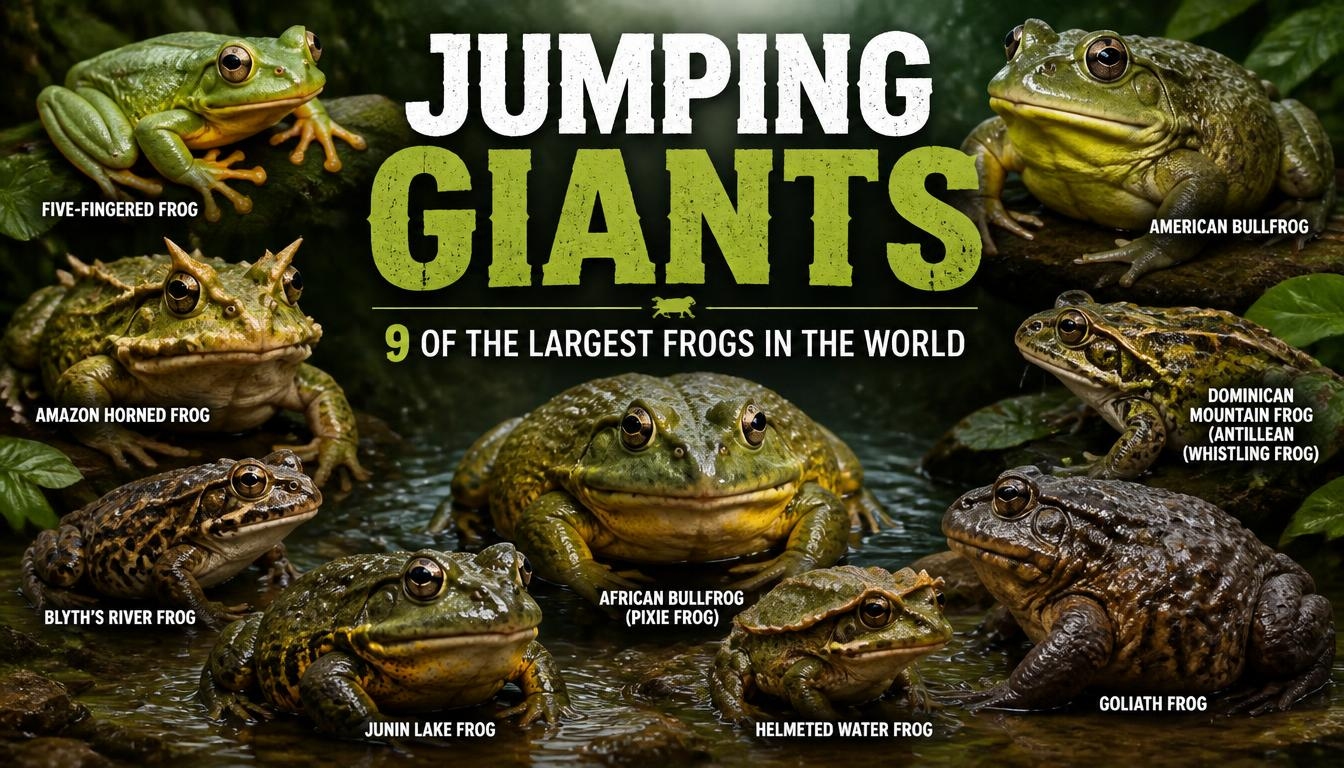
Here are nine of the largest frog species in the world.
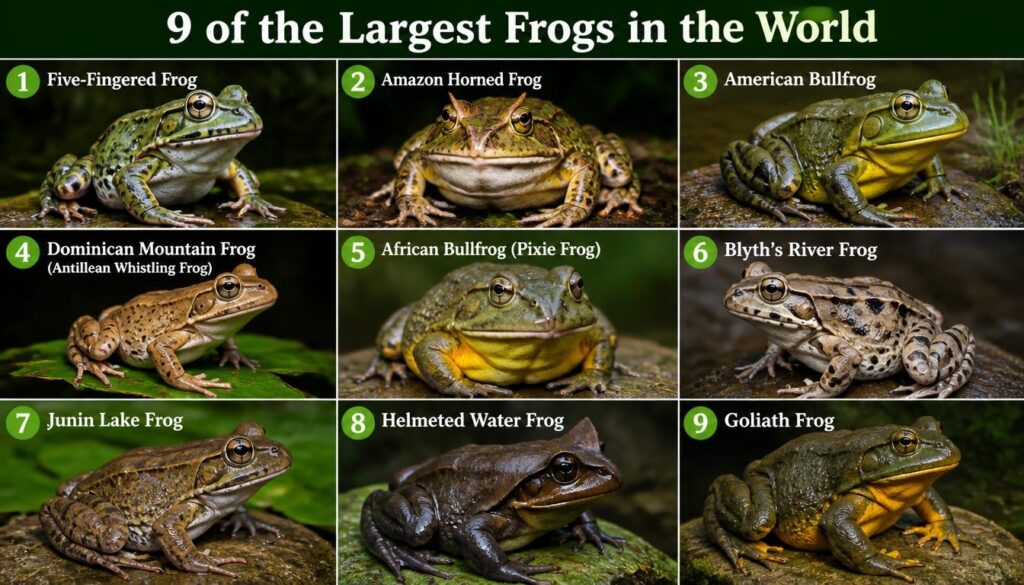
1. Five-Fingered Frog
Length: Up to 18 cm (7 inches)
The five-fingered frog has a brownish back marked with dark patches and a pale underside. Males can be distinguished by the dark spines on their chests and thumbs. These structures help them maintain their grip on females during mating.
During the day, these frogs usually remain hidden in burrows, beneath fallen logs, or among leaf litter. They become active at night, when they search for food. Their diet includes a variety of invertebrates and even small vertebrates, such as birds and chicks.
One particularly unusual feature is their ability to eat scorpions. Their tadpoles are also remarkably predatory, feeding on eggs and sometimes other tadpoles. When food is scarce, however, they can switch to a more plant-based diet.
Five-fingered frogs are native to Central America, with a range extending from Honduras through Panama and into areas near the Colombian border. They inhabit tropical forests, freshwater wetlands, marshes, and areas near rivers.
When threatened, they may inflate their bodies to appear larger and raise themselves on all four legs. They can also release a slippery skin secretion that discourages potential predators. If the threat continues, they may produce a loud, piercing call.
You may also like: 10 of the Most Dangerous Animals in Asia
2. Amazon Horned Frog
Length: Up to 20 cm (8 inches)
The Amazon horned frog is a large, round-bodied amphibian native to the Amazon Basin. It occurs in parts of northern South America, including Colombia and Brazil, where it inhabits freshwater wetlands, marshes, and pools.
This frog is an ambush predator. Rather than chasing its prey, it often hides beneath leaves or in the forest substrate, waiting for an unsuspecting animal to come close. When an opportunity appears, it strikes quickly and swallows its prey whole.
Its broad mouth, powerful jaws, and sharp tooth-like structures make it an effective hunter. Because of its enormous mouth and appetite, horned frogs are sometimes nicknamed Pacman frogs, after the famous video game character.
The species has a stout, rounded body, short limbs, and bumpy skin. The horn-like projections above its eyes resemble the stems of leaves and help break up its outline among forest vegetation.
Amazon horned frogs are generally solitary and territorial. Males may defend their territories aggressively against other individuals. Despite their size and impressive hunting abilities, they can still fall victim to larger predators, including birds and snakes.
Habitat destruction and collection for the exotic pet trade are among the concerns affecting these frogs.
3. American Bullfrog
Length: 15–20 cm (6–8 inches)
The American bullfrog is one of the most recognizable large amphibians in North America. Its appearance is familiar from cartoons and illustrations: a broad, flat head, a wide mouth, and a green or greenish-brown body.
Its powerful hind legs make it an excellent swimmer and jumper. A bullfrog can leap approximately one meter high and cover distances of around two meters in a single jump.
Native to much of the eastern and central United States, the species has also been introduced to many other regions. Established populations now occur in parts of Europe, Asia, and South America, where bullfrogs can affect local ecosystems.
American bullfrogs are carnivorous ambush predators. They eat almost anything they can catch and swallow, including crayfish, snails, insects, dragonfly larvae, fish, mice, small turtles, young waterbirds, and other frogs.
They are usually solitary outside the breeding season, which generally takes place from May to July. During this period, males become highly territorial and use loud calls, aggressive displays, chasing, and physical confrontations to defend their breeding areas.
4. Dominican Mountain Frog (Antillean Whistling Frog)
Length: Up to 20 cm (8 inches)
The Dominican mountain frog, also known as the mountain chicken, is one of the largest frogs in the Caribbean. Its unusual nickname comes from its history as a traditional food on some islands, where its large hind legs were considered a delicacy.
Historically, this frog inhabited several islands in the eastern Caribbean. Today, its remaining populations are restricted mainly to Dominica and Montserrat, where numbers have declined dramatically.
It lives in humid environments with dense vegetation, including ravines, lowland forests, and areas near streams. During the day, it tends to remain hidden and inactive. In dry periods, it may become even less active.
Like many large frogs, it is an ambush predator. It hides in burrows, rock crevices, or among vegetation, relying on camouflage to remain unnoticed until prey approaches. Its diet includes crickets, insects, crustaceans, and small vertebrates such as other frogs, small mammals, and snakes.
The mountain chicken has suffered severe population declines because of habitat loss, overhunting, and volcanic activity. One of its most devastating threats has been chytrid fungus, which has caused major losses among amphibian populations across the Caribbean.
5. African Bullfrog (Pixie Frog)
Length: 11.4–25.4 cm (4.5–10 inches)
The African bullfrog, often called the pixie frog, is one of the largest frogs in southern Africa. Its massive body can reach the size of a dinner plate, making it an impressive sight.
This species occurs across parts of southern and eastern Africa, including South Africa and Tanzania. It generally inhabits open landscapes, especially in lowland areas.
African bullfrogs have short, blunt toes without webbing and an exceptionally large mouth. They also possess three prominent tooth-like projections on the lower jaw, which help them grip prey.
These frogs are carnivorous and eat a wide range of animals, including insects, birds, and other frogs. They are patient ambush hunters, often partially burying themselves in the ground with only their nostrils exposed while waiting for prey.
One of their most remarkable survival adaptations is aestivation. During prolonged dry periods, they can remain underground in a dormant state for months, sometimes for as long as ten months. When the rains return, they emerge and begin breeding.
African bullfrogs are known for their defensive behavior. When threatened, they may inflate their bodies, open their enormous mouths, and lunge at an intruder. They can also produce a variety of sounds, including deep calls and noises resembling bleating or roaring.
They shed their skin periodically and often eat it afterward. Despite their formidable appearance, these frogs face threats from habitat destruction, collection for the pet trade, and hunting for food. Natural predators include birds of prey, monitor lizards, and turtles.
6. Blyth’s River Frog
Length: 9–26 cm (3.5–10 inches)
Blyth’s river frog (Limnonectes blythii) is one of the largest frog species found in Southeast Asia. Its appearance can vary considerably: some individuals have smooth backs, while others have scattered bumps or noticeable skin folds.
Its coloration is usually brownish, gray, or yellowish, allowing it to blend into the forest floor and streamside environment.
The species occurs in several Southeast Asian countries, including Indonesia, Laos, Malaysia, Myanmar, Thailand, and Vietnam. It favors evergreen forests and clear streams with gravelly or rocky bottoms.
Blyth’s river frogs are closely associated with freshwater habitats, where they can find shelter and suitable feeding grounds. Their large size makes them particularly noticeable among the amphibians of the region.
However, these frogs face increasing pressure from habitat loss, collection for human consumption, and the wildlife trade. Protecting forest streams and surrounding habitats is important for their continued survival.
7. Junin Lake Frog
Length: Up to 30 cm (12 inches)
The Junin Lake frog (Telmatobius macrostomus), also known as the smooth Andean frog, is one of the largest fully aquatic frog species in the world.
It is endemic to high-altitude lakes and other freshwater habitats in the central Peruvian Andes, particularly around Junin and Pasco. Its natural habitat lies at elevations of approximately 4,000–4,600 meters above sea level.
Unlike many frogs that regularly move between land and water, this species is highly adapted to an aquatic lifestyle. It has smooth, dark brownish skin and a large body.
Its diet includes aquatic insects, freshwater snails, and small fish. Living in cold, high-altitude waters requires specialized adaptations, making this frog particularly interesting to researchers.
Unfortunately, the Junin Lake frog faces serious conservation challenges. Pollution from human activities, agricultural runoff, harvesting for food, and introduced predatory trout all threaten its survival.
8. Helmeted Water Frog
Length: 15.5–32 cm (6–12.6 inches)
The helmeted water frog is a large aquatic and semi-aquatic amphibian found in central Chile. It inhabits deep ponds, reservoirs, and other freshwater environments.
Adult individuals have robust bodies and variable coloration, ranging from brown and green to lighter green and yellow. As they age, their coloring may become grayer or develop gray patches against a darker background.
These frogs are opportunistic predators and consume a wide variety of animals that they can catch and swallow. Their diet may include fish, aquatic invertebrates, other frogs, small birds, and small mammals.
Despite their impressive size, helmeted water frogs are vulnerable to several threats. Habitat destruction, pollution, disease, harvesting for human consumption, and introduced species have all contributed to concerns about their populations.
Protecting freshwater habitats is essential for the long-term survival of this unusual Chilean amphibian.
9. Goliath Frog
Length: 17–32 cm (6.7–12.6 inches)
The Goliath frog is the largest living frog species in the world. Its enormous body, powerful legs, and impressive jumping ability make it one of the most remarkable amphibians on Earth.
Its skin is generally green with a grainy texture, while the underside of its body is often yellowish or orange. Despite its considerable weight, the Goliath frog is capable of jumping up to approximately three meters under favorable conditions.
It also has large eyes and well-developed senses that help it detect prey and navigate its environment. As a carnivore, it feeds on a variety of animals, including fish, insects, bats, and small snakes.
Goliath frogs are found only in a limited region of Cameroon and Equatorial Guinea. They inhabit fast-flowing rivers and streams with sandy or rocky bottoms, usually surrounded by humid tropical rainforest.
Their powerful swimming ability helps them move through these river environments and capture prey. During the breeding season, which generally occurs between July and August, males compete for access to suitable breeding areas and potential mates.
Unfortunately, Goliath frog populations are declining. Deforestation, habitat destruction, hunting for food, and collection for the exotic pet trade all threaten this extraordinary species.
Protecting the rivers and rainforests where these giants live is essential if future generations are to have the chance to encounter the world’s largest frog in the wild.