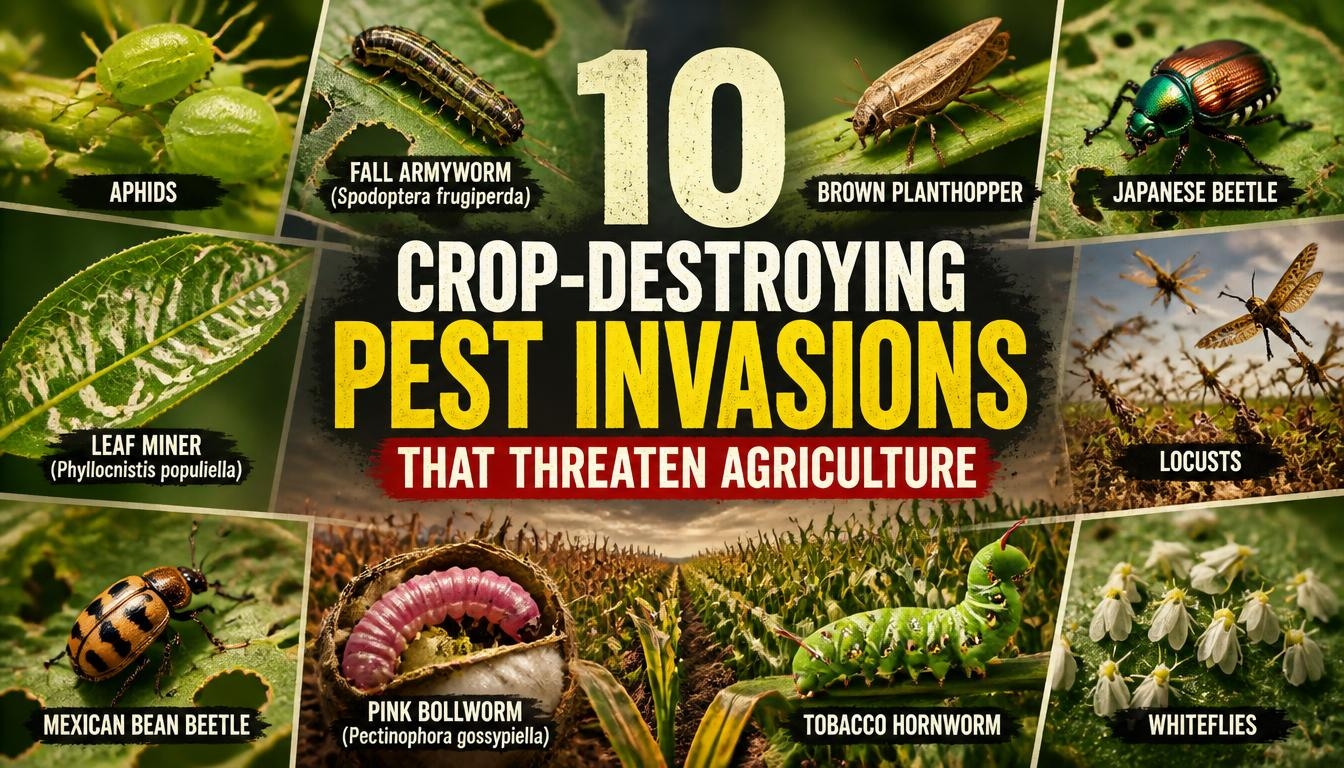
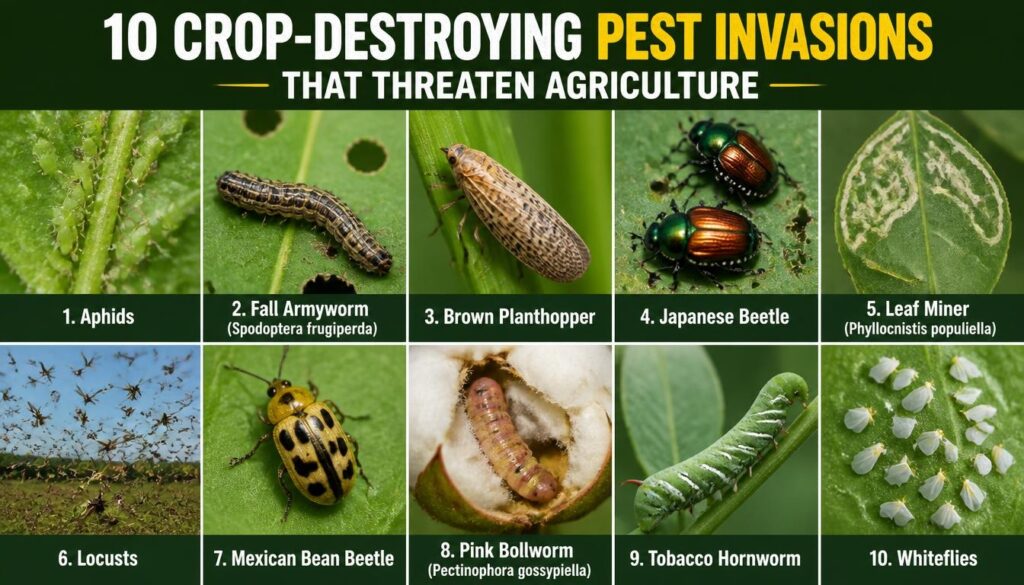
10 Crop-Destroying Pest Invasions That Threaten Agriculture
Animal pest invasions occur every year, often when large numbers of insects descend on fields, crops, and other vegetation. When people hear the word infestation, they may think of insects invading homes. However, agricultural pest outbreaks can be much more destructive. Some cause millions of dollars in crop damage and threaten food production across entire regions.
Here are 10 animal pest invasions that can cause serious damage to crops.
Aphids
These tiny insects use specialized mouthparts to suck fluids from flowers, leaves, crops, and other plants. As sap-feeding insects, aphids are among the most destructive agricultural pests in temperate regions.
Most aphids are wingless, although certain females produce winged offspring that can travel to new host plants. An infestation often begins when winged aphids locate a suitable plant. They settle on its tender tissues and produce wingless young before moving on to find additional hosts.
Young aphids can mature in approximately seven to ten days. Many species reproduce without mating, and a single female can produce as many as 60 offspring. This rapid reproduction allows populations to grow quickly and spread across a wide range of plants.
As aphids feed, affected plants may stop growing or develop yellow leaves. In fields and gardens, infestations can damage beans, pumpkins, tomatoes, squash, and many other crops. Plant health and overall yields can decline significantly.
There are more than 500 aphid species, and approximately 450 of them feed on fiber and food crops. Large populations can also produce airborne particles that may trigger allergic reactions in sensitive individuals.
You may also like: The 10 Most Painful Insect Stings in the World
Fall Armyworm (Spodoptera frugiperda)
The fall armyworm is the caterpillar stage of a moth species that attacks cereal crops and grasses, particularly during wet seasons. These caterpillars can be found in soil or beneath plant debris in grassy areas, and they have a broad diet.
A single female moth can lay up to 2,000 eggs during her lifetime, with individual egg clusters sometimes containing as many as 134 eggs. After hatching, young larvae feed on grasses and cereal crops such as corn. When their numbers increase, they can move from one field to another in large groups.
Fall armyworm outbreaks can occur at different times of the year, including early spring, early summer, and winter, depending on local conditions. Their intense feeding activity can strip plants of vegetation and cause substantial crop damage.
The caterpillars also feed on pasture grasses, which are an important food source for livestock in many regions. If populations are not controlled, the larvae can develop into adults in approximately six weeks. Adult moths may then disperse downwind and lay eggs in new areas, creating further outbreaks.
Brown Planthopper
The brown planthopper is an insect pest that feeds on rice plants and can transmit two plant viruses. Damage may appear as darkening, drying, and yellowing of the plants, sometimes accompanied by dry, circular patches.
As the population grows, rice leaves may turn orange-yellow before becoming brown and dry. Severe infestations can cause devastating crop losses. Under heavy pest pressure, rice yields may be completely lost if the outbreak is not controlled.
Japanese Beetle
Farmers and gardeners have struggled with Japanese beetle infestations for decades. Adult beetles feed on a wide variety of plants, with more than 300 species included in their diet.
Their shiny metallic-green bodies and copper-brown wing covers make them visually striking. However, large groups of these beetles can gather on shrubs, trees, and other plants surprisingly quickly, causing extensive damage.
Japanese beetle grubs feed on plant roots, which can cause grass to turn brown and die. Adult beetles attack flowers and foliage, chewing away leaf tissue and leaving behind a skeletonized appearance.
Controlling a major infestation can be difficult. Farmers and gardeners need to watch for early signs of beetle activity. Prompt detection and intervention can help protect crops and ornamental plants before populations become harder to manage.
Leaf Miner (Phyllocnistis populiella)
Leaf miners can leave plants with a distinctive pattern of damage. The larvae are responsible for much of the harm, feeding within the tissues of leaves rather than entirely on their outer surfaces.
Female insects use their ovipositors to puncture leaf surfaces and deposit eggs inside. The larvae may hatch within approximately ten days and begin feeding between the layers of leaf tissue, creating winding mines as they consume plant material.
After several weeks, the larvae mature and emerge as adults, beginning another reproductive cycle. Without timely intervention, successive generations can spread through crops and other plants.
Leaf miners can be difficult to control because their larvae live inside leaves, where they are protected from some surface treatments. Different leaf-mining species affect plants such as beets, boxwood, citrus, peas, spinach, tomatoes, and other crops.
Read also: 10 Dangerous Invasive Animal Species
Locusts
When it comes to destructive pest invasions, locust outbreaks are among the most alarming. Desert locust swarms threaten food supplies in several parts of the world, particularly in Africa, the Arabian Peninsula, and the Indian subcontinent.
These highly mobile migratory pests can travel up to 145 kilometers in a day. When millions of locusts move together, they can consume enormous quantities of vegetation and leave fields devastated.
A large swarm can eat as much food in one day as approximately 35,000 people consume. The scale of these outbreaks makes locusts a serious threat to agriculture and food security.
In 2019 and 2020, the damage and losses associated with locust outbreaks reportedly exceeded $8 billion as swarms continued to spread across affected regions.
Mexican Bean Beetle
As its name suggests, the Mexican bean beetle primarily attacks legume plants. It is commonly found wherever beans and other suitable host plants are grown.
These beetles can survive the winter on legume foliage and become more active as temperatures rise. Their larvae and adults feed on leaves, often leaving them with a skeletonized appearance.
A Mexican bean beetle infestation can develop rapidly. The source reports that a beetle can produce up to 75 batches of eggs, with as many as 600 eggs in each batch. If the population is not controlled before the eggs hatch, large numbers of larvae can emerge and damage bean plants.
The beetles feed on different types of beans, and severe infestations can destroy an entire crop. Although control methods are available, early detection is particularly important. Finding the beetles before they reproduce can help prevent a much larger outbreak.
Pink Bollworm (Pectinophora gossypiella)
The pink bollworm is a major pest of cotton crops and can cause extensive agricultural damage. Its larvae enter cotton bolls and feed on the developing seeds, moving from one seed to another as they grow.
An infestation can cause flower buds to drop, flowers to become deformed, and fiber development to decline. The larvae may also damage the seeds themselves.
In severe cases, their feeding can stain cotton fibers and make the harvested material unsuitable for commercial use. This makes the pink bollworm a significant threat to cotton production in several countries, including China and India.
Tobacco Hornworm
Tobacco hornworm caterpillars can cause direct damage to a wide range of agricultural crops and garden plants. They feed on plants such as cabbage, cauliflower, peas, potatoes, and tomatoes.
Young larvae scrape the surfaces of leaves, while larger caterpillars consume more substantial amounts of foliage and may also attack fruit. Because they are primarily active at night, they often feed after dark and hide in the soil around plants during the day.
A severe infestation can strip plants of their leaves in a very short time. The caterpillars may also bore into fruit and feed inside it. Damaged fruit can ripen prematurely and become discolored, soft, and watery.
Whiteflies
Both adult whiteflies and their immature stages feed on plant sap, usually from the undersides of leaves. This feeding weakens plants and can interfere with their growth.
Whitefly infestations can damage flowers, fruits, and vegetables. Although these insects are particularly troublesome in gardens and greenhouses, they can also affect agricultural crops.
Controlling whiteflies can be challenging because some populations have developed resistance to synthetic pesticides. This can make chemical treatments less effective and complicate efforts to eliminate an infestation.
If you notice small white insects flying around your houseplants or garden plants, it is important to identify the problem early. Whiteflies are active during the day, making them relatively easy to spot. Prompt action can help prevent their populations from growing and spreading to nearby plants.