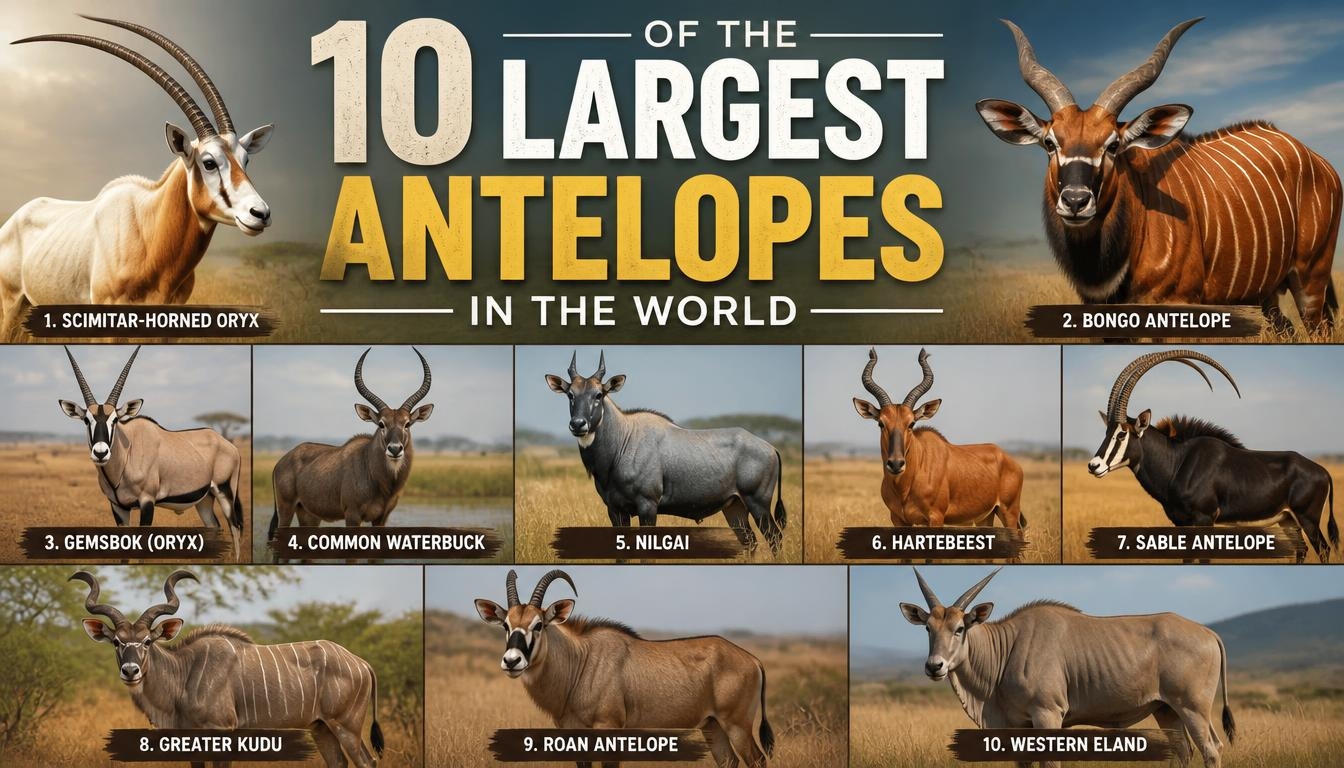
10 of the Largest Antelopes in the World
Antelopes are mammals native to various regions of Africa and Eurasia. One of their most interesting features is their horns, which continue growing throughout their lives rather than being shed every year like deer antlers. There are 91 recognized species of antelope, but this article focuses on ten of the largest.
Here is our list of some of the biggest antelopes in the world.
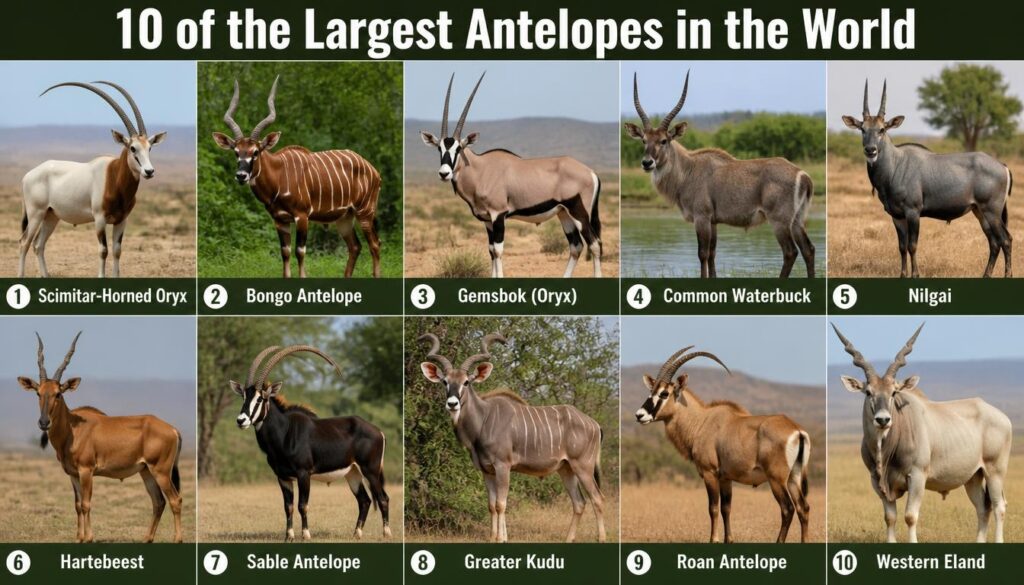
1. Scimitar-Horned Oryx
Height: 1–1.4 meters
The scimitar-horned oryx is an elegant and graceful antelope with remarkable adaptations for surviving in desert environments. It can tolerate extreme heat by allowing its body temperature to rise rather than sweating excessively. This helps it conserve water and survive for long periods without drinking.
Its white coat reflects the intense desert sunlight, helping keep its body cool. Meanwhile, its dark skin and the black tip of its tongue provide protection against sun exposure. Its enlarged hooves also make walking across soft sand easier. Thick eyelashes and strong eyelids help protect its eyes from windblown sand.
Some people believe the scimitar-horned oryx may have inspired the legend of the unicorn. Its long, ridged, sharply pointed horns curve backward and can grow to an impressive length. Ancient Egyptians reportedly domesticated these animals and sometimes tied their horns together, creating the appearance of a single horn. This may have contributed to the origins of the unicorn myth.
Despite its impressive size, the species disappeared from the wild around 2000, according to the source article. Drought, food shortages, human disturbance, and excessive hunting all contributed to its decline. Reintroduction projects have been established, although restoring wild populations remains challenging because these animals naturally migrate across large areas.
You may also like: Jumping Giants: 9 of the Largest Frogs in the World
2. Bongo Antelope
Height: 1.1–1.3 meters
The bongo is one of the most distinctive-looking antelopes. Its large ears, spiral-shaped horns, and bright body markings make it easy to recognize. Its coat ranges from reddish chestnut to dark brown, with striking vertical stripes.
The bongo is one of the largest antelopes in the world and the largest forest-dwelling antelope in the wild. It is also capable of jumping impressive heights when necessary. However, it often prefers to move around or underneath obstacles rather than use its jumping ability.
Another adaptation helps it move through dense vegetation. When navigating thick forests, a bongo raises its chin so that its horns lie close to its back. This allows it to move more easily through narrow spaces and helps explain the worn patches sometimes seen along its back.
These large and colorful African antelopes inhabit dense forests, wooded savannas, and tropical rainforests. In the past, they were also surrounded by local beliefs and superstitions. Some communities believed that touching or eating a bongo could cause convulsions resembling epileptic seizures. Such beliefs sometimes helped protect the animals from human interference.
Their natural predators include leopards, lions, and hyenas. Today, however, human activity represents a major threat. Bongos are targeted by trophy hunters, while habitat destruction reduces the dense vegetation they depend on for food and shelter. Their exact population in the wild is difficult to determine because they are elusive animals that are rarely seen.
3. Gemsbok (Oryx)
Height: 1.2–1.4 meters
The gemsbok, also known as the South African oryx, is a striking antelope that can reach 1.4 meters in height. It is one of the largest and best-known members of the oryx group.
A dark marking runs from its chin down the lower part of its neck and across the shoulder area. Its body has a horse-like appearance, with muscular shoulders and a strong neck. When running, the animal moves at a gallop.
One of its most impressive features is its long horns, which can reach approximately 1.2 meters. These horns are not merely decorative. Gemsboks use them to defend themselves against predators and to compete with other animals over territory. Their sharp points make them formidable opponents, and they are even capable of killing a lion.
Gemsboks are also remarkably strong and well adapted to dry environments. Their slow metabolism helps them survive for extended periods without drinking water, reportedly up to a year under suitable conditions. They can obtain much of the moisture they need from their food.
Their diet includes desert melons, which they dig up during dry periods, as well as tough grasses and leaves. These adaptations allow them to survive in deserts and scrublands across southwestern Africa.
Gemsboks are social animals that often gather in herds of ten or more individuals. Although their populations are generally considered stable in the source article, hunting remains a threat, particularly because people target them for their meat and horns.
4. Common Waterbuck
Height: 1.2–1.4 meters
The common waterbuck differs from many other antelopes because of its close association with water. It prefers habitats near rivers and other permanent water sources, including gallery forests, riverine woodlands, and savannas.
Waterbucks rarely move far from water. When threatened by predators, they may escape by running directly into it. Their main predators include large cats, which are generally less comfortable hunting in water.
Another recognizable feature is the white ring around the animal’s hindquarters. This marking acts as a visual signal that can help other members of the group follow a fleeing waterbuck when danger appears.
Waterbucks also have thick hair around their necks. Although this may seem unusual for an animal living in hot African environments, the hair is hollow and provides additional buoyancy. It helps the animal keep its head above water while swimming.
Their coats are also covered with a special oily secretion that repels water and helps keep the animals dry. The substance can repel insects such as ticks as well, partly because of its unpleasant smell.
Despite their adaptations, waterbucks face several environmental threats. Dams and the diversion of rivers for hydroelectric projects can disrupt the water sources they depend on. Agricultural expansion also destroys grazing habitats, while uncontrolled hunting contributes to declining populations in some areas.
5. Nilgai
Height: 1–1.5 meters
At first glance, it may be difficult to believe that the nilgai is actually an antelope. It is not only one of the largest antelopes in the world but also the largest antelope species in Asia.
Native to the Indian subcontinent, the nilgai has a distinctive appearance. It stands on long, strong legs and has a deep neck and sloping back. A white patch is visible on its throat, while a short mane runs along the back of its neck and shoulders.
Its front legs are longer than its hind legs, and all four legs often have white markings that resemble socks. Males have horns and thicker skin around the neck, which helps protect them during fights. Females do not have horns.
Nilgai prefer open grasslands with scattered trees and short shrubs, as well as scrub forests. They are also frequently found near agricultural land because they can adapt to a wide range of habitats.
Like many other antelopes, nilgai are well suited to dry environments. They can survive for several days without drinking water by obtaining moisture from the plants they eat.
Despite their bulky appearance, nilgai are fast runners. When disturbed or threatened, they usually flee at a gallop.
Their main threats include deforestation, habitat degradation, and hunting. In several northern Indian states, farmers consider nilgai agricultural pests because they raid fields and trample crops. Nevertheless, the species remains widespread and has a relatively large population across much of its natural range.
6. Hartebeest
Height: 1–1.5 meters
The hartebeest is a large antelope with several distinctive physical features. Its elongated forehead and muzzle give it a narrow, streamlined appearance, while its sloping back and long legs make it one of the taller antelopes.
Those long legs also make the hartebeest an exceptional runner. It can reach speeds of up to 70 km/h, an important advantage for an animal that lives mainly in grasslands and open plains. Speed helps it escape predators such as cheetahs.
Other natural predators include hyenas, African wild dogs, jackals, leopards, and lions.
Hartebeest are social animals that can form large herds of 300 individuals or more when food is abundant. Their herds are often divided into four groups: territorial adult males, non-territorial adult males, young males, and females with their offspring.
Females sometimes form smaller groups of five to twelve individuals and compete for dominance. As a result, sparring between females is not unusual.
Hartebeest also benefit from cooperation within the herd. While most members are feeding, one animal will often remain alert and watch for potential danger.
The species is widely distributed across Africa, but its population is declining in many areas. Competition for food, habitat destruction, and hunting are among the main factors contributing to this decline.
7. Sable Antelope
Height: 1.3–1.5 meters
The sable antelope is one of the largest and most impressive-looking antelopes in the world. It has magnificent horns, distinctive facial markings, and a striking appearance.
Its horns can grow to approximately 1.6 meters in length, almost comparable to an elephant’s tusk. They continue growing throughout the animal’s life, and annual growth rings can help indicate its age.
When young, the horns grow relatively straight and upright. As they develop, they gradually curve backward, creating the impressive shape for which the species is known.
Sable antelopes also have a powerful build, a thick neck, and a prominent mane running along the back. Their appearance reflects their strength, which is particularly evident in the behavior of adult males.
Males can be aggressive when competing for females and territory. They sometimes fight by locking their horns together, and these battles can occasionally result in fatal injuries.
Natural predators include lions, leopards, and hyenas, while humans also pose a significant threat. Habitat destruction and trophy hunting have contributed to population declines.
According to the figures given in the source article, approximately 50,000 sable antelopes remained across 11 countries, with numbers continuing to decrease.
8. Greater Kudu
Height: 1.2–1.6 meters
The greater kudu is one of Africa’s largest and most impressive antelopes. It is most common in southern Africa, although populations also occur in eastern Africa and the Horn of Africa.
Its preferred habitats include lightly wooded savannas and rocky scrublands, where vegetation and terrain provide shelter from predators. These include hyenas, leopards, lions, and African wild dogs.
Greater kudus are highly alert animals. Their large ears help them detect sounds and identify potential danger nearby. When they spot a predator, they may produce a loud, harsh bark to warn other members of the group before escaping.
Despite their considerable size, greater kudus are relatively light-bodied and surprisingly agile. They can jump over high fences and other obstacles when necessary.
Their horns are among their most remarkable features. They have a distinctive spiral shape, usually with two and a half twists, and can reach approximately 120 centimeters in length when straightened. In some males, the horns have three complete twists and can measure up to 187 centimeters.
Male kudus do not usually display extreme physical aggression, but they may compete during the mating season by pushing against one another with their horns. Sometimes their horns become locked together. If the animals cannot separate, both may die.
Unfortunately, their impressive horns cannot protect them from hunters who target them for their skins, meat, and horns. Local communities also use kudu horns in traditional rituals, for making tools, and for storing honey.
According to the African Wildlife Foundation figures cited in the source article, greater kudus are considered threatened, with approximately 118,000 individuals remaining in the wild.
9. Roan Antelope
Height: 1.3–1.6 meters
The roan antelope is one of the largest antelope species, with a powerful, horse-like body and a thick, muscular neck. It has a short, upright mane along its back and distinctive markings on its face.
Its long horns curve backward, particularly in males. These horns are useful for defending against predators such as lions and other large cats. Roan antelopes also use them when competing with one another for access to females and territory.
The roan antelope looks remarkably similar to the sable antelope. In areas where their ranges overlap, the two species can sometimes be confused. One of the easiest ways to recognize a roan antelope is by its characteristic facial markings, which combine dark and light areas.
Roan antelopes inhabit central, southern, and western Africa. Their preferred environments include tropical and subtropical grasslands, savannas, woodlands, and scrublands where sufficient food is available.
These social animals usually live in groups consisting of five to fifteen females and a dominant male. Females may also compete for dominance, and groups led by a dominant female are sometimes found.
Roan antelopes are generally shy, but they can be courageous when threatened and are capable of confronting predators when necessary.
Their biggest challenges, however, come from human activity. Habitat loss and poaching are major reasons for their declining numbers. Today, they mainly survive in protected areas or in the regions surrounding them.
10. Western Eland
Height: 1.8–2.2 meters
The western eland is the largest antelope in the world, with an impressive size and distinctive appearance. Its smooth coat is usually chestnut or reddish-brown, marked with eight to twelve clearly defined vertical white stripes.
Males are generally darker than females, and their coats tend to become darker as they age. Both sexes have slender legs with black-and-white markings just above the hooves.
Western elands also have tightly twisted, V-shaped horns. Those of males are generally longer and thicker, with the tips spreading farther apart.
These large antelopes inhabit broadleaf savannas, woodlands, and areas along the edges of deserts in Central and West Africa. They can also be found near hilly or rocky landscapes, provided that water sources are available nearby.
Western elands often form separate groups of males and females with their young. Adult animals can be relatively solitary, spending much of their time alone and sometimes joining females for periods ranging from an hour to a week.
When a male senses danger, it may produce a deep, throaty bark that alerts the rest of the herd.
Despite being the largest antelopes, western elands are surprisingly good jumpers. They can leap to heights of approximately 1.5 meters.
Their natural predators include hyenas, leopards, and lions. However, their greatest threats come from habitat destruction, excessive hunting for meat and hides, and trophy hunting. These pressures have made the species vulnerable in parts of its range.