8 Plants That Don’t Need Chlorophyll to Survive
At school, we learn that plants need chlorophyll to capture sunlight and produce energy through photosynthesis. But nature has some remarkable exceptions. Certain plants have lost the ability to photosynthesize and instead obtain nutrients through parasitism or through complex relationships with fungi.
Some attach themselves directly to the roots or stems of other plants, while others depend on underground fungal networks to obtain the nutrients they need. Many of these species look completely unlike ordinary green plants because they lack the chlorophyll that normally gives leaves their characteristic color.
Here are eight fascinating plants that can survive without relying on chlorophyll and conventional photosynthesis.
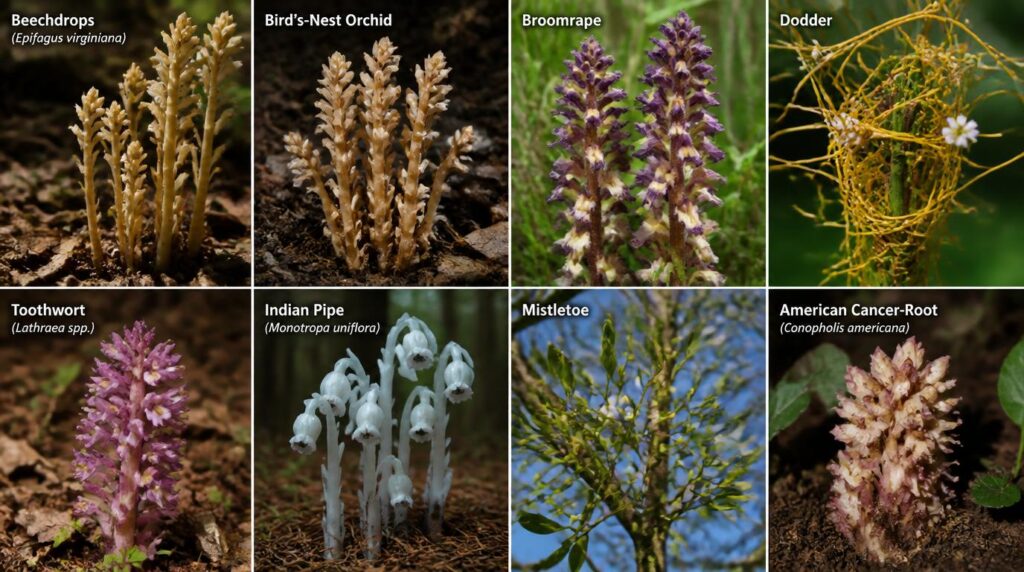
1. Beechdrops (Epifagus virginiana)
Beechdrops is a holoparasitic plant that lacks both chlorophyll and conventional green leaves. It lives in association with beech trees and obtains nutrients from their roots.
Most of the plant remains hidden or develops close to the host’s root system, while the part that appears above ground is mainly its flowering structure. Between late summer and autumn, beechdrops produces small purplish flowers of different types, including flowers capable of self-pollination and flowers adapted for cross-pollination.
The plant forms specialized structures that connect with the roots of its beech host and allow it to obtain the resources necessary for growth. Because it has no chlorophyll, it does not need to produce energy through photosynthesis.
2. Bird’s-Nest Orchid
The bird’s-nest orchid is an unusual orchid that lacks the green leaves normally associated with plants. Its brownish or yellowish appearance is a direct result of its lack of chlorophyll.
Rather than producing its own energy through photosynthesis, the plant depends on a close relationship with fungi in the soil. These fungi connect the orchid to underground sources of nutrients and help it complete its life cycle.
Bird’s-nest orchids occur across parts of Europe and North Africa and are particularly associated with woodland habitats. Their unusual appearance and dependence on underground fungal relationships make them very different from the typical green orchids found in gardens.
You may also like: Natural Snake Repellents: Plants That Keep Snakes Away and Beautify Your Space
3. Broomrape
Broomrapes belong to the genus Orobanche and are parasitic plants that produce little or no chlorophyll. Instead of obtaining energy from sunlight, they take nutrients and water from other plants.
They accomplish this with specialized structures called haustoria, which penetrate the tissues of a host plant and establish a connection with its vascular system.
There are many species of broomrape, and some can become serious agricultural pests. Certain species attack crops and can cause substantial losses, particularly when infestations become widespread.
Because broomrapes depend on other plants for their resources, they can be particularly difficult to control once they become established in agricultural fields.
4. Dodder
Dodder is a distinctive parasitic plant recognized by its thin, twining stems and almost complete lack of conventional leaves. It occurs across temperate and tropical regions of the world and can grow on a wide variety of host plants.
A dodder seed begins its life by producing a small root and a slender stem. Once the young plant finds a suitable host, it wraps around the stem and develops haustoria that penetrate the host’s tissues.
From that point onward, dodder obtains water and nutrients from its host while continuing to grow and spread across it. A heavy infestation can severely weaken or even kill the host plant.
Because dodder can spread rapidly and parasitize many different species, it is considered an important agricultural weed in some regions.
5. Toothwort
Toothwort is a strange-looking parasitic plant found in parts of Europe and other temperate regions. It belongs to a group of plants that have lost chlorophyll and therefore cannot rely on photosynthesis for their nutrition.
Most of the plant’s life takes place underground. Its specialized structures attach to the roots of woody plants and draw nutrients from them.
Toothwort is commonly associated with trees such as beech, ash, elm, hazel, and alder. For much of the year it can remain almost completely hidden beneath the soil and leaf litter.
When it emerges above the ground, its unusual flowers make it much easier to spot. Some species of toothwort are also cultivated as unusual ornamental plants.
6. Indian Pipe (Monotropa uniflora)
Indian pipe is sometimes called the ghost plant or corpse plant because of its striking white appearance. Unlike most plants, it has no chlorophyll and therefore cannot use sunlight to produce energy through photosynthesis.
Its waxy stems and small scale-like leaves are usually white or pale pink. When the plant dries out, it can become much darker.
Indian pipe obtains nutrients through a complex relationship involving fungi in the soil. The fungi themselves are associated with nearby trees, creating an underground pathway through which resources ultimately reach the plant.
Because it does not depend directly on sunlight for photosynthesis, Indian pipe can grow in the dark understory of dense forests, where ordinary green plants may struggle to receive enough light.
7. Mistletoe
Mistletoe is one of the best-known parasitic plants, although its biology differs from that of completely non-photosynthetic species. Many mistletoes are hemiparasites: they retain chlorophyll and can photosynthesize, while also taking water and minerals from their host plants.
Mistletoe attaches to branches of trees and shrubs and develops specialized structures that penetrate the host’s tissues. Different species can grow on a wide variety of trees.
Heavy infestations may weaken a host, reduce its growth, or damage individual branches. At the same time, mistletoes can play an important ecological role by providing food and habitat for birds and other wildlife.
The plant also has a long history of cultural and traditional use. However, claims about medicinal benefits should be distinguished from scientifically established medical treatments.
8. American Cancer-Root (Conopholis americana)
American cancer-root is a non-green parasitic plant native to parts of North America. It obtains nutrients from the roots of trees, particularly members of the beech and oak families.
Much of the plant’s biomass remains underground, and young plants can spend several years developing below the soil surface. Specialized structures connect the plant to the roots of its host and allow it to obtain the resources necessary for growth.
When it finally emerges above the ground, the flowering structure has an unusual appearance that can resemble a small pine cone or corn cob rising from the forest floor.
American cancer-root is particularly associated with mature woodland habitats. Its seeds and stems can also provide food for some mammals, while the plant has appeared in traditional medicinal practices.