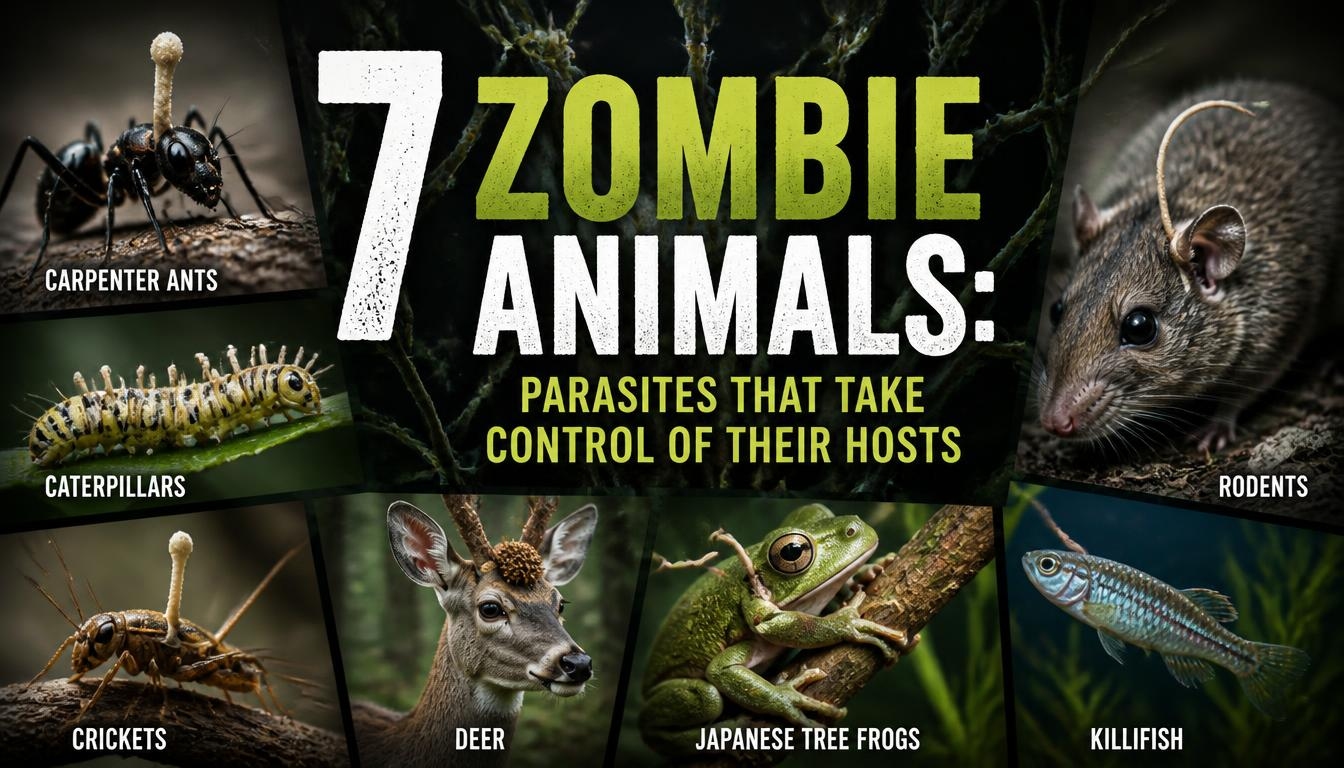
7 Zombie Animals: Parasites That Take Control of Their Hosts
Zombie animals may sound like something invented for a horror movie, but nature has its own examples of creatures that lose control of their behavior. Certain parasites can invade an animal’s body and manipulate its actions in ways that benefit the parasite rather than the host.
The process can involve fungi, viruses, worms, and microscopic organisms. Some change where their hosts move, others influence how they respond to danger, and a few even affect the sounds they make.
These animals do not become zombies in the literal sense. Instead, they experience biological changes that can make them behave in unusual and sometimes destructive ways. Here are seven examples of animals whose bodies or behavior can be affected by other organisms.
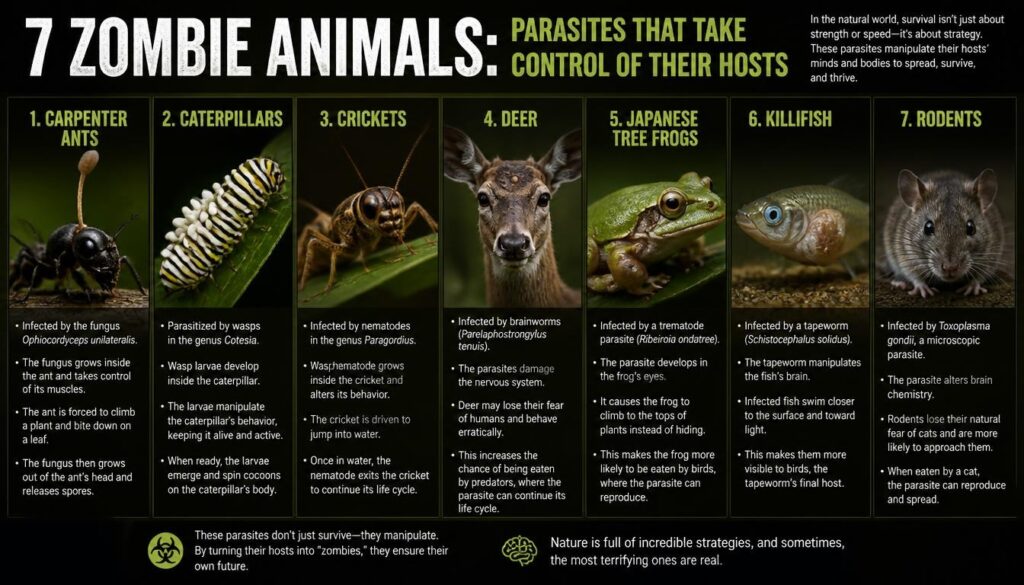
1. Carpenter Ants
The fungus Ophiocordyceps unilateralis is known for infecting carpenter ants in tropical forests, including regions of Brazil and Thailand. Once its spores attach to an ant’s exoskeleton and establish an infection, a remarkable process begins.
The fungus obtains nutrients from its host while developing germ tubes and networks of hyphae throughout the ant’s muscles. As the infection progresses, fungal growth spreads through the body and head, gradually interfering with normal muscle function.
After approximately three weeks, the infected ant may begin displaying abnormal behavior. Instead of remaining with its colony, it spends less time inside the nest and wanders away from its usual surroundings.
Eventually, the fungus drives the ant to climb a plant, often reaching a height of around 25 centimeters above the ground.
This particular position is important for the fungus. Research suggests that the height provides suitable humidity and temperature conditions for its development. The behavior also tends to occur around midday, although the reason for this timing remains unclear.
Once the ant reaches the right location, the fungus produces substances that damage the muscles controlling its jaws. The ant then clamps down tightly on a leaf or small branch and cannot release its grip. This phenomenon is often described as a death grip.
The fungus eventually kills the ant. Afterward, a long fungal stalk emerges from the back of its head, releasing spores when it matures. These spores spread onto nearby plants and soil, where they can infect other ants and continue the cycle.
You may also like: 10 Harmless Yet Terrifying-Looking Animals
2. Caterpillars
If fictional zombie transformations seem disturbing, the natural world offers examples that are just as unsettling. Certain baculoviruses can alter the behavior of infected caterpillars, turning their bodies into environments for producing new viral particles.
There are several types of baculovirus, and they affect many caterpillar species, including gypsy moth caterpillars.
Normally, a healthy caterpillar feeds on leaves at night and moves down from the tree in the morning, where it can hide from predators. However, the situation changes if it consumes leaves contaminated with baculovirus particles.
The infection can interfere with its usual routine. Instead of descending to shelter, the caterpillar remains high in the tree canopy. As its condition deteriorates, it continues staying among the leaves until it eventually dies.
Meanwhile, the virus uses the caterpillar’s body to produce enormous numbers of new viral particles. Certain viral genes also cause the infected caterpillar’s body to break down.
Eventually, the caterpillar becomes a container filled with millions of virus particles. When the body disintegrates, these particles fall onto the vegetation below, potentially infecting other caterpillars that feed there.
3. Crickets
Crickets can become hosts to parasitic worms that develop inside their bodies. The relationship becomes especially disturbing when the worm reaches maturity and needs to enter water to reproduce.
At that stage, the parasite can influence the cricket’s behavior and guide it toward a nearby body of water. The infected insect may then jump into the water and drown.
While the cricket is submerged, the worm emerges through openings in its host’s exoskeleton. The parasite can be as much as ten times longer than the cricket itself, making its appearance particularly startling.
These parasites are known as horsehair worms or Gordian worms. They require an aquatic environment to reproduce, which explains why getting their host into water is essential to their life cycle.
The worm can produce chemicals that affect the cricket’s nervous system and behavior. It may also influence the production of neurotransmitters inside the host, encouraging the insect to move toward water.
Once free of the cricket, the mature worm mates and lays eggs. It eventually dies, while the next generation remains in the environment until it is consumed by another suitable host.
And so the cycle begins again.
4. Deer
Chronic wasting disease is a fatal, progressive neurodegenerative condition that affects the brains of deer and elk. Unlike infections caused by bacteria or viruses, this disease is associated with prions — abnormal proteins that can trigger other proteins to fold incorrectly.
These infectious proteins accumulate particularly in brain and spinal cord tissue. As the disease advances, they cause serious damage to the nervous system.
Infected animals may develop symptoms resembling dementia. They can become disoriented, experience difficulties eating and walking, and appear unsteady on their feet. Their condition gradually worsens until the disease leads to death. There is currently no cure.
The disease has been described as relatively uncommon, but it has spread among deer and other hoofed mammals across parts of the United States.
Because infected animals can appear weak and behave strangely, chronic wasting disease is often referred to as zombie deer disease. However, affected deer do not become aggressive creatures that attack other animals.
Prions can spread through direct or indirect contact with infected bodily fluids and tissues, including blood, feces, saliva, and urine.
No confirmed cases of chronic wasting disease in humans have been reported in the source material. Nevertheless, scientists have considered the possibility of transmission to people. The disease has also been observed in several other animal species, including macaques, mice, monkeys, and squirrels.
5. Japanese Tree Frogs
A fungal pathogen called Batrachochytrium dendrobatidis (Bd) causes chytridiomycosis, an infectious disease that has had devastating effects on amphibian populations.
The fungus damages amphibian skin, disrupts normal immune function, and can lead to heart failure. It has contributed to the deaths and decline of hundreds of frog species around the world and poses a serious threat to a substantial proportion of the world’s frogs, salamanders, and other amphibians.
Japanese tree frogs are among the species described as being more tolerant of this pathogen than many other amphibians. However, tolerance does not necessarily mean that the infection has no effect on them.
Unlike many other examples of animal manipulation, the reported changes in these frogs involve their mating calls rather than their movements.
Infected males produce calls that are faster and longer than usual. According to the research described in the source, these altered sounds may be more attractive to females.
This creates an unusual situation in which the pathogen may benefit from changes in its host’s reproductive behavior. Males with altered calls can attract and mate with more females, potentially helping Bd spread through the population.
Females can then pass the infection to their offspring, allowing the disease to continue spreading and potentially contributing to further population declines.
6. Killifish
The animal kingdom’s unusual host-manipulation strategies are not limited to land. Killifish can also become hosts to parasites that influence their behavior and increase the likelihood that they will be eaten by birds.
One example is Euhaplorchis californiensis, a parasitic worm that reproduces inside the intestines of seabirds. Its life cycle involves several hosts, beginning with eggs released into the environment through bird droppings.
Horn snails are among the animals that consume these eggs. Once inside a snail, the parasite larvae multiply asexually before leaving the host and swimming freely through the water.
The free-swimming parasites then attach themselves to fish and enter their bodies.
After reaching a killifish, the parasite can influence activity in the fish’s brain. It may interfere with serotonin production and alter the host’s behavior.
Infected fish are more likely to swim close to the water’s surface, where birds can spot and catch them. The more frequently the fish appears near the surface, the greater its chances of becoming a bird’s meal.
This outcome benefits the parasite. Once the infected fish is eaten, the worm reaches the bird’s digestive system, where it can mature and reproduce.
Its eggs are then released into wetlands and ponds through bird droppings, allowing the cycle to begin again.
7. Rodents
Mice and rats normally avoid cats, but infection with the single-celled parasite Toxoplasma gondii can change this familiar predator-prey relationship.
The parasite can infect the cells of rodents and alter certain aspects of their behavior. Infected mice and rats may lose some of their natural fear of cats. Even more unusually, they can become attracted to the smell of cat urine rather than avoiding it.
This behavioral change makes the rodents more vulnerable to predators. By approaching cats instead of fleeing from them, infected animals are more likely to be caught and eaten.
For Toxoplasma gondii, this is an important part of its life cycle because cats are the parasite’s definitive hosts. Once a cat consumes an infected rodent, the parasite can continue developing and reproducing inside the animal.
Cats can also release parasite stages into the environment through their feces. Other animals and humans may become infected through contact with contaminated material or by accidentally ingesting it.
In humans, toxoplasmosis can affect several parts of the body, including the brain, eyes, heart muscle, and skeletal muscles. Some infected individuals may experience neurological or psychological complications. The effects can vary depending on the person’s immune system and other factors.
In people with a healthy immune response, the body may control the infection. The parasite can then remain in a dormant form without causing noticeable harm.
Nature has developed some extraordinary relationships between parasites and their hosts. From fungi that direct ants to climb plants to worms that lead crickets into water, these examples show how parasites can influence the behavior of other organisms to complete their life cycles.
Not every so-called zombie animal is controlled in the same way. Some experience changes in movement, others in feeding or mating behavior, while diseases such as chronic wasting disease damage the nervous system. Together, these cases reveal just how complex — and sometimes unsettling — the natural world can be.