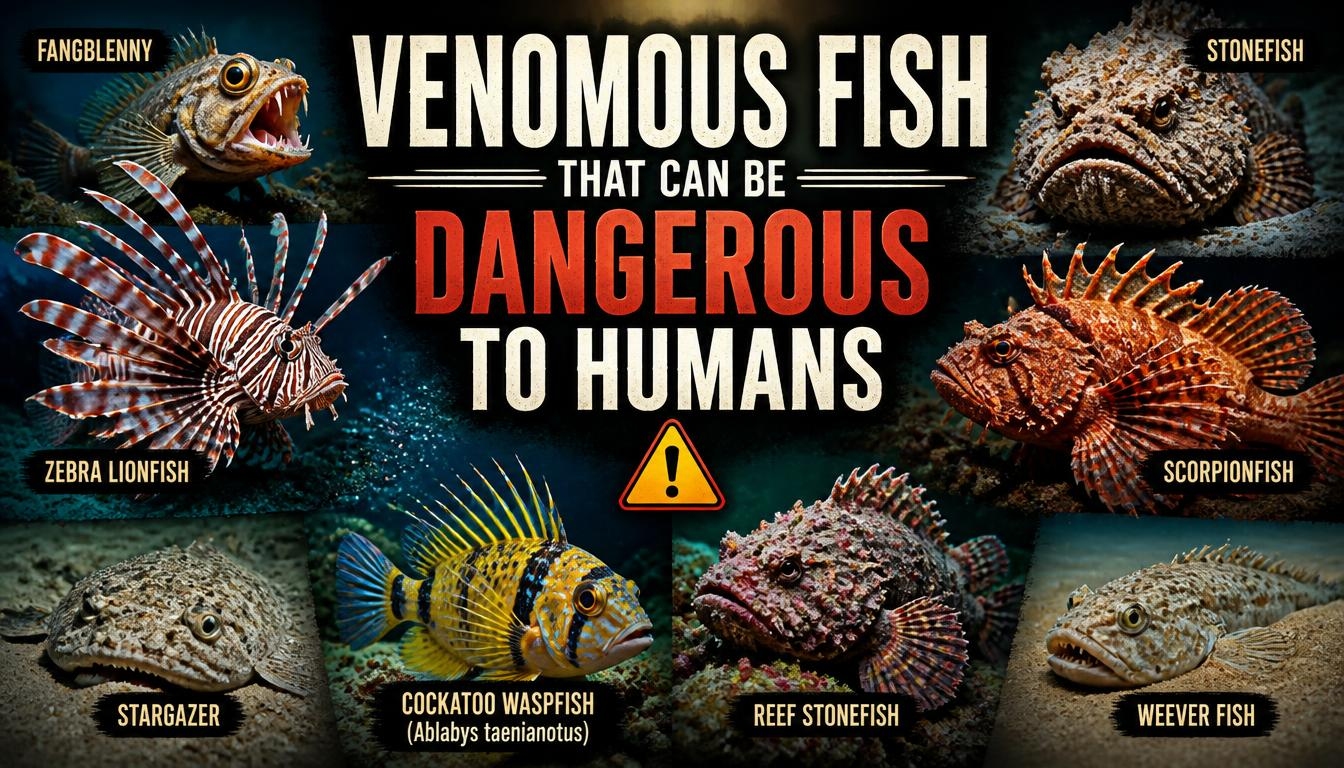
7 Venomous Fish That Can Be Dangerous to Humans
Venomous fish are marine and freshwater species equipped with toxins that can cause painful injuries and, in some cases, life-threatening reactions in humans. A sting, puncture, or even accidental contact with certain species can be dangerous.
According to estimates cited in research, at least 1,200 venomous fish species inhabit the world’s waters. Some are familiar sights to divers and swimmers, while others remain well camouflaged on the ocean floor.
Here are seven venomous fish that can pose a danger to humans.
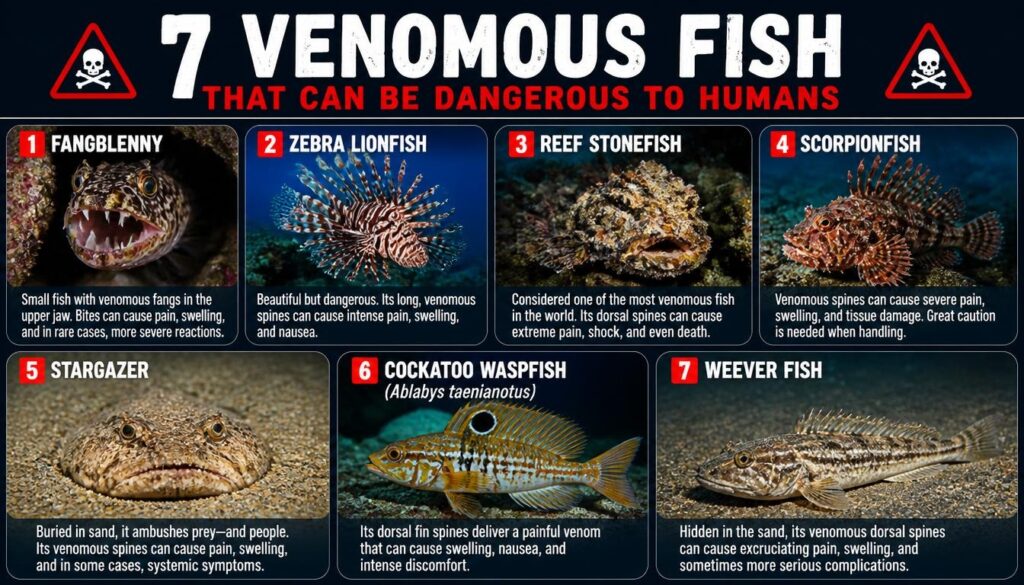
1. Fangblenny
Nobody expects this ordinary-looking little fish to be among the venomous species capable of delivering a painful bite. Fangblennies have two enlarged, grooved fangs on their lower jaws, which give them their name. These teeth are connected to venom glands that allow the fish to deliver venom through a bite.
The fangs are primarily defensive. When threatened, a fangblenny may open its mouth wide to expose its teeth. Its venom can lower a predator’s blood pressure and relax its jaw muscles, giving the small fish an opportunity to escape.
One particularly interesting feature of fangblenny venom is its effect on opioid receptors. This has attracted scientific interest because compounds in the venom could potentially contribute to the development of new pain-relief treatments.
Several fangblenny species exist, but venom glands are found only in certain groups. Their venom contains at least three types of compounds, including enkephalins, neuropeptide Y, and phospholipases.
Despite these defensive adaptations, fangblennies are among the less dangerous venomous fish to humans. Their small mouths limit the severity of most bites, although the wounds can still be painful and surprisingly deep.
Fangblennies are found throughout parts of the Indian and western Pacific Oceans, including the Great Barrier Reef, where they inhabit shallow waters. Their diet consists mainly of filamentous algae, bryozoan stalks, coral mucus, and fish eggs.
Climate change is among the pressures affecting their populations.
2. Zebra Lionfish
If you enjoy snorkeling, scuba diving, or swimming in tropical waters, you may already be familiar with this striking fish. The zebra lionfish, also known as the lionfish, has an unmistakable appearance that often attracts the attention of divers and swimmers.
Its body is covered in brown, red, or white stripes. Fan-shaped fins and distinctive appendages make it particularly recognizable.
However, its appearance is not its only remarkable feature. The lionfish has venomous spines that serve as a defensive mechanism against predators. A puncture from one of these spines can inject venom beneath the skin and cause severe pain.
Lionfish venom affects the nervous and muscular systems. The severity of an injury depends partly on how deeply a spine penetrates the skin.
Common symptoms include bleeding, bruising, numbness, redness, swelling, and throbbing pain. Although lionfish stings are rarely fatal to humans, serious complications can occur, particularly in people who experience severe allergic reactions.
Lionfish are not naturally aggressive toward humans. Most injuries happen when someone accidentally touches or handles the fish.
Their striking appearance should never be mistaken for an invitation to get closer. A lionfish sting can be extremely painful, and any suspected envenomation should receive prompt medical attention.
3. Reef Stonefish
The reef stonefish is one of the most dangerous venomous fish in the ocean, partly because of its extraordinary camouflage. At first glance, it can look almost exactly like a rough rock or a piece of coral.
This disguise makes accidental encounters particularly dangerous. A person who steps on a stonefish may trigger a painful defensive response.
The reef stonefish has 13 strong spines along its dorsal fin. These spines can inject highly potent venom when pressure is applied. Rather than swimming away when disturbed, the fish may raise its dorsal spines as a warning and defensive measure.
Stonefish are generally not aggressive toward humans. They prefer to remain motionless in their habitat, waiting for prey to approach.
Their venom can cause intense pain and serious systemic effects. In severe cases, envenomation can become life-threatening without appropriate treatment.
Reef stonefish inhabit tropical marine waters across the Indo-Pacific region. They are found around Australia, including the Great Barrier Reef and coastal areas of Queensland and northern New South Wales.
Their preferred habitats include coral seabeds, rubble, rocky areas, and sheltered spaces beneath ledges. Some individuals also bury themselves in sand.
As ambush predators, stonefish wait for prey such as crustaceans and smaller fish to pass within striking distance. They can attack with remarkable speed.
Despite their camouflage and potent venom, stonefish have natural predators, including rays and sharks.
You may also like: 9 Remarkable Fish That Can Breathe on Land
4. Scorpionfish
Scorpionfish resemble lionfish in several ways and are also equipped with venomous spines. Their dorsal fin spines contain toxins that can cause extremely painful injuries to humans and other animals.
Many species have brightly colored pectoral fins that may serve as warning signals to potential predators.
A sting can produce a range of symptoms, including blisters, bruising, numbness, swelling, tingling, and tissue damage around the wound. The pain may be intense and throbbing, sometimes lasting for up to 12 hours.
In more serious cases, symptoms can include low blood pressure, nausea, vomiting, weakness, tremors, seizures, hallucinations, and an unusually slow heartbeat.
Scorpionfish are masters of camouflage. They often remain motionless on reefs or the ocean floor, blending into their surroundings while waiting for prey.
When a suitable target approaches, they attack rapidly. Their diet includes crustaceans, small fish, and snails. Some species may also use venom to help immobilize prey.
Many scorpionfish spend the daylight hours resting in crevices and become more active at night. Their natural predators include large groupers, rays, and sharks.
5. Stargazer
Stargazers have an unusual name and an equally unusual appearance. These fish are known for their upward-facing eyes and their ability to deliver painful venomous stings.
Some species also possess electric organs capable of producing electrical discharges. This combination of defensive adaptations makes stargazers particularly unusual among marine fish.
Venomous spines are located behind the gill covers, and certain species can deliver an electric shock through specialized organs. The strength of the electrical discharge varies between species.
Although these shocks are generally not considered powerful enough to kill a healthy adult human, they can cause pain and localized swelling. A sting may also produce redness, fever, and puncture wounds.
Stargazers are not usually aggressive toward people. Injuries generally occur when someone accidentally disturbs or handles one.
These elusive fish often live in shallow coastal waters, where they bury themselves in sand or mud. Only their eyes and mouths may remain visible, allowing them to wait for unsuspecting prey.
Stargazers occur in the Atlantic Ocean and Mediterranean Sea, while other species inhabit deeper marine waters around the world.
Some use a worm-like appendage to attract prey toward their mouths. Their diet includes crabs, other crustaceans, and small fish.
6. Cockatoo Waspfish (Ablabys taenianotus)
Ablabys taenianotus, commonly known as the cockatoo waspfish, is a member of the scorpionfish family. Like other venomous relatives, it has defensive spines that can inflict painful injuries.
Its long dorsal fin rises above its body like a cockatoo’s crest, which explains one of its common names. The fish is also known for its unusual way of moving.
Growing to approximately 15 centimeters in length, the cockatoo waspfish is not a strong swimmer. Instead, it often moves slowly, gently rocking from side to side like a dead leaf drifting through the water.
This behavior helps it blend into its surroundings and avoid attracting attention.
The species inhabits warm waters of the western Pacific, ranging from Japan to Australia. Its habitats include bays, coral reefs, and sheltered estuaries, generally in relatively shallow water.
Cockatoo waspfish usually remain in secluded areas near the seabed. They may be found alone or in pairs, feeding, resting, or moving together.
Although its venom is generally considered less dangerous than that of some other scorpionfish relatives, its spines can still cause painful injuries. It is best observed without touching or handling it.
7. Weever Fish
Although encounters with weever fish are relatively uncommon, their venomous spines can cause serious injuries. These fish include several species, among them the greater weever and the lesser weever.
They occur in European waters, including the Mediterranean Sea and areas along the northern coast of Africa. Weever fish are also found in British waters, where encounters are more common during the summer months.
Their bodies are elongated and laterally flattened, with eyes positioned high on the head. Venomous spines are located on the dorsal fins and gill covers.
The greater weever can deliver a painful sting through its dorsal spines and gill-cover spines. The lesser weever is smaller, but its sting can also be extremely painful.
Weever fish often bury themselves in sand, leaving only their eyes and parts of their heads visible. They wait for unsuspecting prey to approach before striking.
This behavior can make them hazardous to swimmers, beachgoers, and fishermen, particularly in shallow water where people may accidentally step on them.
A weever fish can remain venomous even after death. Its spines may continue to pose a risk for some time, so dead specimens should never be handled with bare hands.
If you encounter one while fishing, avoid touching it directly. Even a seemingly harmless fish can cause a painful injury.