
13 of the Loudest Animals in the World
Have you ever wondered which animals can produce the loudest sounds? Whales are often associated with extraordinary volume, but they are not the only animals capable of making powerful calls. The ocean has some remarkable acoustic performers, while animals on land also use loud sounds to communicate, defend territory, and attract mates.
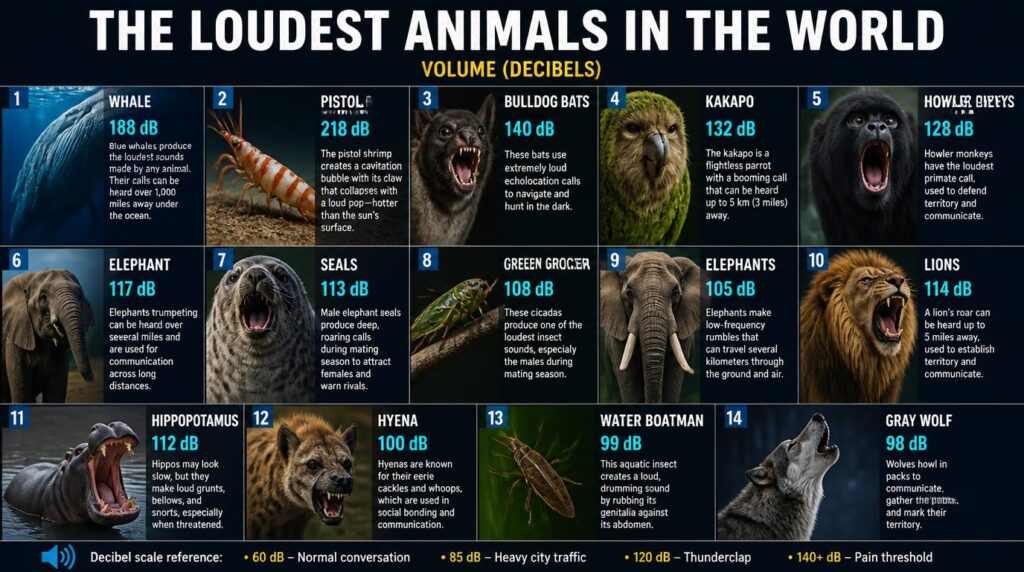
Here are 13 animals known for their remarkably loud vocalizations or sound-producing abilities. The decibel figures below are those reported in the source article; they should be treated as approximate, since sound measurements can vary depending on how and where they are recorded.
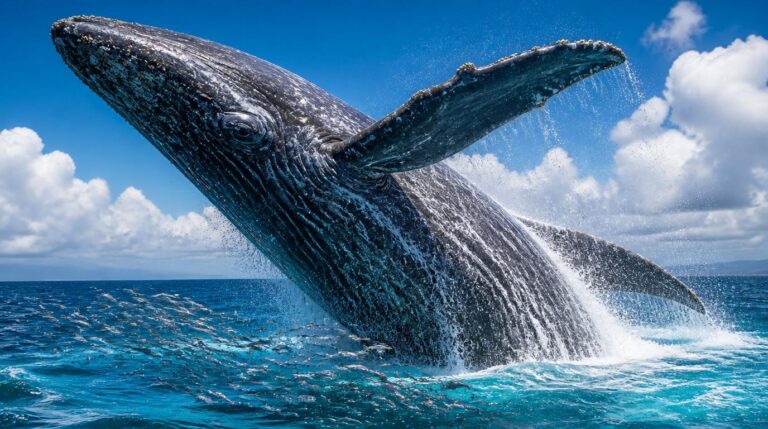
1. Whale
Reported sound level: 188–230 dB
Two whale species are especially notable for their powerful sounds: the blue whale and the sperm whale. Blue whales are the largest animals on Earth, and their calls can reach reported levels of around 188 decibels. Sperm whales produce a series of sharp clicks that have been reported at up to 230 decibels.
These clicks are used in echolocation and communication. The source article notes that sperm whale sounds may be heard by other whales from as far as 10 miles away. Based on the figures cited here, the sperm whale is presented as the loudest animal in the world.
2. Pistol Shrimp (Alpheus bellulus)
Reported sound level: 200 dB
Pistol shrimp are small marine animals with an unusually powerful way of producing sound. They use a specialized claw to fire a fast jet of water, creating a cavitation bubble. When the bubble collapses, it generates a loud snap and a powerful pressure wave.
The source article reports that the shock wave can kill fish within a radius of about two metres and that the sound can reach 200 decibels—louder than a gunshot. The bubble’s collapse can also produce a brief flash of light, making this tiny crustacean’s snap an impressive physical phenomenon.
You may also like: 5 Fascinating Animals With More Than One Heart
3. Bulldog Bats
Reported sound level: 140 dB
Bulldog bats are known for using echolocation to navigate and find prey. Some species can detect fish moving near the water’s surface, making them skilled hunters in aquatic environments.
Their echolocation calls are described in the source article as reaching 140 decibels. These calls are ultrasonic, meaning they are produced at frequencies above the range of normal human hearing. The article gives a frequency range of 20 to 200 kilohertz, far beyond what people can typically hear.
4. Kakapo
Reported sound level: 132 dB
The kakapo is a large, flightless parrot native to New Zealand. It is known for its unusual appearance and distinctive breeding calls. During courtship, males produce deep booming sounds that can carry over long distances.
The source article reports that kakapo calls can reach 132 decibels and travel as far as four miles. These loud calls help males attract potential mates across the bird’s habitat.
5. Howler Monkeys
Reported sound level: 128 dB
Howler monkeys are named for the loud calls they use to communicate. They live in groups and produce powerful howls that can travel through dense forest over considerable distances.
Their calls help members of a group communicate and can also signal the presence or location of other groups. The source article reports a sound level of up to 128 decibels and says their howls may be heard from as far as three miles away.
6. Elephant Seals
Reported sound level: 125 dB
Male elephant seals produce loud calls during the breeding season. Their vocalizations play a role in interactions with other males and can help establish dominance in crowded breeding areas.
The source article describes these sounds as a way to attract females and discourage rival males from competing. The reported volume is around 125 decibels, though the precise meaning of that figure depends on the measurement conditions.
7. Green Grocer Cicada (Cyclochila australasiae)
Reported sound level: 120 dB
The green grocer cicada is an Australian insect known for its loud, buzzing call. Like other cicadas, it produces sound using specialized structures on its body, rather than by vocalizing in the way mammals and birds do.
Males call to attract females, and groups of cicadas may sing at the same time. The source article reports that their calls can reach 120 decibels and suggests that calling in groups may make it harder for predators to locate an individual insect.
8. Elephants
Reported sound level: 117 dB
Elephants produce a variety of sounds, including deep rumbles and loud trumpeting calls. A trumpet is made by forcing air through the trunk and is often associated with moments of excitement, alarm, or agitation.
According to the source article, an elephant’s trumpet can reach 117 decibels and may be heard from as far as 10 miles away. Elephants also use quieter sounds to communicate over long distances, including low-frequency calls that can travel through the environment.
9. Lions
Reported sound level: 110–114 dB
A lion’s roar is one of the most recognizable sounds of the African savanna. Lions use roaring to communicate with members of their pride, signal their presence, and help maintain contact across their territory.
The source article reports that a lion’s roar can reach 110–114 decibels and may be heard from up to five miles away. Roaring can also serve as a warning to rival males and other animals. Lion prides occupy large territories, so long-distance calls can be an important part of their social communication.
10. Hippopotamus
Reported sound level: 114 dB
Hippopotamuses make a range of vocalizations, including grunts, bellows, and loud honking calls. These sounds help them communicate with one another, particularly when they are gathered in or near water.
The source article gives a reported sound level of up to 114 decibels for the hippo’s loud grunting calls. Such vocalizations can also function as warnings during tense encounters or territorial disputes.
11. Hyena
Reported sound level: 112 dB
Hyenas are known for their distinctive vocal repertoire, which includes whoops, growls, and the familiar “laughing” sound. These calls are used in social interactions and can communicate information about an animal’s condition or situation.
Despite the name, hyena laughter does not necessarily mean an animal is amused. The source article notes that hyenas may produce laughing sounds when threatened. It reports that their calls can reach 112 decibels.
12. Water Boatman (Micronecta scholtzi)
Reported sound level: 105 dB
Micronecta scholtzi is a tiny aquatic insect, yet it is capable of producing a surprisingly loud sound relative to its body size. Males make their calls by rubbing a body part against a surface on their body, a process known as stridulation.
The source article reports a sound level of 105 decibels, despite the insect measuring only about 0.07 inches long. Its call is unusual not only for its volume, but also for the contrast between the sound it produces and its very small size.
13. Gray Wolf
Reported sound level: 90–115 dB
Gray wolves are famous for their howls, which help pack members communicate across large areas. A wolf may howl to make contact with other members of its pack, gather the group, or signal its presence to neighboring wolves.
The source article reports a range of 90–115 decibels. Wolves may occupy territories spanning many miles, and their howls can carry through the landscape, helping individuals communicate without needing to meet face to face.
Editorial fact-check note: The decibel figures in the source are not necessarily comparable as a single ranking. Underwater and airborne sound levels use different reference pressures, and readings also depend on distance and measurement method. In particular, the extremely high figures cited for whales and pistol shrimp should be checked against their original measurement sources before publication. The source’s description of the pistol shrimp’s shock wave and its claim about the loudest animal should also be independently verified.