Springtails: The Tiny Six-Legged Creatures You Probably Don’t Know
If you have ever noticed tiny insects jumping around in damp soil, flowerpots, compost, or even on the surface of a pool, you may have encountered springtails.
Despite their insect-like appearance, springtails are not actually insects. They belong to a separate group of tiny arthropods called Collembola and are among the most abundant small animals found in soil and leaf litter.
They are usually harmless to people and pets, but their unusual anatomy and ability to survive in surprisingly difficult conditions make them worth a closer look.
What Are Springtails?
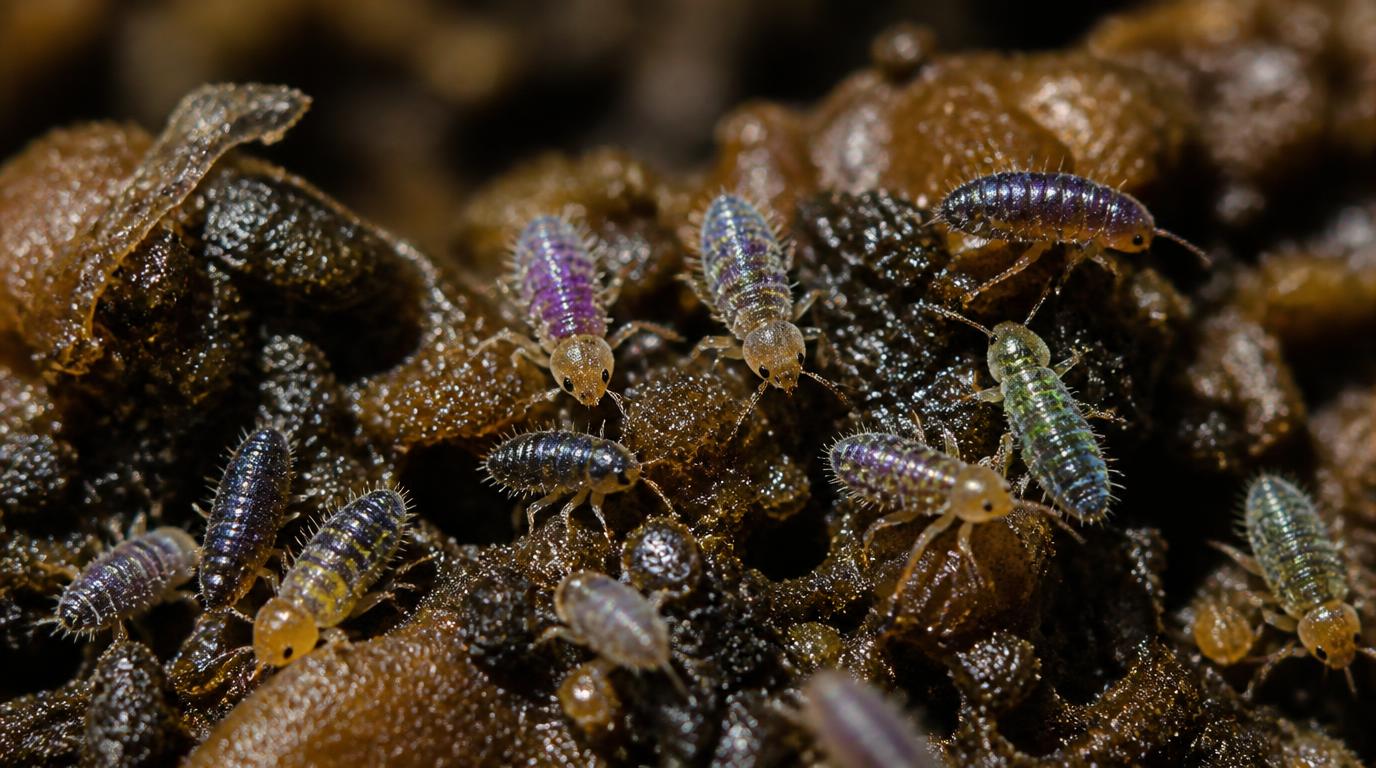
Springtails are extremely small, wingless arthropods that are commonly found in soil, leaf litter, moss, rotting wood, and other moist environments.
Most species are only a few millimeters long, although their exact size and appearance vary considerably. Their bodies may be black, gray, brown, white, or surprisingly colorful depending on the species.
The feature that gives many springtails their common name is a specialized structure called a furcula. This forked appendage is normally folded underneath the abdomen. When the animal feels threatened, it can release the furcula against the ground and launch itself through the air.
The jump can happen so quickly that the tiny animal appears to disappear instantly.
Springtails do not have wings and cannot fly. Instead, they rely on this remarkable spring-like mechanism to escape danger.
How Do Springtails Survive?
Springtails are particularly successful in moist environments. Their tiny bodies are vulnerable to dehydration, so humidity plays an important role in where they live.
They can be found throughout the year when conditions are suitable, and some species are surprisingly tolerant of cold temperatures. In fact, springtails can sometimes be seen moving across snow, which has earned certain species the nickname “snow fleas.”
Despite the name, snow fleas are not fleas and do not belong to the flea family.
One fascinating adaptation found in some springtails is their ability to alter their physiology in response to environmental conditions. Certain species can reduce their body size and metabolic activity, helping them cope with periods of environmental stress.
Some species also produce specialized proteins and other compounds that help protect their cells from freezing temperatures.
What Do Springtails Eat?
Springtails have remarkably diverse diets.
Depending on the species, they may feed on:
- fungi and fungal hyphae;
- algae;
- bacteria;
- decaying plant material;
- pollen;
- spores;
- organic debris;
- microscopic organisms.
Some species are predators and hunt tiny invertebrates such as nematodes and rotifers. Others may even prey on smaller springtails.
Many springtails, however, are decomposers. By feeding on organic material and microorganisms in soil, they contribute to the breakdown of dead plant matter and the recycling of nutrients.
This makes them an important part of soil ecosystems.
Where Do Springtails Live?
Springtails can be found on almost every continent and in an enormous variety of habitats.
They are particularly common wherever moisture and organic material are available.
Typical habitats include:
- forest soil;
- gardens;
- compost;
- moss;
- rotting logs;
- leaf litter;
- grass;
- decaying vegetation;
- animal nests;
- soil around plants.
Some species can also live in unusual environments, including caves, wetlands, coastal habitats, and even areas associated with ant and termite colonies.
When outdoor conditions become too dry, springtails may search for more humid places. This is one reason they occasionally appear around buildings.
They can be found in damp basements, bathrooms, greenhouses, houseplants, and areas around swimming pools.
Why Are Springtails Sometimes Found in Homes?
Finding a few springtails indoors is usually not a sign of a serious pest infestation.
These tiny animals are attracted primarily to moisture rather than to human homes themselves. They may enter through doors, windows, ventilation openings, cracks, or plants brought indoors.
Large numbers of springtails often indicate that an area is unusually damp.
For example, they may become noticeable around:
- leaking pipes;
- overwatered houseplants;
- damp soil;
- poorly ventilated rooms;
- humid basements;
- areas around pools.
Unlike mosquitoes, fleas, or ticks, springtails do not feed on humans. They do not bite people and are generally harmless to pets.
If they suddenly appear in large numbers indoors, reducing excess moisture is usually more useful than trying to eliminate the animals individually.
Are Springtails Harmful to Plants?
The answer is more complicated than simply calling them pests.
Most springtails are beneficial members of soil ecosystems and help break down organic material. Some also interact with fungi and microorganisms associated with plant roots.
However, a small number of species can damage certain crops or seedlings, particularly when populations become large or food is scarce.
At the same time, springtails may contribute to plant health by feeding on fungal spores and microorganisms, including some organisms associated with plant disease.
Their role therefore depends on the species and the ecosystem in which it lives.
Why Are Springtails Important?
Despite their tiny size, springtails play a surprisingly important role in the environment.
They help decompose organic matter and influence the movement of nutrients through soil. By feeding on fungi, bacteria, algae, and decaying plant material, they participate in the complex food web beneath our feet.
They are also an important food source for many predators, including spiders, mites, beetles, and other small animals.
In other words, these nearly invisible creatures are part of the machinery that keeps soil ecosystems functioning.
Final Thoughts
Springtails may be tiny, but they are far more interesting than their size suggests.
They can launch themselves through the air without wings, survive cold environments, live in enormous numbers in healthy soil, and contribute to decomposition and nutrient cycling.
And if you discover a group of them inside your home, there is usually no reason to panic. They are more likely telling you something about the moisture level of the environment than trying to invade your house.
The next time you see tiny creatures jumping across damp soil or water, take a closer look. You may be looking at one of the planet’s most successful—and most overlooked—little arthropods.