10 of the Most Venomous Snakes in Africa
Africa is home to an extraordinary variety of snakes, including some of the most medically significant venomous species on Earth. From fast-moving mambas and cobras to perfectly camouflaged vipers, these reptiles have evolved an impressive range of hunting and defensive strategies.
Some African snakes rely on powerful neurotoxic venom, while others use toxins that affect blood clotting, muscles, or tissue. Some species are highly defensive when threatened, whereas others would rather escape than confront a person.
Despite their reputation, encounters between people and many of these snakes are relatively uncommon. Most snakes prefer to avoid humans whenever possible.
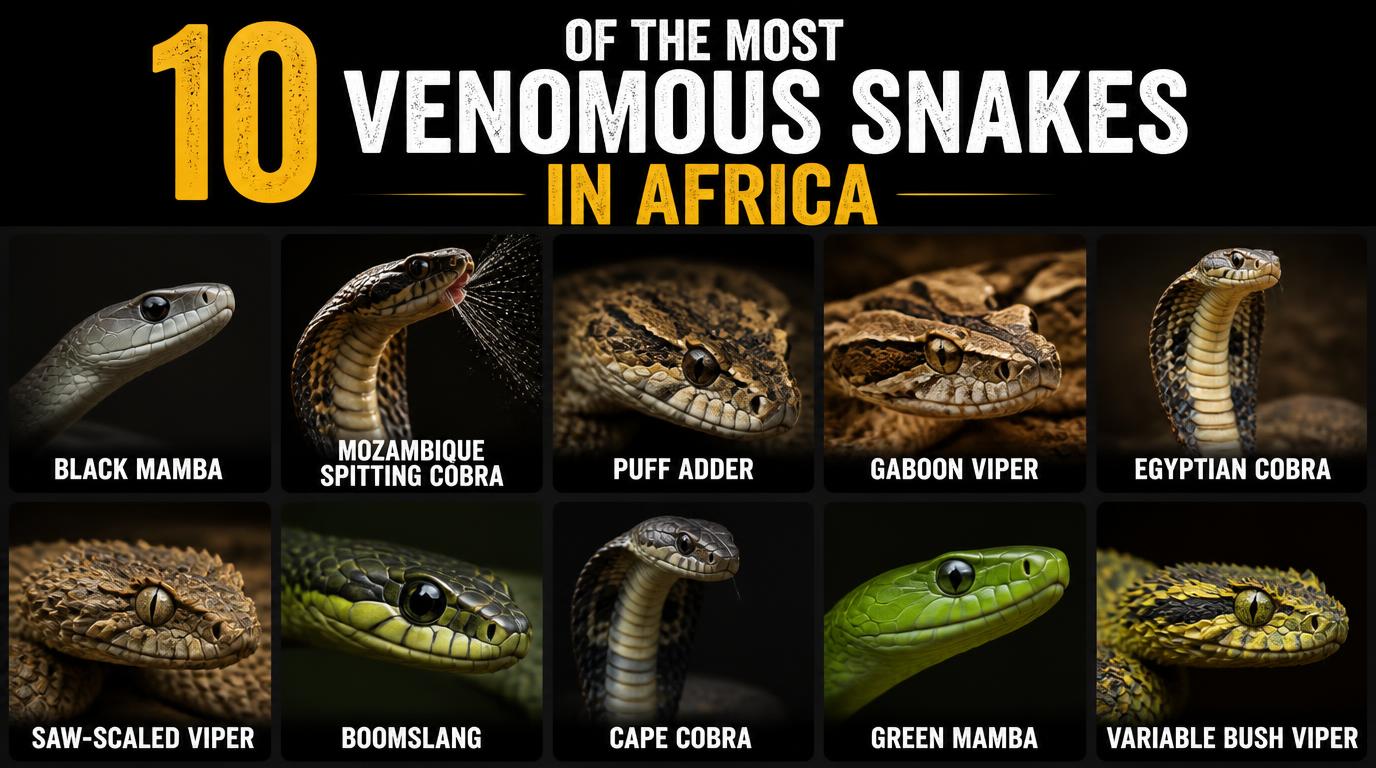
Here are 10 fascinating and potentially dangerous venomous snakes found across Africa.
1. Black Mamba
The black mamba (Dendroaspis polylepis) is one of Africa’s most famous venomous snakes and one of the largest mamba species.
Despite its name, the snake is not usually black. Its body can range from gray and olive to brownish shades. The name comes from the dark, almost black coloration inside its mouth, which it may display when threatened.
Black mambas are long, slender, and exceptionally fast. They are primarily terrestrial but are also capable climbers. Their venom contains powerful neurotoxins that can interfere with the nervous system and, without appropriate medical treatment, a bite can become life-threatening.
Their diet consists mainly of small vertebrates, including rodents, birds, and other small animals.
Despite their frightening reputation, black mambas do not normally seek out humans. Like most snakes, they generally prefer to escape when given the opportunity.
2. Mozambique Spitting Cobra
The Mozambique spitting cobra (Naja mossambica) is a highly adaptable snake found across parts of eastern and southern Africa.
What makes this cobra particularly remarkable is its ability to project venom toward a perceived threat. It can accurately spray venom toward the face and eyes of an attacker from a considerable distance.
Venom entering the eyes can cause severe irritation and potentially serious damage if it is not treated promptly.
The species can also deliver a conventional bite and may raise the front portion of its body when threatened, displaying the characteristic defensive posture associated with cobras.
Its diet includes rodents, frogs, birds, lizards, and other small animals.
You may also like: Natural Snake Repellents: Plants That Keep Snakes Away and Beautify Your Space
3. Puff Adder
The puff adder (Bitis arietans) is one of Africa’s most widespread vipers.
Unlike fast-moving snakes that rely on escape, puff adders are masters of camouflage. Their patterned bodies blend remarkably well with leaves, soil, and dry vegetation, allowing them to remain motionless while waiting for prey.
This strategy can unfortunately bring them into close contact with people, particularly when someone accidentally steps near one.
When threatened, a puff adder may inflate its body and produce a loud hissing sound. If the warning is ignored, it can deliver a powerful strike.
Its venom can cause extensive tissue damage and other serious systemic effects, making bites a medical emergency.
4. Gaboon Viper
The Gaboon viper (Bitis gabonica) is one of Africa’s most impressive vipers.
It has an exceptionally broad head, a heavy body, and an intricate pattern that allows it to disappear among fallen leaves and forest debris.
Gaboon vipers are ambush predators. Rather than actively chasing prey, they often remain motionless until an animal comes within striking range.
Their diet includes rodents, birds, and other small to medium-sized animals.
One of their most remarkable features is their enormous hinged fangs. Gaboon vipers have among the longest fangs of any venomous snake, allowing them to deliver venom deep into their prey.
Although they are generally not aggressive toward humans, their camouflage means that accidentally approaching one can be dangerous.
5. Egyptian Cobra
The Egyptian cobra (Naja haje) is one of the most widely distributed cobra species in Africa.
It occurs across large parts of northern Africa and can also be found in some areas farther south. Depending on the population, its coloration can range from brown and olive to darker shades.
Egyptian cobras are adaptable snakes that can live in relatively dry environments as well as areas associated with water.
Their venom primarily affects the nervous system and can interfere with breathing if a serious envenomation is left untreated.
The species feeds on a wide range of prey, including rodents, birds, frogs, lizards, and other animals.
The Egyptian cobra has also been associated with the ancient Egyptian cultural tradition of the uraeus, although popular stories connecting the species directly to Cleopatra’s death remain uncertain.
6. Saw-Scaled Viper
The saw-scaled viper (Echis carinatus) is a relatively small snake with a reputation that far exceeds its size.
It occurs across parts of North Africa and the Middle East, with several closely related Echis species found elsewhere in Africa.
When threatened, the snake can produce a distinctive rasping sound by rubbing specialized scales against one another. This behavior gives saw-scaled vipers their common name.
They are generally nocturnal and may become particularly active during cooler periods.
Their venom can interfere with blood clotting and cause serious medical complications. Because these snakes can occur in areas where people live and work, bites can happen when the animal is accidentally disturbed.
7. Boomslang
The boomslang (Dispholidus typus) is a slender tree-dwelling snake native to sub-Saharan Africa.
Its name comes from Afrikaans and essentially means “tree snake.”
Boomslangs are highly adapted to life in vegetation. Their large eyes provide excellent vision, while their body shape helps them move through branches.
The species is generally shy and prefers to escape rather than confront humans.
Its venom is hemotoxic, meaning it can interfere with blood clotting and potentially cause severe internal bleeding. Serious bites are uncommon, partly because boomslangs are not typically aggressive toward people, but their venom can be extremely dangerous.
Interestingly, males and females can look dramatically different. Males are often green with darker markings, while females are commonly brown or olive.
8. Cape Cobra
The Cape cobra (Naja nivea) is a highly venomous cobra found primarily in southern Africa.
Its coloration is surprisingly variable. Individuals may be yellow, brown, copper, reddish, or nearly black, depending on the region.
Cape cobras are active during the day and are highly capable hunters. Their diet can include rodents, birds, lizards, frogs, and even other snakes.
Like other cobras, the Cape cobra can raise the front part of its body and spread a hood when threatened.
Its venom contains powerful neurotoxins that can disrupt communication between nerves and muscles. Severe envenomation can therefore lead to respiratory failure without rapid medical treatment.
9. Green Mamba
The term green mamba refers to several closely related mamba species, including the eastern green mamba and western green mamba.
Unlike the predominantly terrestrial black mamba, green mambas are strongly associated with trees and dense vegetation.
Their bright green coloration provides excellent camouflage among leaves and branches.
Green mambas are generally more elusive than black mambas and often attempt to escape when disturbed.
Their venom contains neurotoxic components capable of affecting the nervous system. A bite requires urgent medical attention.
Their slender bodies and long tails make them exceptionally well adapted to moving through the canopy.
10. Variable Bush Viper
The variable bush viper (Atheris squamigera) is one of Africa’s most visually striking venomous snakes.
Also known as the green bush viper or rough-scaled bush viper, it inhabits forest environments across parts of central and eastern Africa.
Its coloration can vary dramatically. Individuals may be green, yellowish, brown, orange, or reddish, sometimes with contrasting patterns.
The snake spends much of its life in vegetation and has a prehensile tail that helps it grip branches.
Bush vipers are ambush predators, feeding on small vertebrates such as frogs, lizards, and rodents.
They are generally secretive and avoid confrontation, but their venom makes accidental encounters potentially dangerous.
Why Are African Venomous Snakes So Diverse?
Africa’s enormous range of habitats has provided snakes with countless opportunities to evolve different survival strategies.
Some species specialize in forests, while others thrive in savannas, wetlands, deserts, or grasslands. Their hunting techniques vary just as much.
A black mamba relies on speed and highly potent neurotoxic venom. A Gaboon viper depends on extraordinary camouflage and ambush tactics. A boomslang spends much of its life in trees, while a puff adder can remain almost invisible on the ground.
These differences show that there is no single formula for survival.
What Should You Do If You Encounter a Venomous Snake?
The safest approach is simple: keep your distance and do not attempt to handle the snake.
Do not try to kill it, catch it, or move it. Many bites occur when people attempt to interact with or remove a snake.
If a bite does occur, seek emergency medical care immediately. Do not rely on cutting the wound, sucking out venom, applying a tourniquet, or other traditional remedies.
The correct treatment depends on the species and the type of envenomation, and antivenom may be required.
Final Thoughts
Africa’s venomous snakes are often portrayed as monsters, but they are highly specialized predators that play important roles in their ecosystems.
Rodents, birds, frogs, lizards, and other small animals form part of their diets, while the snakes themselves are part of larger food webs.
Their venom is primarily a tool for hunting and defense—not a weapon designed to attack humans.
From the spectacular Gaboon viper to the elusive green mamba, these snakes demonstrate just how diverse and sophisticated African wildlife can be.