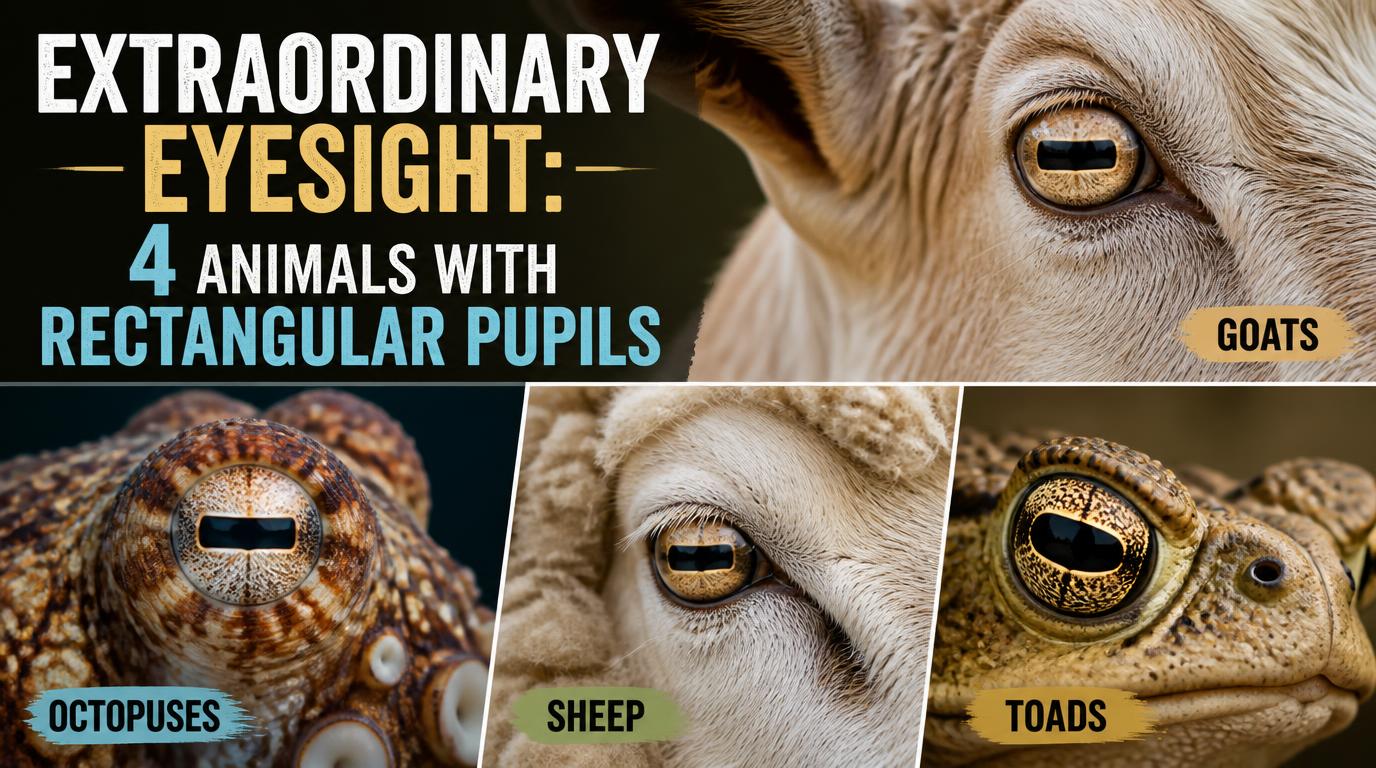
Extraordinary Eyesight: 4 Animals With Rectangular Pupils
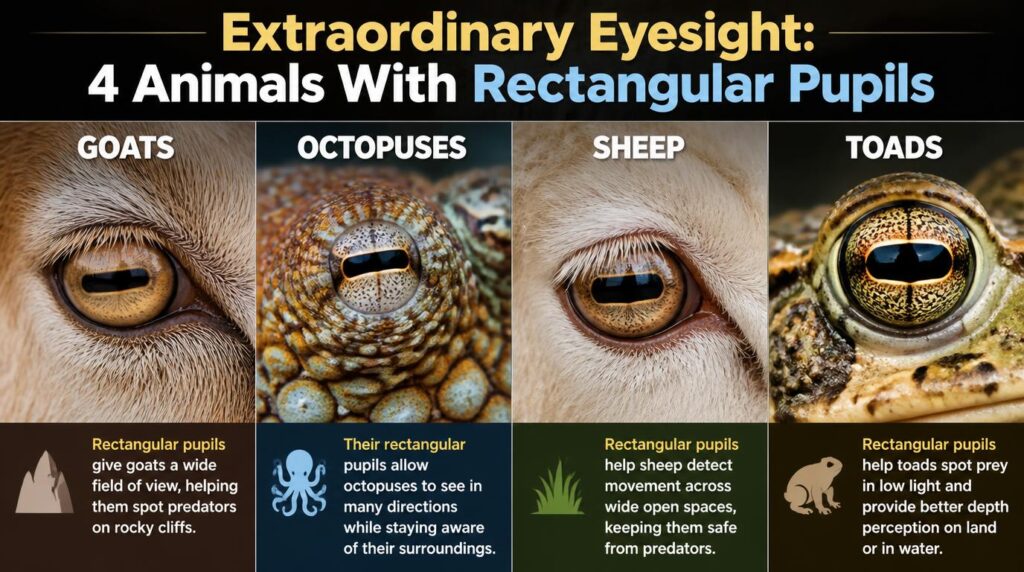
Have you ever noticed that some animals have unusual, rectangular-shaped pupils instead of the round pupils humans typically have? This distinctive eye structure is more than a curious feature. In many grazing animals, horizontally elongated pupils help provide a wide field of view, allowing them to monitor their surroundings while feeding.
From goats and sheep to octopuses and toads, different animals have evolved remarkable eye structures suited to their lifestyles. Although their pupils may look similar, the way they see the world can be very different.
Here are four fascinating animals with unusual pupil shapes and the visual abilities associated with them.
1. Goats
Goats have distinctive horizontal, rectangular pupils that help them monitor a broad area around their bodies. As grazing animals, they benefit from being able to search for food while remaining alert to potential predators.
Their unusual pupils contribute to a wide field of view, which can approach 320 degrees under suitable viewing conditions. This allows goats to detect movement over a large area without constantly turning their heads.
Their pupils also help regulate how much light enters the eyes. Combined with other features of their visual system, this supports vision across changing light conditions, from bright daylight to dimmer environments.
Another interesting feature is that a goat’s eyes can rotate as its head changes position, helping keep the pupils aligned with the ground while it grazes. This allows the animal to maintain a useful view of its surroundings even when its head is lowered.
Goats can distinguish some colors, although their color vision differs from human vision. Their wide field of view and sensitivity to movement are particularly valuable for animals that need to remain alert while feeding.
You may also like: 10 Unusual Animals of Africa
2. Octopuses
Octopuses have some of the most unusual eyes in the animal kingdom. Depending on the species, their pupils may appear rectangular, slit-shaped, or otherwise elongated, giving their eyes a distinctive appearance.
Unlike goats and sheep, octopuses are marine invertebrates with a very different visual system. Their eyes are well adapted to detecting movement, locating prey, and navigating underwater environments.
Octopuses are often described as color-blind because they generally possess only one type of visual pigment in their eyes. However, their visual abilities are more complex than a simple comparison with human color vision suggests. Some cephalopods can detect polarized light, which may help them identify contrast and visual patterns underwater.
Their eyes also focus differently from human eyes. Rather than changing the shape of the lens as people do, octopuses focus by moving the lens relative to the retina.
Vision is important for finding food, avoiding predators, and interacting with their surroundings. Combined with their flexible bodies, camouflage abilities, and intelligence, their eyes help them survive in a wide range of marine habitats.
3. Sheep
Sheep have horizontally elongated pupils that provide a broad view of their surroundings. As prey animals, they benefit from detecting movement across a large area while grazing.
Their field of view can reach approximately 270–320 degrees, although the exact range depends on the position of their eyes and other factors. This wide perspective helps them notice potential threats approaching from the side without needing to turn their heads constantly.
The shape of their pupils also helps control incoming light. Their visual system is adapted to outdoor environments, where they must move between shaded areas and bright open ground.
Sheep have color vision, but it differs from ours. They can distinguish some colors, while their ability to separate red and green is limited compared with human vision.
Their broad field of view is especially useful when sheep graze in groups. By remaining alert to movement around them, they can react to possible danger and respond to the behavior of other flock members.
4. Toads
Toads have a variety of pupil shapes, depending on the species. Some have horizontal pupils, while others have pupils that appear more rounded or vertically elongated. Their eye structure reflects differences in habitat, activity patterns, and evolutionary history.
For species with horizontal pupils, the shape can help provide a broad view of the environment. This is useful for detecting movement while remaining relatively still, whether the toad is searching for prey or watching for predators.
Toads rely heavily on visual cues when detecting moving insects and other small prey. Their eyes also help them recognize movement that may indicate a threat, although their visual capabilities vary among species.
Unlike grazing mammals, toads do not share the same combination of eye position and pupil structure as goats and sheep. Therefore, it would be inaccurate to assume that all toads have nearly 360-degree vision or that their pupils serve exactly the same purpose.
Their unusual eyes nevertheless demonstrate how different animals can evolve distinctive visual adaptations to suit their ecological needs.