
Maleo: The Prehistoric-Looking Bird of Indonesia
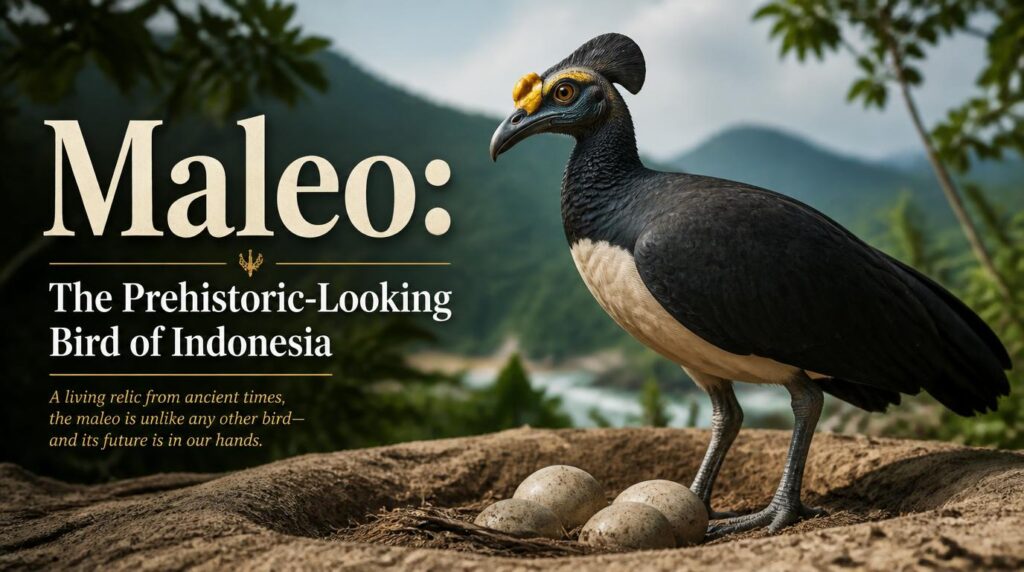
The maleo is one of the most unusual birds in the world. With its dark plumage, bare yellow facial skin, and distinctive helmet-like crown, this rare bird looks as though it belongs to another era. Yet its most remarkable feature is not its appearance, but its extraordinary approach to reproduction.
Native to the Indonesian island of Sulawesi and nearby Buton, the maleo is a member of the megapode family. Instead of incubating its eggs with body heat, it relies on warm sand, sunlight, or geothermal energy. This unusual strategy makes the maleo one of the most fascinating birds in the tropical forests of Southeast Asia.
Appearance
The maleo (Macrocephalon maleo) typically measures around 55–60 centimeters in length. Its dark plumage contrasts with the pale pinkish coloring of its lower body and the bright yellow skin around its face.
The bird has reddish-brown eyes, a reddish-orange bill, and a prominent dark, helmet-like crest on top of its head. Its bluish-gray feet have four long toes equipped with strong claws.
Maleos have powerful legs that help them move through forest undergrowth and dig nesting holes. These adaptations are especially useful during breeding season, when the birds need to prepare suitable places for their unusually large eggs.
Unlike many birds, maleos do not depend on conventional nests made from twigs and leaves. Instead, they use their legs to dig deep holes in suitable nesting grounds, where environmental heat can incubate their eggs.
Behavior
One of the maleo’s most remarkable characteristics is its unusual breeding strategy. Rather than sitting on its eggs to keep them warm, the bird buries them in naturally heated sand or soil. Depending on the nesting site, the heat may come from sunlight or geothermal activity.
Maleo eggs are exceptionally large relative to the size of the adult bird. The female lays an egg in a deep hole, which is then covered with sand or soil. The surrounding environment provides the warmth needed for incubation.
After hatching, the chick must dig its way to the surface without parental assistance. Maleo chicks are highly developed at birth and can fly soon after emerging. They must immediately begin finding food and avoiding predators on their own.
The parents do not provide the prolonged care typical of many other bird species. This makes the maleo’s reproductive strategy particularly unusual: the chick emerges already equipped with many of the abilities it needs to survive independently.
Potential predators include monitor lizards, snakes, feral pigs, and other animals that may threaten eggs or young birds. Protecting nesting sites is therefore essential to the species’ survival.
You may also like: The 10 Most Beautiful Songbirds in the World
Diet and Habitat
Maleos are omnivorous, feeding on a variety of foods available in their forest habitats. Their diet includes fruits, seeds, ants, beetles, termites, and other small invertebrates. They forage on the forest floor, using their strong feet to move through leaf litter and search for food.
The species is endemic to Sulawesi and the nearby island of Buton in Indonesia. It inhabits tropical lowland and hill forests, but its breeding grounds are often located in separate areas where suitable sources of natural heat are available.
These nesting sites may include sunny beaches, open sandy clearings, and areas of volcanic or geothermal activity. Maleos can travel between forest feeding areas and communal nesting grounds, making the protection of both habitats important.
Their dependence on specific nesting locations makes them particularly vulnerable to environmental changes. Even when suitable forest remains, the loss or disturbance of traditional egg-laying sites can threaten successful reproduction.
Threats
The maleo faces serious threats from habitat destruction and the collection of its eggs by people. Because the eggs are large and laid in accessible communal nesting grounds, they can be especially vulnerable to harvesting.
Agricultural expansion, forest fragmentation, and other forms of land development reduce the bird’s habitat and can isolate populations. Forest fires may also damage the ecosystems on which maleos depend.
Although the species receives legal protection in Indonesia, enforcement and habitat conservation remain important challenges. Protecting nesting grounds is particularly critical because the maleo’s unusual reproductive cycle depends on specific environmental conditions.
The maleo is classified as Endangered on the IUCN Red List. Continued conservation efforts are essential to preserve its remaining populations and the unique habitats that allow this extraordinary bird to survive.