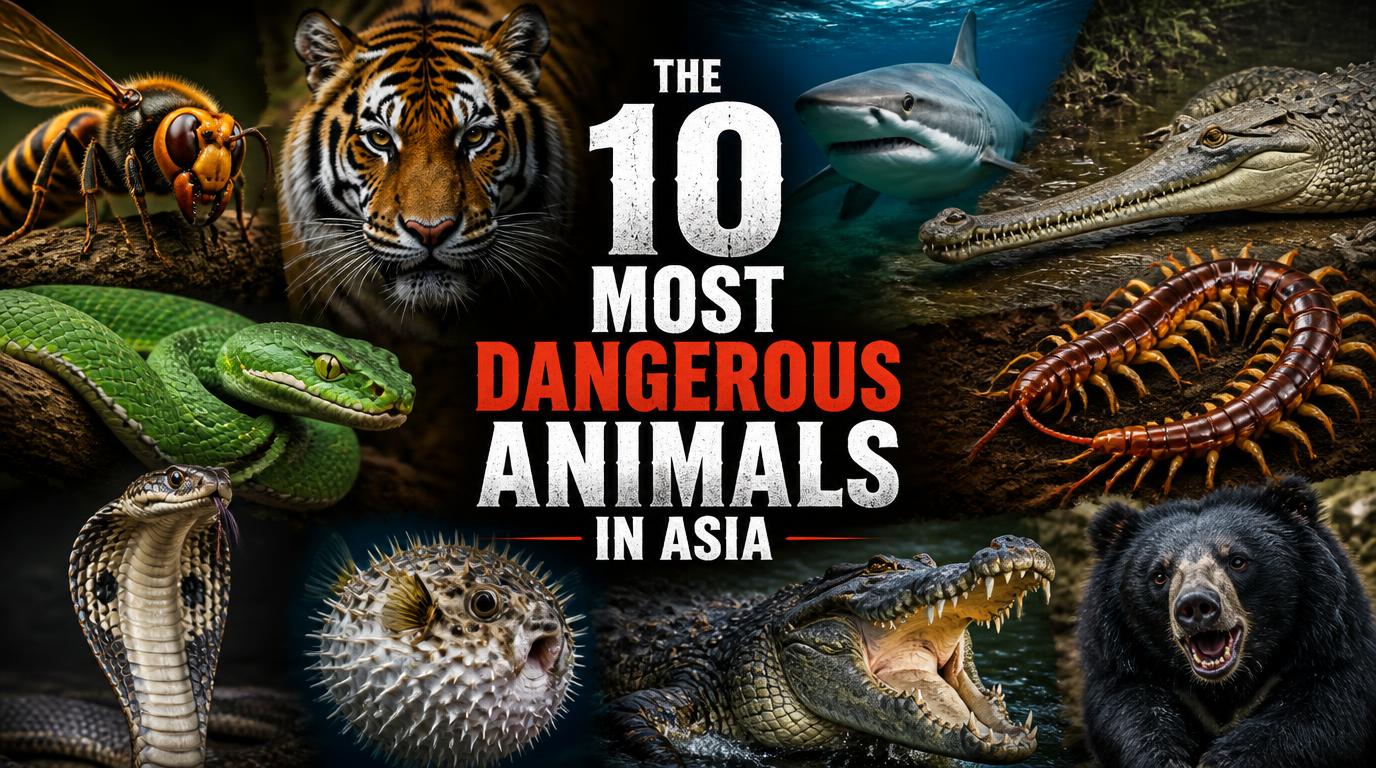
10 of the Most Dangerous Animals in Asia
Asia is home to an extraordinary range of wildlife, including some of the most dangerous animals on the planet. From dense tropical forests to rivers, coastlines, and remote wilderness areas, these creatures can pose serious risks to humans. Some rely on powerful venom, others have formidable teeth and claws, and a few are dangerous because of their size and defensive behavior.
Here are 10 remarkable animals found in Asia that deserve caution and respect.
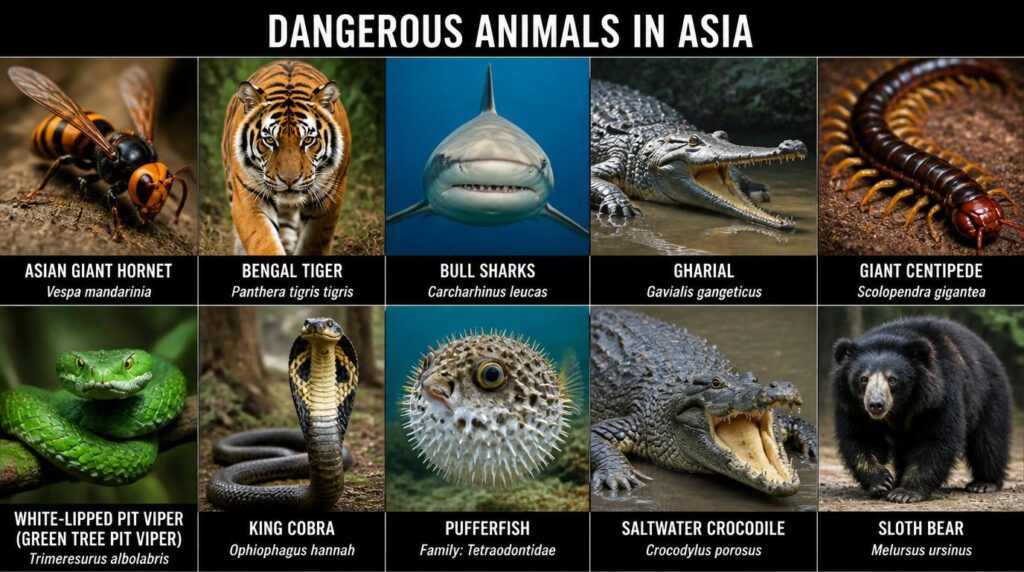
1. Asian Giant Hornet
The Asian giant hornet is the largest hornet species in the world. It occurs in parts of East Asia, particularly in forested and mountainous regions of Japan and other countries. Despite its impressive size, the hornet is not usually interested in people unless it feels threatened or its nest is disturbed.
Unlike honeybees, Asian giant hornets can sting repeatedly. Multiple stings can cause severe tissue damage and, in serious cases, kidney injury or organ failure. Fatal reactions may result from anaphylaxis, while a large amount of venom can also cause systemic complications. The risk is especially serious when someone receives numerous stings.
The safest approach is to keep your distance from hornets and their nests. If you encounter a nest, do not attempt to disturb or remove it yourself.
2. Bengal Tiger
The Bengal tiger is one of Asia’s most powerful predators. Recognizable by its orange coat, dark stripes, and muscular build, this large cat inhabits forests, grasslands, and mangrove ecosystems across the Indian subcontinent.
Bengal tigers are solitary animals that establish territories and use scent markings to communicate with other tigers. Their striped coats provide effective camouflage, allowing them to approach prey with remarkable stealth before launching a sudden attack.
Although tigers generally avoid humans when possible, encounters can be dangerous. Their strength, sharp claws, and powerful jaws make them formidable predators. Attacks on people are uncommon in many areas but can occur, particularly where human settlements overlap with tiger habitat.
You may also like: Dangerous Animals in North America: 7 Species You Should Know
3. Bull Sharks
Bull sharks are among the best-known shark species because they can tolerate both saltwater and freshwater. They inhabit warm coastal waters and may travel far upstream into rivers, making them unusual among large sharks.
These powerful predators feed on a varied diet that includes fish, rays, and other aquatic animals. Their robust bodies and strong jaws help them capture and subdue prey. Bull sharks are also one of the three shark species most frequently associated with serious, unprovoked attacks on humans, alongside great white and tiger sharks.
However, shark attacks remain rare relative to the number of people who enter the water. Caution is particularly important in murky water, near river mouths, and in areas known to support large sharks.
4. Gharial
The gharial is a distinctive crocodilian recognized by its exceptionally long, narrow snout lined with numerous sharp teeth. It lives primarily in freshwater river systems of the Indian subcontinent and is highly adapted to catching fish.
Unlike many other crocodilians, gharials have slender jaws that are poorly suited to capturing large terrestrial animals. As a result, they are generally considered much less dangerous to humans than larger, broad-snouted crocodiles.
Nevertheless, gharials are wild reptiles and should not be approached. A nesting female may defend her nest, and their powerful jaws can cause injury. Gharials are also threatened by habitat degradation, declining fish populations, and changes to river systems.
5. Giant Centipede
Giant centipedes are large, fast-moving predatory arthropods found in tropical and subtropical regions, including parts of Asia. Their elongated bodies consist of many segments, each bearing a pair of legs. The first pair has evolved into venom-delivering appendages used to subdue prey.
These centipedes feed on insects and other small animals, but some species can also attack larger prey, including small reptiles. Their venomous bites can cause intense pain, swelling, redness, and discomfort that may last for several days.
Severe complications are uncommon, and fatal human cases are exceptionally rare. Even so, a giant centipede should never be handled casually. If one is found indoors, keeping a safe distance is preferable to attempting to catch it by hand.
6. White-Lipped Pit Viper (Green Tree Pit Viper)
The white-lipped pit viper is a venomous snake found in parts of South and Southeast Asia. Its green coloration helps it blend into foliage, where it may rest on branches and ambush passing prey. Depending on the species and population, similar green pit vipers occur across a broad region extending from parts of the Himalayas into Southeast Asia.
These snakes feed on small vertebrates, including frogs, birds, and small mammals. Heat-sensitive pits between the eyes and nostrils help them detect warm-blooded prey in low-light conditions.
A bite can cause pain, swelling, bruising, and bleeding complications. The severity varies depending on the snake, the amount of venom injected, and the circumstances of the bite. A bite from any venomous snake requires urgent medical assessment. Never try to handle a green snake simply because it appears calm or motionless.
7. King Cobra
The king cobra is the world’s longest venomous snake, capable of reaching lengths of more than five meters. It inhabits forests and other natural environments across South and Southeast Asia.
When threatened, a king cobra can raise the front portion of its body, spread its hood, and produce a loud hiss. This defensive display makes the snake appear even larger and serves as a warning to potential threats.
King cobras primarily prey on other snakes, including venomous species. Their venom contains neurotoxins that interfere with the nervous system and can cause respiratory failure in severe cases. A single bite can deliver a substantial quantity of venom, making an encounter potentially life-threatening.
Despite their fearsome reputation, king cobras do not normally seek out people. Maintaining distance and leaving the snake an escape route is the safest response.
8. Pufferfish
Pufferfish are famous for their ability to inflate their bodies when threatened. By swallowing water, or sometimes air, they expand into a much larger shape that can be harder for predators to swallow. Some species also have spines that become more prominent when the fish inflates.
Their most serious defense, however, is chemical rather than physical. Many pufferfish contain tetrodotoxin, a potent neurotoxin that can cause paralysis and respiratory failure. The toxin may be present in different tissues, with concentrations varying among species and individual fish.
There is no specific antidote for tetrodotoxin poisoning, and severe cases can be fatal. Not every pufferfish species contains the same toxin levels, but wild pufferfish should never be eaten unless prepared under applicable food-safety regulations by properly trained specialists. Touching or approaching one underwater is also unnecessary and potentially risky.
9. Saltwater Crocodile
The saltwater crocodile, also known as the estuarine crocodile, is the largest living crocodilian and one of the most dangerous predators in Asia. Its range includes parts of eastern India, Southeast Asia, and northern Australia.
Despite its name, this crocodile can live in freshwater rivers, swamps, and other inland waterways as well as coastal habitats. It is an ambush predator that often remains almost completely submerged, waiting for prey to approach the water’s edge.
Large saltwater crocodiles have exceptionally powerful jaws and can attack animals of considerable size. Humans are also at risk, particularly when swimming, fishing, or working near crocodile-inhabited waterways.
Avoid swimming in areas where saltwater crocodiles are known to occur, and follow local wildlife warnings. Their ability to remain concealed makes judging the safety of a waterway difficult.
10. Sloth Bear
The sloth bear is a shaggy-coated bear native to the Indian subcontinent. It has a long muzzle, flexible lips, and specialized teeth that help it feed on termites, ants, and other insects. It also eats fruits and other plant material.
Its name comes partly from its appearance and distinctive feeding adaptations, not from a close relationship with sloths. The bear has long, curved claws that help it dig into termite mounds and tear apart decaying wood.
Sloth bears can be unpredictable when surprised, particularly at close range. Defensive encounters may result in severe injuries, and the species has a reputation for dangerous confrontations with people in some parts of its range. It is also capable of defending itself against formidable predators, including tigers.
If you encounter a sloth bear in the wild, do not approach it or attempt to provoke it. Giving the animal space is essential.