Cameroon’s Killer Lakes
On the night of August 15, 1984, a truck overloaded with a dozen passengers rumbled along a foggy road in Cameroon, Africa. Although everything seemed normal just moments earlier, the vehicle suddenly began hissing before its engine stalled.
Most of the passengers climbed out to investigate, while two remained on the roof. Within moments, all ten people who had stepped off the truck collapsed to the ground. A few minutes later, they were dead.
The cause was something few people could have imagined: Cameroon’s killer lakes.
Lake Monoun: The Killer Lake
The unfortunate travelers were not the only people in the area to die mysteriously that night. In nearby lowland villages, another 27 residents reportedly died in their sleep. An unknown number of animals also perished.
Investigators were initially baffled by the mass deaths. They considered various explanations, including the possibility of an unusual terrorist attack.
Interviews with surviving villagers revealed that a distant explosion-like sound had been heard sometime after sunset. Shortly afterward, a light fog appeared. When investigators examined the surrounding area, they noticed that nearby Lake Monoun had turned a rusty color. However, these clues did not match any familiar weapon or natural disaster.
It took authorities approximately two years to establish what had happened. A phenomenon known locally as mazuku, meaning “evil wind,” had swept through the Cameroonian valleys from the shores of the discolored lake.
The cause was neither terrorism nor a volcanic eruption in the conventional sense. The lake itself had released a massive amount of gas in a rare event known as a limnic eruption.
Read also: The Most Dangerous Lakes in the World
The Mystery of the Lake
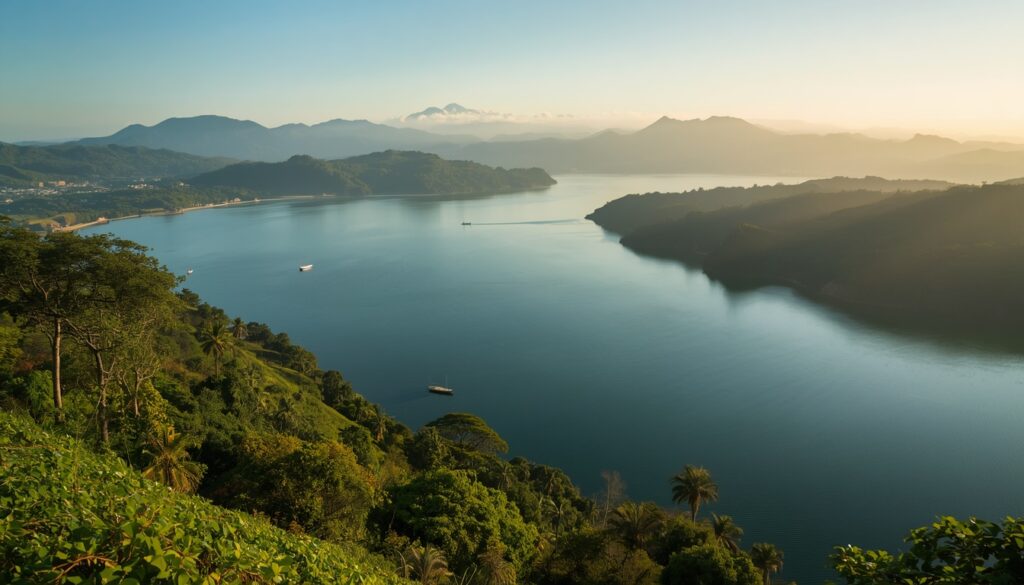
At first glance, Lake Monoun looks like an ordinary body of water. In reality, it has several unusual characteristics.
Its basin is exceptionally deep, with steep sides that prevent surface winds from creating enough turbulence to mix the different layers of water. As a result, the cold water at the bottom can remain largely undisturbed for decades or even centuries.
This stagnant lower layer would not necessarily be dangerous on its own. However, Lake Monoun lies above a volcanic vent that slowly releases carbon dioxide (CO2) into the water through the lakebed.
In most lakes, gas bubbles would simply rise to the surface, or dissolved carbon dioxide would gradually move upward through natural mixing processes.
Lake Monoun’s conditions are different. The high pressure and low temperature at the bottom allow large quantities of carbon dioxide to remain dissolved in the deep water. Over many years, the gas accumulates, creating a potentially dangerous concentration.
Killer Lakes: The Mystery Explained
On that deadly evening in 1984, something disturbed the water at the bottom of Lake Monoun. The source article suggests several possible triggers, including seismic activity, a landslide, or heavy rainfall.
Whatever the cause, part of the gas-saturated deep water was pushed upward and mixed with warmer water at lower pressure.
Even a relatively small change in temperature and pressure can cause dissolved carbon dioxide to become unstable. Once the gas passes a critical threshold, it can no longer remain dissolved in the same way.
One or more pockets of CO2 suddenly expanded into gas bubbles. These bubbles then acted as nucleation sites, encouraging the surrounding water to release even more of its dissolved gas.
As the expanding bubbles rushed toward the surface, they drew additional deep water into areas of lower pressure. This released more carbon dioxide and accelerated the process.
The result was a rapidly escalating chain reaction that sent a huge volume of gas out of the lake.
A Poisonous Tsunami
Hundreds of thousands of tons of trapped gas were reportedly released from the depths in a matter of moments. The sudden eruption displaced water with tremendous force, creating a wave-like surge as the upper layers of the lake rushed toward the shore.
The escaping gas cloud was denser than the surrounding air, causing it to spread close to the ground and flow down the nearby valleys.
The gas was largely invisible, although occasional patches of white mist could be seen. People and animals caught in its path were exposed to dangerous concentrations of carbon dioxide, which displaced oxygen and caused suffocation.
Almost everyone in the cloud’s path died within minutes. A small number of people managed to escape after seeing their neighbors collapse, while others survived because they were on higher ground.
Over the following days, Lake Monoun gradually turned reddish-brown. This color change was caused by iron-rich water brought up from the depths, which reacted with oxygen in the atmosphere.
Killer Lakes: The Exploding Lake Phenomenon
The unusual event at Lake Monoun became known as a limnic eruption.
The phenomenon can be compared to opening a bottle of carbonated soda after shaking it. When a bottle is shaken, carbon dioxide spreads through the liquid in the form of tiny bubbles.
If the pressure is suddenly reduced by opening the bottle, the gas escapes rapidly, producing a surge of foam.
A similar process can occur in a lake when large quantities of dissolved carbon dioxide suddenly escape from deep water. However, the scale of a limnic eruption can be far more dangerous, releasing enormous volumes of gas into the surrounding environment.
Lake Nyos
Almost exactly two years after the mysterious disaster at Lake Monoun, another Cameroonian lake erupted without warning.
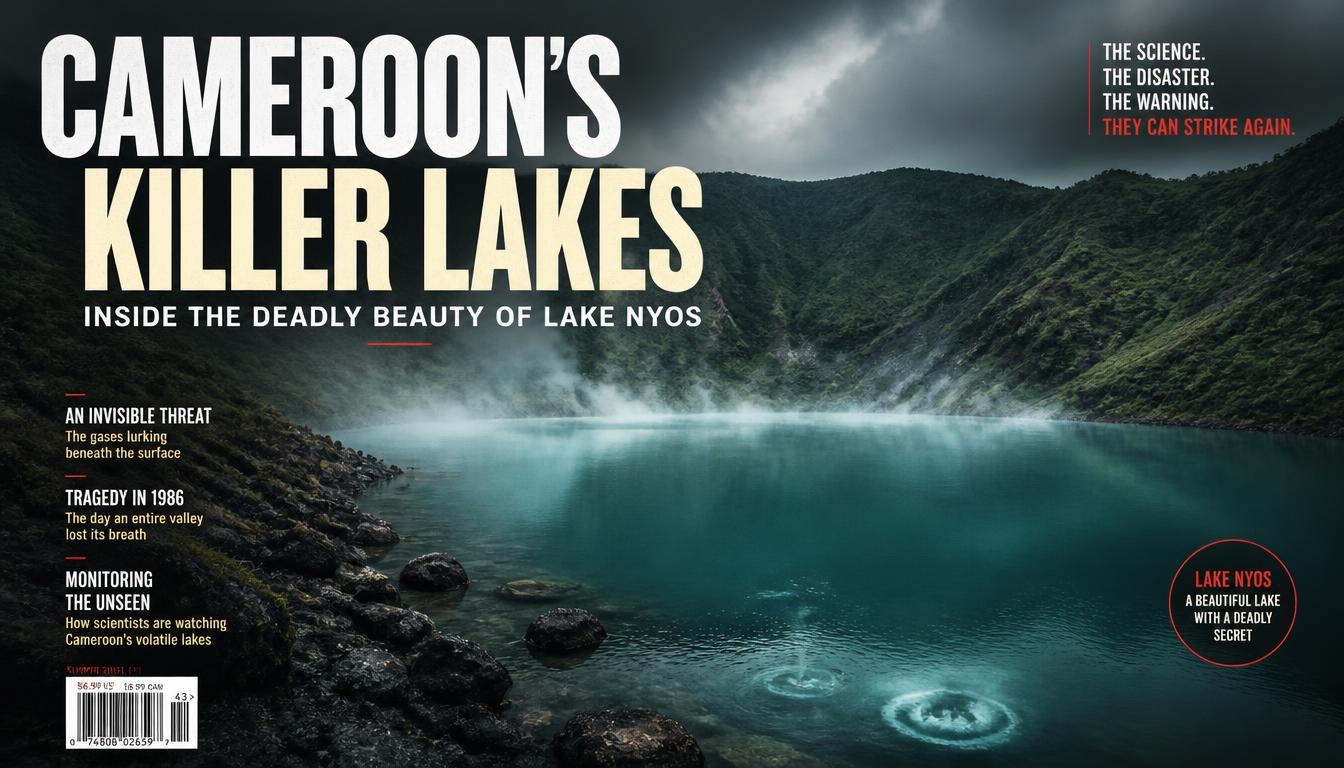
On the night of August 21, 1986, Lake Nyos, which shares several characteristics with Lake Monoun, released its own enormous cloud of deadly gas.
Although the Monoun disaster was tragic, the death toll was relatively small compared with the devastation caused by the second event.
Lake Nyos released more than a million tons of gas, forming a dense cloud that spread across a populated valley.
Villagers began feeling seriously ill. They struggled to breathe, gasping for air but unable to get enough oxygen.
Approximately 4,000 people managed to save themselves by fleeing the valley. Many survivors experienced respiratory problems that continued for several days.
Of the roughly 1,800 people who failed to escape the deadly cloud, only a small number survived.
One survivor was Joseph Nkwain, from the village of Subum. In a 1999 interview, he described the terrifying experience:
I heard my daughter snoring terribly, in a very abnormal way. When I went to her bed, I lost consciousness and fell down. I remained there until nine in the morning, when a friend came and knocked on my door. I was surprised to see that my trousers were red, with spots that looked like honey. I opened the door and tried to speak, but I could not breathe. My daughter was already dead. I went to her bed, thinking she was still sleeping. I had slept until half past four in the afternoon on Friday. Then I managed to visit my neighbors’ houses. They were all dead.
Killer Lakes: The Power of the Lake
The exact death toll was difficult to establish. However, nearly all people and animals within a radius of approximately 15 miles were reportedly killed.
The disaster claimed between 1,700 and 1,800 human lives, along with approximately 3,500 cattle and a large number of wild animals.
Researchers also noticed that Lake Nyos had turned reddish-brown over the following days, just as Lake Monoun had after its eruption two years earlier.
Another disturbing observation was that vegetation along the lake’s shores had been flattened, seemingly by the force of the event.
Killer Lakes: The Aftermath
Before the Lake Nyos disaster, scientists were still uncertain about the cause of the mysterious deaths at Lake Monoun in 1984. The enormous destruction caused by the second event provided much stronger evidence that sudden gas releases were responsible.
The United States and several Western European countries sent emergency funding, medical teams, and scientists to Cameroon. Their mission was to assist survivors and investigate the cause of the catastrophe.
Analysis confirmed that Lake Nyos still contained dangerously high concentrations of dissolved carbon dioxide, even after the eruption.
Scientists estimated that the event had released only around 2% of the total dissolved gas stored in the lake. Meanwhile, underwater vents continued supplying additional CO2.
Without intervention, researchers feared that another eruption could occur within just a few years.
Read also: 10 of the Strangest Natural Phenomena
Killer Lakes: Lake Kivu
Since the disasters at Monoun and Nyos, scientists have also identified the much larger Lake Kivu, located between Rwanda and the Democratic Republic of the Congo, as a potential site of dangerous gas releases.
Its waters contain unusually high concentrations of dissolved carbon dioxide and methane. Fossil evidence has also been cited as suggesting that major biological die-offs occurred around the lake approximately every 1,000 years.
Lake Kivu presents an especially serious concern because of its size and the large population living along its shores.
According to the source article, a major limnic eruption could potentially kill around two million people.
Measures Taken
Today, large pipes are used to pump CO2-rich water from the depths of Lakes Monoun and Nyos. As the water reaches the surface, the dissolved gas escapes, creating fountain-like jets.
These degassing systems are designed to reduce the dangerous accumulation of carbon dioxide and lower the risk of another limnic eruption.
However, a 2005 report by the United States Geological Survey indicated that the existing pipes were not sufficient to eliminate the danger entirely.
At the time, scientists warned that the lakes could not yet be considered completely safe. As long as gas continues accumulating in their deep waters, the possibility of another eruption remains a concern.