9 Incredible Examples of Bioluminescence in Nature
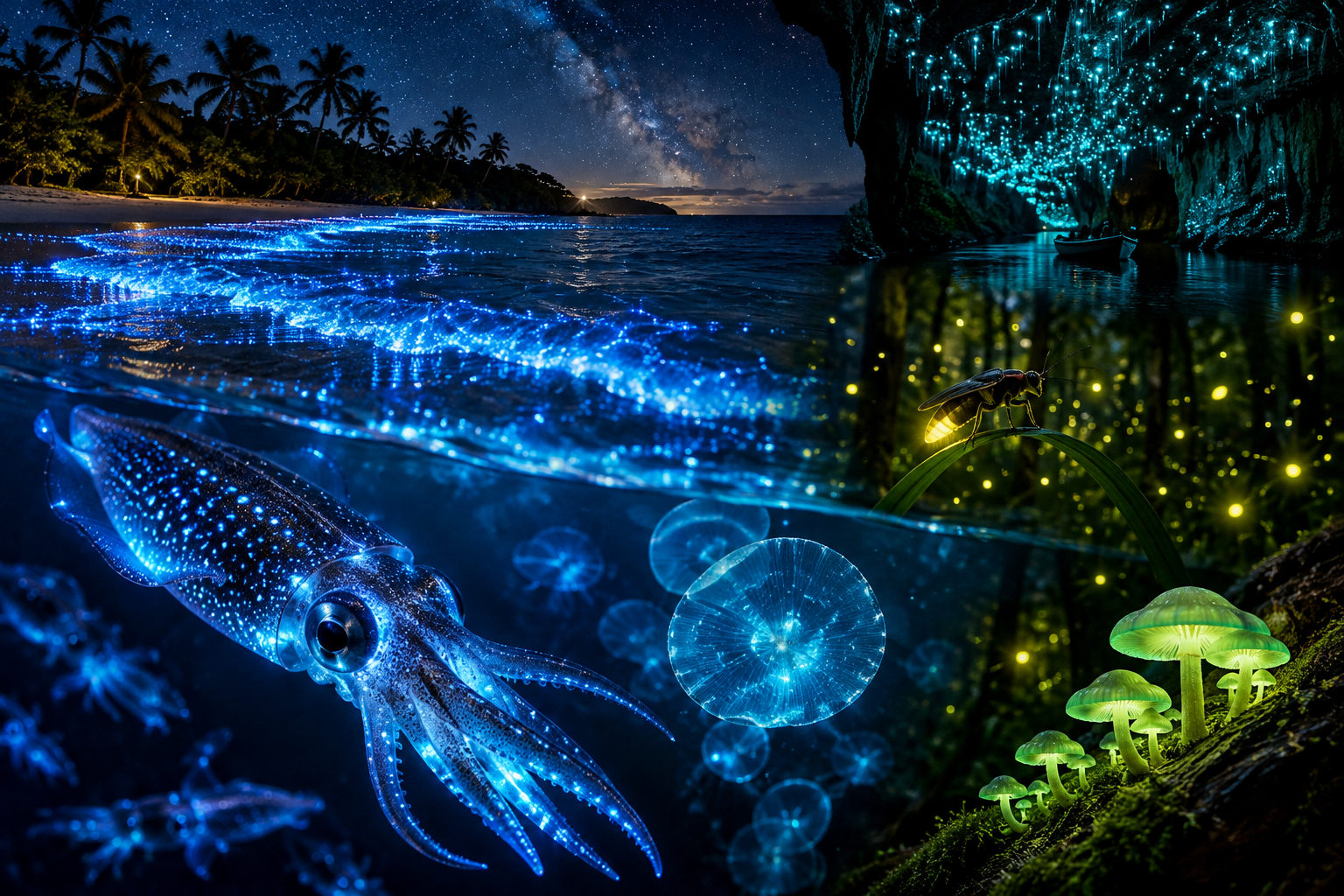
Bioluminescence is one of nature’s most extraordinary phenomena: living organisms producing their own light through chemical reactions inside their bodies.
Although glowing organisms can be found on land, bioluminescence is most common in the ocean. In fact, in the deep sea—where sunlight cannot reach—natural light produced by animals and microorganisms plays an essential role in survival, communication, hunting, and defense.
On land, bioluminescence is much rarer but equally spectacular. Certain fungi glow in the darkness, while insects such as fireflies and glowworms transform forests and caves into landscapes that look almost otherworldly.
From glowing beaches to underwater creatures and star-like cave ceilings, here are some of the most fascinating examples of bioluminescence found in nature.
Gippsland Lakes, Australia
The Gippsland Lakes in southeastern Australia became famous for spectacular displays of bioluminescence.
Under the right environmental conditions, large populations of microscopic marine organisms can cause the water to glow blue when disturbed. Waves, splashing water, swimming animals, or even the movement of a hand can trigger flashes of light.
One of the organisms associated with these displays is Noctiluca scintillans, a type of dinoflagellate capable of producing light. During the day, large blooms may dramatically change the appearance of the water, while darkness reveals their more spectacular side.
At night, every movement across the surface can create glowing trails that make the lakes appear illuminated from within.
Vaadhoo Island, Maldives
The Famous “Sea of Stars”
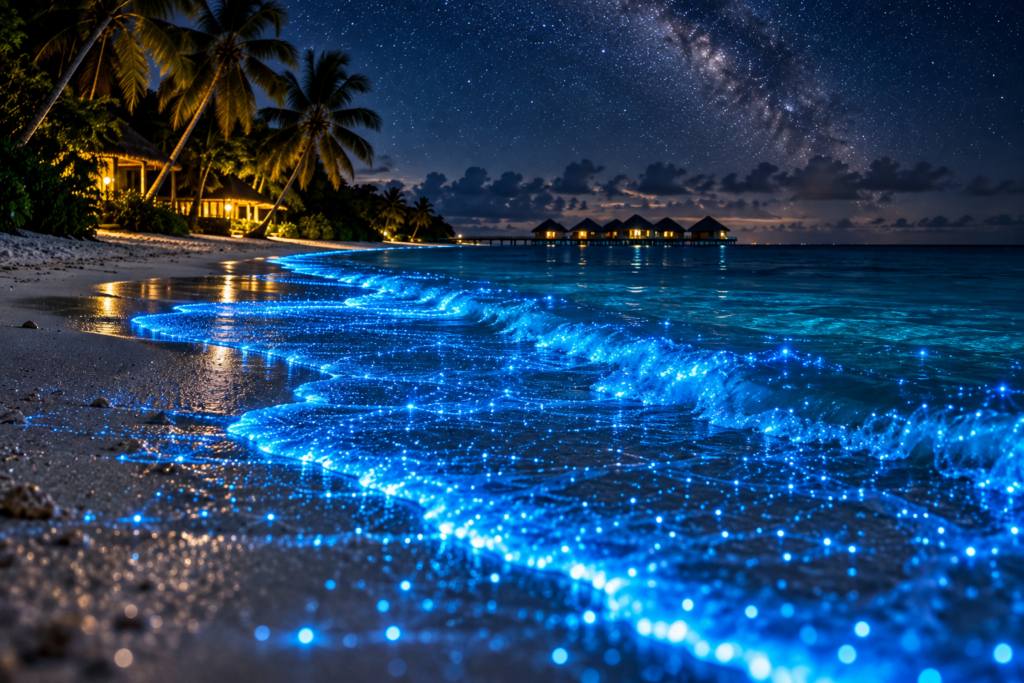
The Maldives are home to some of the world’s most famous bioluminescent beaches.
Under favorable conditions, microscopic organisms known as dinoflagellates can produce flashes of blue light when the water is disturbed. Waves rolling onto the shore, footprints in wet sand, and moving water can all trigger the organisms’ natural glow.
The effect can make the shoreline appear covered in tiny blue stars, which is why scenes like this are often described as a “Sea of Stars.”
It is important to remember that bioluminescent displays are natural events and are not guaranteed every night. Their intensity depends on environmental conditions and the concentration of glowing organisms in the water.
You might also like: 10 Incredible Bioluminescent Creatures That Light Up the Natural World
Firefly Squid, Toyama Bay, Japan
Toyama Bay is famous for one of the most remarkable underwater light displays in the world.
Every year, large numbers of firefly squid (Watasenia scintillans) can be found in the waters of the bay. These small squid are equipped with specialized light-producing organs called photophores.
Their bodies can produce an intense blue glow that creates a surreal spectacle beneath the surface.
Firefly squid normally spend much of their lives in deeper water, but seasonal movements bring large numbers closer to the surface. During the peak season, the coastline of Toyama Bay can become associated with glowing blue lights created by thousands of tiny squid.
For such a small creature, the firefly squid produces one of nature’s most dramatic displays of bioluminescence.
Luminous Lagoon, Jamaica
Jamaica’s famous Luminous Lagoon is known for water that can glow when disturbed.
The phenomenon is caused by microscopic organisms living in the lagoon. When the water moves, these organisms can emit flashes of light, creating glowing trails around boats, swimmers, and moving fish.
On especially dark nights, the contrast between the glowing water and the surrounding landscape can make the lagoon appear almost unreal.
Bioluminescent lagoons are particularly fascinating because the light can seem to follow every movement. A paddle entering the water may leave a glowing streak behind it, while fish swimming beneath the surface can appear to create trails of light.
It is one of the clearest examples of how an invisible microscopic world can create an extraordinary natural spectacle.
Synchronous Fireflies in Tennessee
In parts of Tennessee and the surrounding Appalachian region, certain firefly species create one of the most unusual light shows in the insect world.
Instead of flashing randomly, thousands of insects can synchronize their signals.
At first, individual lights may appear scattered throughout the forest. Then, gradually, more insects begin flashing together until large sections of the landscape seem to pulse with synchronized light.
This coordinated behavior is believed to play an important role in communication and reproduction.
Watching thousands of insects flash together in the darkness can make an ordinary forest look like a scene from science fiction.
Because these events are seasonal and dependent on weather and environmental conditions, the timing and intensity of the displays can vary from year to year.
Laguna Grande, Puerto Rico
Laguna Grande in Fajardo is one of Puerto Rico’s best-known bioluminescent ecosystems.
The glowing effect comes from microscopic dinoflagellates living in the water. When disturbed by movement, these organisms can produce flashes of blue-green light.
A moving paddle, swimming fish, or the wake of a boat can suddenly illuminate the water.
The surrounding mangrove environment helps create conditions suitable for the organisms, making the lagoon a fascinating example of how delicate ecosystems can support unusual natural phenomena.
However, bioluminescence is highly sensitive to environmental changes. Pollution, water conditions, weather, and artificial light can all affect how visible the glow becomes.
Springbrook National Park, Australia
Springbrook National Park in Queensland is known for its rainforests, waterfalls, and dramatic landscapes—but after dark, parts of the park reveal another natural wonder.
The Natural Bridge area is famous for glowworms, whose larvae produce a soft blue-green light.
These tiny organisms attach themselves to cave walls and rocky surfaces, creating a display that can resemble a miniature night sky.
Unlike fireflies, glowworms do not flash through the air. Instead, their lights remain relatively stationary, creating clusters of glowing points throughout the darkness.
When large numbers are present, the effect can transform a cave into one of Australia’s most unusual natural attractions.
Bioluminescent Fungi
Forests That Glow in the Dark
Bioluminescent fungi are among the strangest examples of natural light production on land.
Certain species of fungi can produce a greenish glow through chemical reactions within their tissues. In complete darkness, glowing mushrooms or fungal growth on decaying wood can appear almost supernatural.
This phenomenon has historically been called “foxfire” in some parts of the world.
Scientists continue to study why different fungi produce light. One possible explanation is that the glow may help attract insects capable of assisting with the spread of spores.
Whatever its evolutionary purpose, a glowing forest floor is one of the most unusual examples of nature producing its own illumination.
You might also like: 10 Incredible Bioluminescent Creatures That Light Up the Natural World
Waitomo Glowworm Caves, New Zealand
The Waitomo Glowworm Caves are home to one of the world’s most famous natural light displays.
Thousands of glowworm larvae inhabit the cave system, producing blue-green lights that cover the ceilings.
From below, the effect can resemble a star-filled night sky.
These glowworms are not actually worms in the traditional sense. They are the larvae of a species of fungus gnat found in New Zealand.
Their light helps them attract prey in the darkness of the caves.
The combination of darkness, cave formations, and thousands of tiny glowing organisms creates one of the most visually extraordinary ecosystems on Earth.
Why Do Living Things Produce Light?
Bioluminescence is not simply a beautiful natural phenomenon. For many organisms, producing light is an important survival tool.
Different species use bioluminescence for different reasons, including:
- attracting prey;
- communicating with potential mates;
- confusing predators;
- warning enemies;
- attracting other organisms;
- camouflaging themselves in the ocean.
In deep-sea environments, where sunlight cannot reach, the ability to create light can mean the difference between survival and death.
For humans, bioluminescence remains one of the most magical natural phenomena on the planet. A glowing beach, a cave filled with tiny lights, or an ocean illuminated by microscopic organisms reminds us that nature is capable of creating scenes more extraordinary than science fiction.