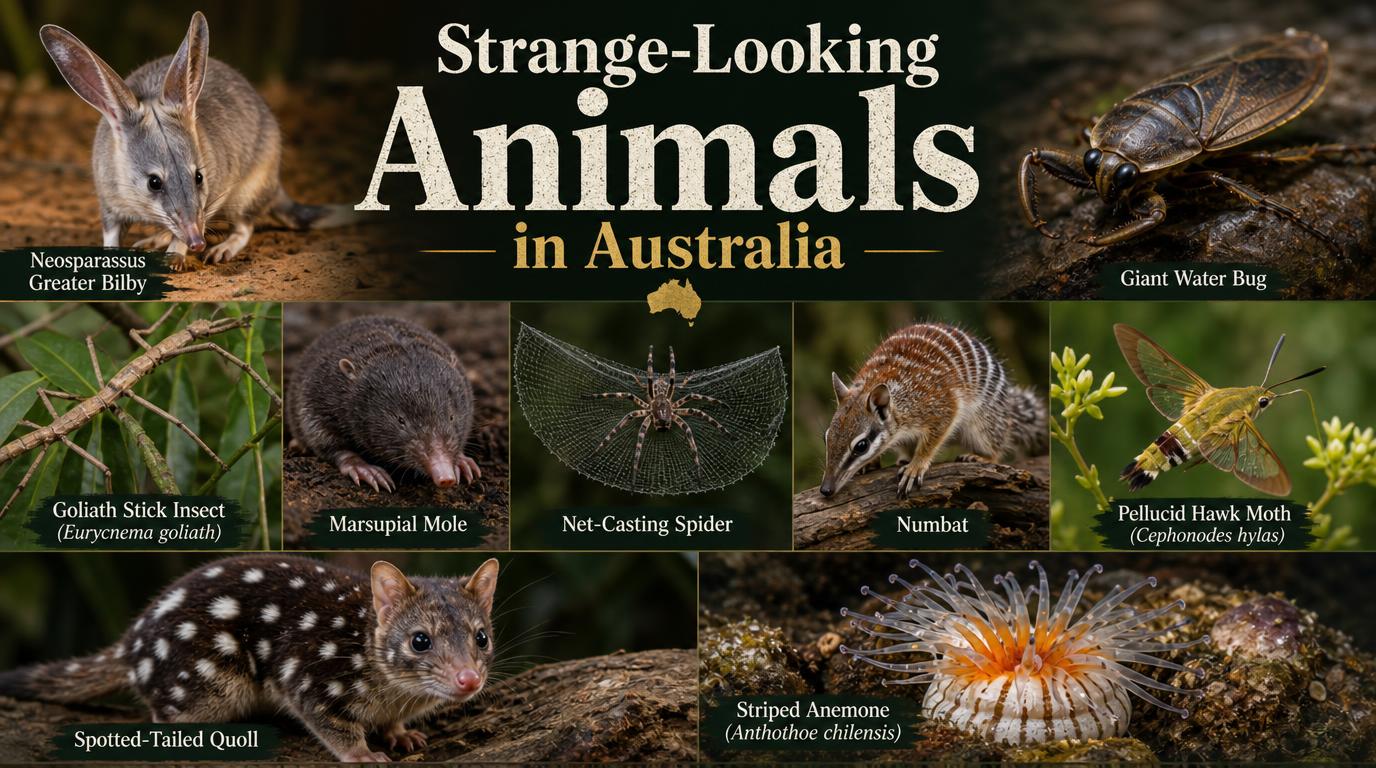
Strange-Looking Animals in Australia
Australia is famous for unusual wildlife, but not every remarkable Australian animal is dangerous. Some simply look so bizarre that they seem almost impossible to believe.
From enormous spiders and strange underground marsupials to transparent-winged moths and unusual marine creatures, Australia is home to animals with some truly extraordinary adaptations.
Here are some of the strangest-looking animals found in Australia.
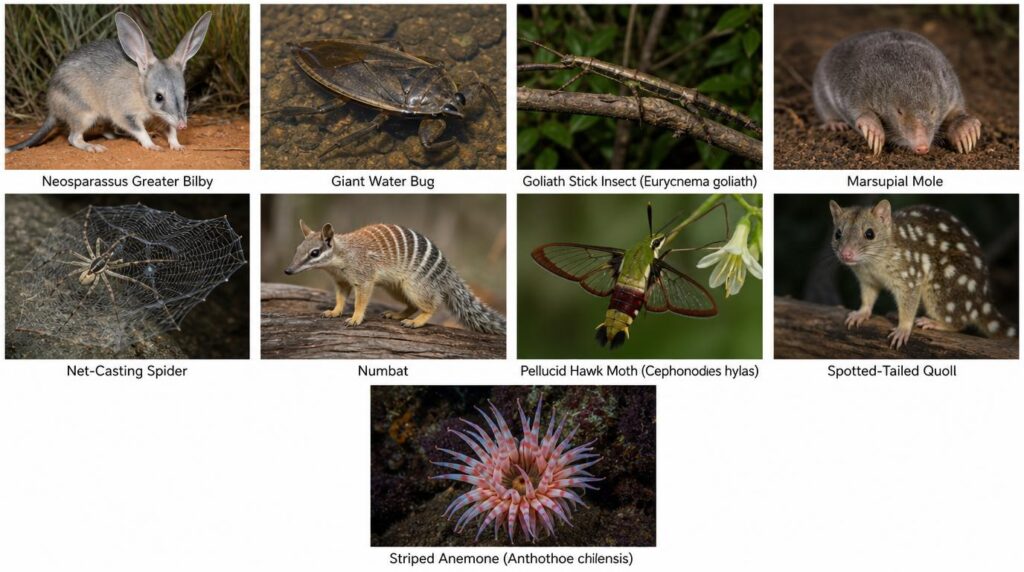
Neosparassus
Neosparassus, a group of huntsman spiders, includes some of Australia’s most unusual-looking spiders. These large, long-legged arachnids can have striking markings on the underside of their bodies, including black, orange, yellow, and reddish colors.
Their unusual body shape allows them to squeeze into narrow spaces, while their flexible legs help them move through difficult terrain.
They can be found beneath loose bark, in rock crevices, among leaf litter, and in other sheltered habitats. Some species also create burrows.
Their diet consists primarily of insects and other small invertebrates.
And yes, huntsman spiders can occasionally turn up inside homes and even cars, where they may hide behind sun visors or move across dashboards.
Although they are not considered among Australia’s most dangerous spiders, a bite can cause significant local pain and other unpleasant symptoms.
Greater Bilby
The greater bilby is one of Australia’s most distinctive marsupials.
About the size of a rabbit, it has a long, pointed snout, enormous ears, small eyes, and a surprisingly unusual appearance. The name “bilby” comes from an Aboriginal Australian language and is traditionally associated with the animal’s long nose.
Bilbies have relatively poor eyesight and rely heavily on their excellent sense of smell to find food and detect potential danger.
They are omnivores, feeding on a wide variety of foods including bulbs, seeds, fruit, insects, termites, spiders, worms, and small animals.
One of their most unusual adaptations is their backward-opening pouch. This arrangement helps prevent dirt from entering the pouch while the female digs.
Bilbies are nocturnal and are well adapted to Australia’s dry landscapes. Their powerful claws allow them to excavate burrows and search underground for food.
The species has faced major population declines, with habitat loss and introduced predators such as feral cats and foxes among its major threats.
You may also like: Australia’s Most Dangerous Animals: Creatures You Don’t Want to Meet
Giant Water Bug
The giant water bug is one of the largest true bugs in the world, with some individuals growing to around 12.5 centimeters long.
Its powerful front legs are adapted for grabbing prey, while its piercing mouthparts allow it to subdue animals much larger than you might expect from an insect.
These aquatic predators live in freshwater environments and can hunt underwater. Their prey may include tadpoles, aquatic insects, and small fish.
A specialized breathing structure allows them to remain underwater while periodically accessing atmospheric air.
Giant water bugs are not strictly aquatic in every stage of their lives. They are also capable of flying and can be attracted to artificial lights at night.
They are best known for their painful defensive bite, which has earned some species colorful nicknames referring to their ability to bite toes or fingers.
Goliath Stick Insect (Eurycnema goliath)
Australia is home to some remarkably large stick insects, including the impressive Eurycnema goliath.
These insects can reach approximately 20–25 centimeters in length, making them look more like pieces of vegetation than living animals.
They have a predominantly green body with yellow markings, while their wings can display contrasting colors underneath.
Females are unable to fly, but their wings can help slow their descent if they fall from vegetation.
Despite their intimidating size, these stick insects are harmless to humans.
They are found along parts of Australia’s eastern coast, particularly in New South Wales and southern Queensland. Their habitats include forests, shrubland, gardens, and parks.
They feed primarily on vegetation, including eucalyptus and other broad-leaved plants, and are most active at night.
Habitat loss and bushfires are among the environmental pressures affecting their populations.
Marsupial Mole
The marsupial mole is one of Australia’s strangest mammals.
Its body is highly specialized for life beneath the ground. It has a cone-shaped head, a leathery shield over the nose, a cylindrical body, and very short limbs.
Perhaps the most unusual feature is its vision—or lack of it. Marsupial moles are effectively blind and have no external ears.
Their front feet contain enlarged, shovel-like claws that help them move through loose soil. Their rear feet are also adapted for pushing soil away as they dig.
Unlike many burrowing animals, marsupial moles do not necessarily create permanent tunnel systems. Instead, they can move through the soil in a way that resembles swimming.
They spend most of their lives underground and rarely appear on the surface, sometimes becoming more active after rainfall.
Net-Casting Spider
The net-casting spider is one of the most unusual-looking spiders on this list.
Its elongated body, extremely thin legs, and enormous forward-facing eyes give it an appearance that has inspired another nickname: the “ogre-faced spider.”
These spiders can be found in forest habitats as well as gardens and shrubs.
Unlike spiders that build large permanent webs to trap prey, net-casting spiders create a small, elastic silk net and hold it between their front legs.
When an insect passes underneath, the spider rapidly extends the net and throws it over the prey.
Their huge eyes are particularly well adapted to low-light conditions, allowing these spiders to hunt efficiently at night.
Their prey can include ants, beetles, crickets, and other spiders.
Despite their unusual appearance, they are not considered dangerous to humans.
Numbat
The numbat, sometimes called the banded anteater, is a small marsupial found in parts of Australia.
Its slender body, short legs, pointed head, and distinctive reddish-brown coat with black-and-white bands make it instantly recognizable.
Numbats have a remarkably specialized diet: termites.
They use their long, sticky tongue to collect termites and rely on their senses to locate colonies beneath the ground.
Their habitat includes eucalyptus woodland, where hollow logs and fallen trees provide shelter and feeding areas.
Unlike many other marsupials, numbats are primarily active during the day.
Unfortunately, they are highly threatened. Habitat loss and introduced predators, particularly feral cats and foxes, have contributed to their decline.
Pellucid Hawk Moth (Cephonodes hylas)
The pellucid hawk moth is an especially unusual-looking insect because of its transparent wings.
The wings are thin and largely transparent, bordered by darker edges and delicate veins. This unusual structure can make the moth difficult for predators to detect.
Its body, in contrast, is much more colorful, with vivid green coloring and contrasting markings.
Although associated with Australia, Cephonodes hylas occurs across a much wider geographic range, including parts of Africa, Asia, Madagascar, and other regions.
Like many species, it depends on suitable temperatures and host plants to survive.
Habitat loss and environmental changes can pose challenges to populations of this unusual moth.
Spotted-Tailed Quoll
The spotted-tailed quoll is Australia’s largest surviving carnivorous marsupial after the Tasmanian devil.
It has a reddish-brown coat covered with distinctive white spots that continue along the body and tail.
Its short legs and long tail make it well suited to both ground-based movement and climbing. Specialized structures on the soles of its feet help it grip surfaces.
Spotted-tailed quolls occupy a range of habitats, but they are particularly associated with wet forests, including eucalyptus forests and rainforest environments.
They are primarily nocturnal predators with a surprisingly varied diet. Depending on the opportunity, they can prey on birds, insects, reptiles, small mammals, possums, wallabies, wombats, and other animals.
They are also capable climbers and may venture high into trees while hunting.
Striped Anemone (Anthothoe chilensis)
Not all of Australia’s strange-looking animals live on land.
The striped anemone, Anthothoe chilensis, is a large marine animal with a broad base, a smooth column, and a wide oral disc surrounded by numerous tentacles.
Some individuals can reach around 20 centimeters across, while their tentacles may extend much farther.
The tentacles have distinctive stripes, which give the animal its common name.
These anemones occur in marine environments around Australia and are also found in parts of Indonesia and the Philippines. They can inhabit relatively shallow waters, including mangroves, sheltered reefs, and areas beneath rocky overhangs.
They capture small aquatic animals with their tentacles.
They also possess specialized stinging cells that can be used for defense. Contact can result in painful injuries, so these beautiful marine animals are best observed without touching them.
Final Thoughts
Australia’s wildlife is famous for its diversity, but some of its most fascinating creatures are not necessarily the biggest or most dangerous.
A giant stick insect can look like a branch. A marsupial mole can spend almost its entire life underground. A net-casting spider hunts with a tiny silk net, while the numbats’ entire lifestyle revolves around termites.
These unusual adaptations are a reminder that evolution can produce an astonishing variety of shapes, behaviors, and survival strategies.
And that may be the strangest thing about Australian wildlife of all: sometimes reality looks much stranger than fiction.