11 Animal Fathers That Go Above and Beyond for Their Young
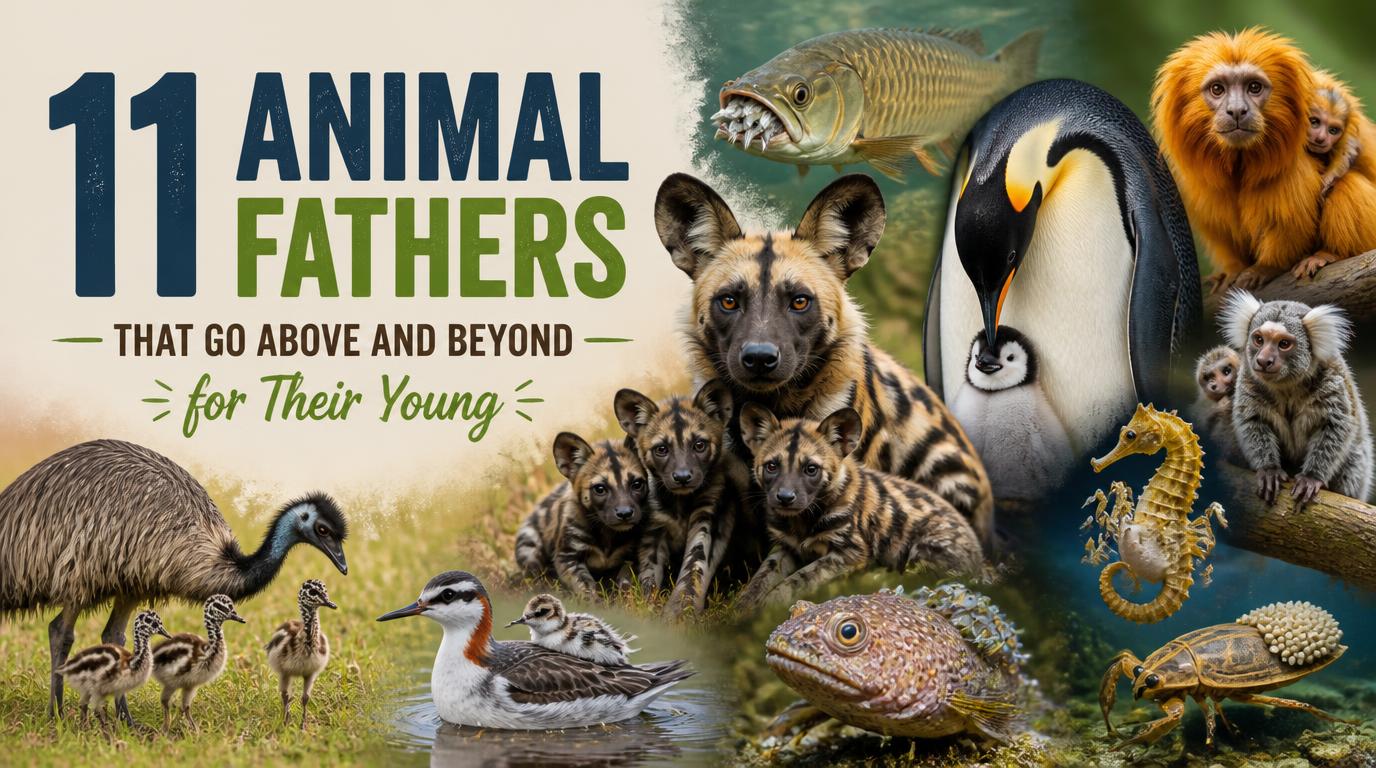
In the animal kingdom, parenting is not always left to mothers. Many animal fathers play an essential role in protecting, feeding, and raising their offspring. Some carry their babies on their backs, others guard eggs for weeks without eating, and a few even carry their developing young inside specialized pouches.
From devoted penguins to protective fish, these fathers demonstrate remarkable parental behavior. Here are 11 animal dads that work hard to give their young the best possible start in life.
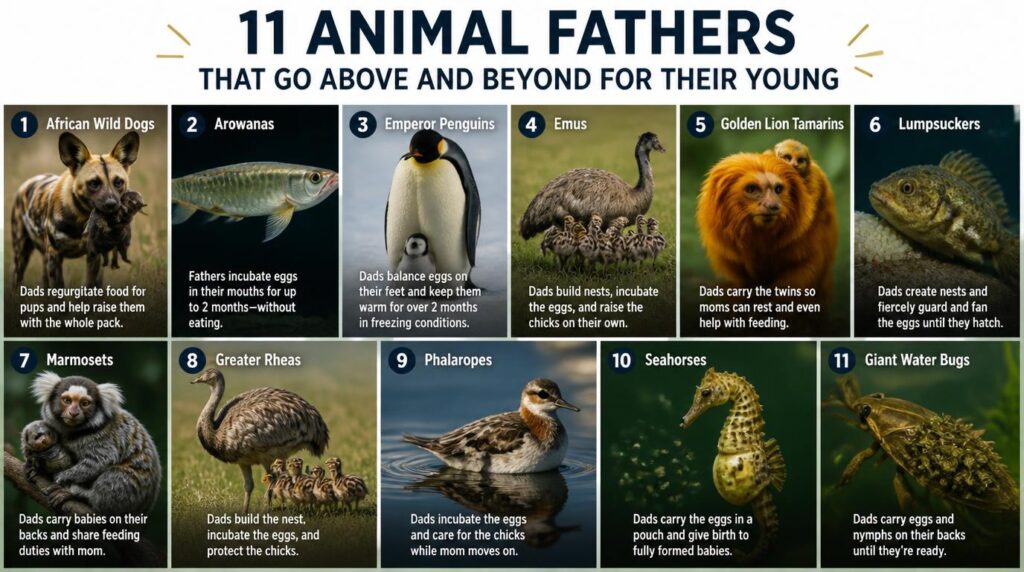
1. African Wild Dogs
African wild dogs are highly social predators that cooperate to raise their pups. After a litter is born, members of the pack help protect the young and provide food for the nursing mother and growing pups.
Male wild dogs contribute to the care of their offspring by guarding the den and helping feed the pack. Adults may return from hunting and regurgitate partially digested food for pups that are too young to eat solid food independently.
This cooperative system improves the pups’ chances of survival. Rather than leaving the mother to raise the litter alone, the pack shares important responsibilities, with fathers playing a significant role in protecting and feeding the next generation.
2. Arowanas
Arowanas are freshwater fish known for their unusual reproductive strategies. In several species, males provide parental care by protecting developing eggs and young fish inside their mouths.
This behavior is called mouthbrooding. After the eggs hatch, the male can continue sheltering the fry in his mouth, protecting them from predators during their most vulnerable stage of development.
When conditions appear safe, the young fish may swim out to explore their surroundings. If danger approaches, they can retreat into their father’s mouth for protection.
This remarkable behavior allows the male to act as a living shelter for his offspring, although the details of parental care vary among arowana species.
You may also like: The World’s Most Dangerous Insects: Tiny Creatures with Deadly Power
3. Emperor Penguins
Emperor penguins are among the most famous examples of devoted animal fathers. After the female lays a single egg, she transfers it to the male, who must keep it warm during the harsh Antarctic winter.
The father balances the egg on his feet and covers it with a specialized fold of skin called a brood pouch. This keeps the egg above the frozen ground and protects it from extreme cold and wind.
During incubation, which lasts roughly two months, the male may go without food while the female returns to the ocean to feed. Males often gather in dense groups, huddling together to conserve body heat.
If the chick hatches before the mother returns, the father can feed it a nutritious secretion produced in his esophagus, commonly called crop milk. Once the female returns with food, the parents take turns caring for and feeding their chick.
The father’s ability to endure prolonged fasting and freezing temperatures is essential to the survival of the next generation.
4. Emus
Emus are large, flightless birds native to Australia. Their breeding behavior places much of the responsibility for incubation and early chick care on the male.
After mating, a female may lay several large, dark-green eggs in a nest prepared by the male. She may mate with other males, while the first male remains to incubate the eggs.
The incubation period lasts approximately eight weeks. During this time, the male spends most of his time on the nest and may lose considerable body weight because he eats and drinks very little.
After the eggs hatch, the father leads his chicks around their habitat, helping them find food and protecting them from potential threats. He can remain highly defensive during this period, so approaching an emu caring for chicks is unwise.
Young emus stay with their father for an extended period as they grow and learn to navigate their surroundings.
5. Golden Lion Tamarins
Golden lion tamarins are small primates native to Brazil’s Atlantic Forest. Their bright orange-gold fur and distinctive manes make them easy to recognize, but their family life is equally remarkable.
Fathers play a major role in carrying and caring for their infants. Golden lion tamarins commonly give birth to twins, and transporting two young babies can be demanding for the mother.
The father often carries the infants on his back, returning them to the mother primarily for nursing. Other members of the family group may also help with infant care.
As the babies grow, the father and other group members help them learn to move through the trees and explore their environment. This shared parental care allows the mother to recover between nursing sessions and contributes to the survival of the young.
6. Lumpsuckers
Lumpsuckers are unusual marine fish with rounded bodies and specialized pelvic fins that form a suction disc. This adaptation helps them attach themselves to rocks and other surfaces.
In several lumpsucker species, males provide dedicated care for eggs deposited by females. After the eggs are laid, the father guards the clutch against predators and helps maintain water circulation around it by moving his fins.
Depending on the species and environmental conditions, the eggs may take several weeks to hatch. During this period, the male remains close to the nest and may aggressively defend it against intruders.
Once the young hatch, they become more independent, and the male’s parental duties gradually come to an end.
7. Marmosets
Marmosets are small New World monkeys found in Central and South America. Many species frequently give birth to twins, creating a substantial caregiving challenge for the parents.
Fathers play an important role by carrying the infants, grooming them, and protecting them as they develop. Other members of the family group may also help carry and care for the young.
The father often transports the babies on his back, bringing them to the mother when they need to nurse. As the infants grow, he and other group members help them explore their surroundings and begin eating solid foods.
This cooperative approach to parenting reduces the burden on the mother and helps the infants remain protected while they are still small and vulnerable.
8. Greater Rheas
Greater rheas are large, flightless birds native to South America. Their breeding behavior is notable because males take on most of the responsibility for incubating eggs and raising chicks.
A male builds a nest, where several females may lay their eggs. The male then incubates the clutch, which can contain dozens of eggs, sometimes contributed by multiple females.
Incubation typically lasts around six weeks. During this period, the male guards the nest and may aggressively chase away animals or people that approach too closely.
After hatching, he continues protecting and guiding the chicks for several months. Young rheas follow their father as they learn to find food and respond to potential threats.
The male’s commitment to the nest and his offspring makes the greater rhea a striking example of paternal care among birds.
9. Phalaropes
Phalaropes are small shorebirds with an unusual reversal of traditional avian parenting roles. In several species, females are more brightly colored and compete for males, while males take on most of the incubation and chick-rearing duties.
After mating, a female may lay a clutch of eggs and then leave to seek another mate. The male remains to incubate the eggs and protect the nest.
Once the chicks hatch, the father leads them through their habitat and helps keep them safe during their early development. The chicks are precocial, meaning they can move around and begin feeding themselves relatively soon after hatching.
This reversed division of parental responsibilities is an example of how mating systems and parenting strategies can differ considerably across the bird world.
10. Seahorses
Seahorses are famous for one of the most unusual reproductive systems in the animal kingdom. The female deposits her eggs into a specialized brood pouch on the male’s abdomen.
The male fertilizes the eggs and carries the developing embryos inside the pouch. During pregnancy, the pouch provides a protected environment and helps regulate conditions needed for development.
Depending on the species, pregnancy can last several weeks. When the young are ready, the male undergoes muscular contractions to release tiny, fully formed seahorses into the water.
The number of offspring varies considerably by species and individual, with some males releasing hundreds or even thousands of young in a single brood.
Although the female provides the eggs, the male carries the developing offspring until birth, making seahorses one of the best-known examples of male pregnancy.
11. Giant Water Bugs
Giant water bugs are aquatic insects known for their powerful front legs and painful bite. Some species also display remarkable paternal care.
In certain species, females deposit eggs on the male’s back, where he carries them until they hatch. He may keep the eggs exposed to sufficient oxygen by moving through the water and adjusting his position.
In other giant water bug species, males guard eggs attached to vegetation above the water surface. They may protect the clutch from predators and help keep the eggs appropriately hydrated.
The exact parenting strategy varies among species, but the father’s role can be critical to the survival of the eggs.
Despite their small size, giant water bugs can be aggressive when threatened. Their bite can be extremely painful, so they should never be handled casually.