
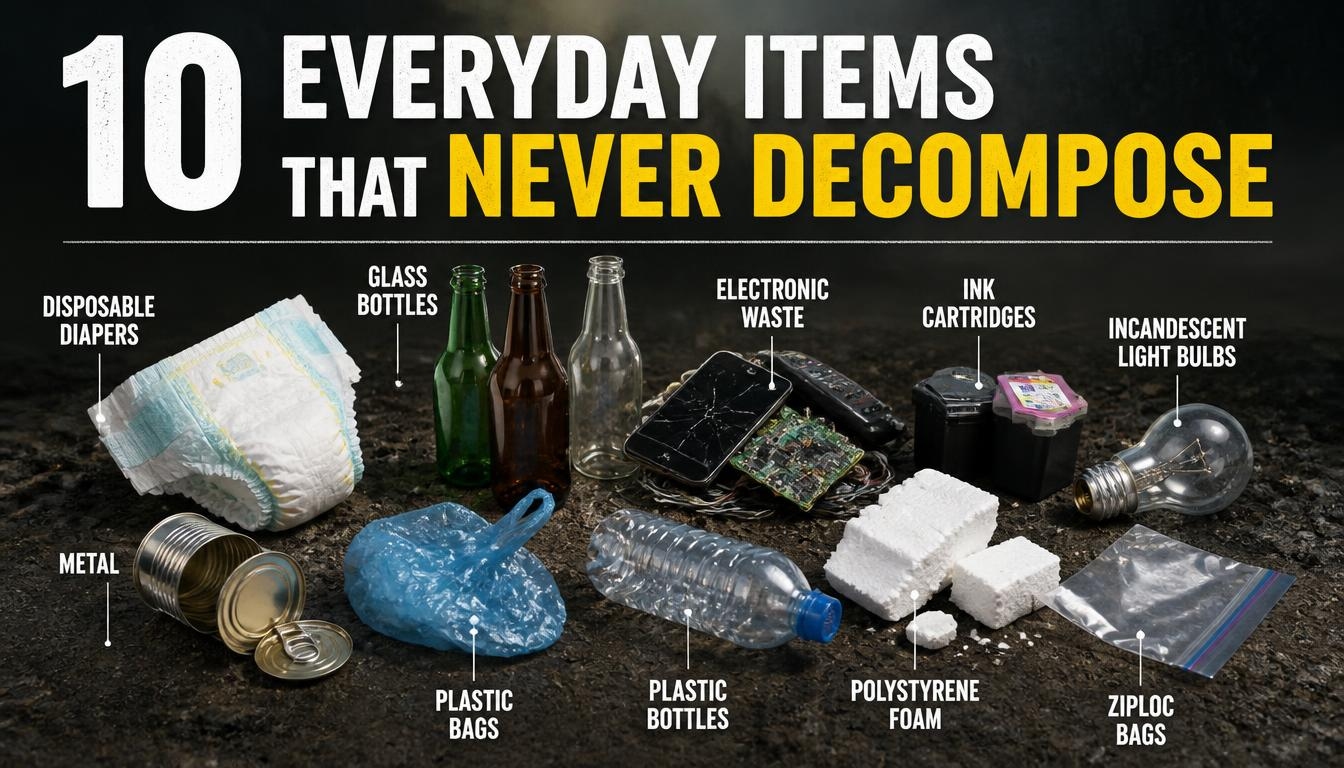
10 Everyday Items That Never Decompose
Throwing away waste is unavoidable, but we can reduce our environmental impact by avoiding products that take an exceptionally long time to break down. Some everyday items can remain in the environment for hundreds of years before they deteriorate.
The following list features 10 common objects that can persist for remarkably long periods because their materials are difficult to decompose.
Here is our list of 10 everyday items that never decompose.
1. Disposable Diapers
Disposable diapers make life more convenient for parents around the world, but they also have significant environmental drawbacks.
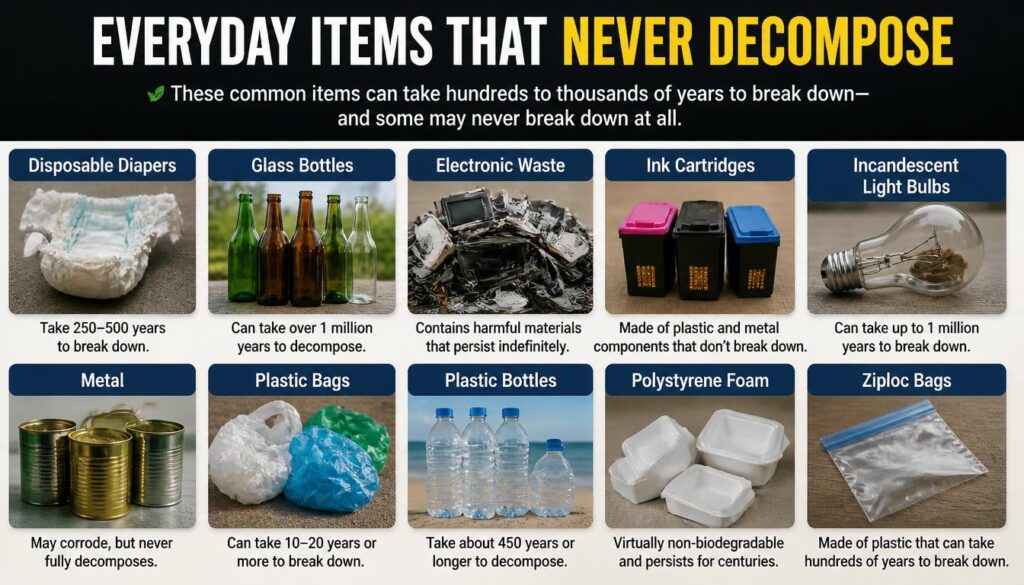
They contain a combination of absorbent materials, plastic, polyester, tissue paper, wood pulp, and other components. Many of these materials are not readily biodegradable, and a disposable diaper can take up to 500 years to break down in a landfill.
Disposable diapers are also difficult to recycle. Even the plastic shrink-wrap packaging they come in is not always recyclable.
One alternative is to choose disposable biodegradable diapers made from more environmentally friendly materials. Although these products can be a better option, many still end up in landfills.
2. Glass Bottles
Glass can be recycled repeatedly, allowing it to be returned to its original form and used for different purposes. Unlike many other materials, glass does not lose its quality no matter how many times it is recycled.
The problem is that millions of glass bottles are still thrown away every year in the United States alone. Broken glass is also frequently discarded as ordinary waste rather than collected for recycling.
When recycling rates are low, more glass ends up in landfills instead of recycling facilities. Experts estimate that glass can take up to one million years to decompose in the environment.
Read also: The Safest Countries From Natural Disasters
3. Electronic Waste
Electronic waste includes a wide range of household appliances and devices that use electricity, such as air conditioners, mobile phones, refrigerators, and televisions.
Throwing away old electronic devices can have serious environmental consequences. They may contain hazardous substances such as arsenic, cadmium, lead, and mercury, which can contaminate the environment when electronic waste is improperly handled.
If you no longer need an electronic device, some companies may be willing to buy it, even for spare parts. Selling or donating usable electronics can extend their lifespan while reducing waste.
Whenever possible, avoid throwing old electronics into ordinary trash. They require specialized collection and recycling because many of their components persist in the environment and can release harmful substances.
4. Ink Cartridges
While people often focus on common household waste, they may overlook the ink cartridges used in printers every day. These products can also take a very long time to break down.
Billions of ink cartridges are used worldwide, but fewer than 30% are recycled. One reason is that many recycling facilities do not accept certain types of cartridges, leaving them to end up in landfills.
Depending on their materials, ink cartridges can take between 450 and more than 1,000 years to decompose. During this time, they may also release harmful chemicals into the soil.
5. Light Bulbs
Some types of light bulbs contain materials that can persist in landfills and create environmental risks.
Compact fluorescent lamps (CFLs) are recyclable through specialized programs, but they can still end up in ordinary waste. Certain fluorescent bulbs contain mercury, which can contaminate local ecosystems if the bulbs break or are improperly disposed of.
The best way to prevent this is to take used bulbs to an appropriate recycling or hazardous-waste collection center.
6. Metal
Metal is durable and can deteriorate over time, but it does not biodegrade like organic materials.
Small metal objects, such as tin cans, can rust and gradually break apart over approximately 100 years. However, larger metal items, including iron rivets and steel sheets, can remain in the environment for much longer.
Microorganisms in landfills do not consume metal particles as a source of food, so metal waste does not biodegrade in the usual sense.
As a result, discarded metal objects can remain in landfills for hundreds of years. Recycling metal is a more sustainable alternative because many metals can be processed and reused.
7. Plastic Bags
What can we say about plastic bags? They are everywhere, and people use them every day.
In the United States alone, people use up to 100 billion plastic bags annually. Although the environmental impact of plastic bags is widely known, they remain a common part of everyday shopping and packaging.
According to the waste management figures cited in this article, only 1% of plastic bags are recycled. Those that end up in landfills can take up to 1,000 years to break down.
Before they deteriorate, many plastic bags enter animal habitats and digestive systems. Thousands also reach the oceans, where they can injure and kill marine wildlife.
8. Plastic Bottles
Today, some plastic bottles can be recycled. However, conventional plastic bottles do not readily biodegrade or decompose under ordinary environmental conditions.
Many are made from synthetic materials such as polyethylene terephthalate (PET). Microorganisms responsible for breaking down organic matter cannot readily consume this type of plastic.
Instead, plastic bottles can break into smaller pieces through photodegradation, a process driven by ultraviolet radiation from sunlight. This process can take approximately 450 years.
Like plastic bags, discarded bottles pose a serious threat to marine life. Sea turtles and other marine animals can mistake plastic waste for food or become entangled in it.
9. Polystyrene Foam
One of the biggest environmental problems associated with polystyrene foam is that it does not readily break down or biodegrade under natural conditions.
Although the material can be destroyed through incineration at extremely high temperatures, this process requires specialized facilities and does not make ordinary disposal environmentally harmless.
Because polystyrene foam is lightweight and can float, it often accumulates along waterways around the world. This creates risks for wildlife and can affect the health of aquatic ecosystems.
Common products made from polystyrene foam include coffee cups, coolers, egg cartons, takeaway bowls, food containers, and disposable plates.
10. Ziploc Bags
Ziploc bags are another type of plastic bag commonly used for storing food and packaging other items.
Millions of these bags, also known as sandwich bags, are used every year. Their widespread use contributes to the growing amount of plastic waste that is difficult to recycle.
Ziploc bags are commonly made from low-density polyethylene (LDPE), a type of plastic that can take hundreds of years to break down.
Without proper recycling and waste management, discarded LDPE bags can accumulate in landfills and pollute waterways.