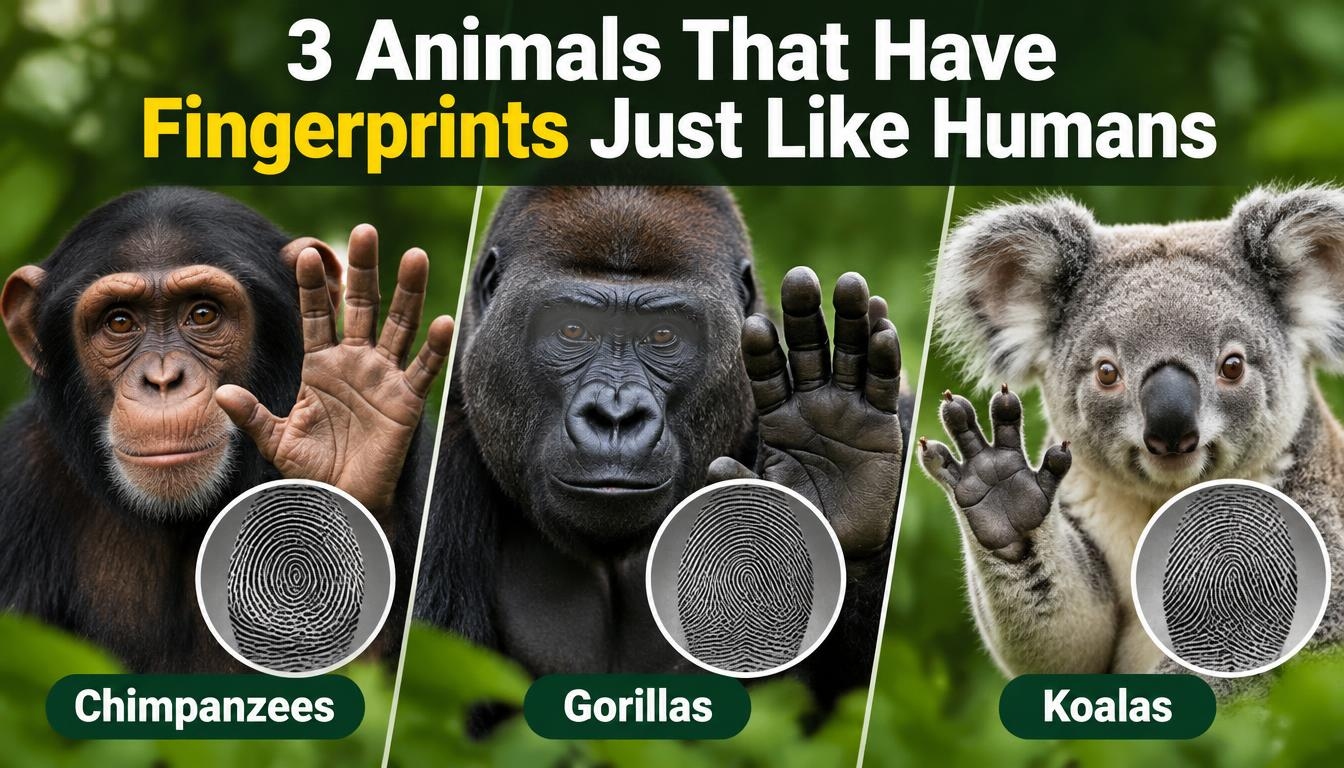
3 Animals That Have Fingerprints Just Like Humans
Fingerprints are among the most familiar ways of distinguishing one person from another. The tiny ridges and patterns on our fingertips are unique, but this feature isn’t exclusive to humans. Several animals have similar markings, and in some cases, their fingerprints look remarkably like ours.
What might seem like a distinctly human characteristic is also found in other species. Here are three animals that have fingerprints of their own.
1. Chimpanzees
Considering that humans and chimpanzees share approximately 99.2% of their DNA, it is perhaps not surprising that these primates have fingerprints too.
Known scientifically as friction ridges, these small patterns of loops and whorls cover the skin on their fingers. They are more than just distinctive markings: they also help chimpanzees maintain a firm grip on the objects and surfaces they encounter.
Research suggests that the ridges on their fingers and palms improve their ability to hold and manipulate objects. This is particularly useful when climbing or handling things in their everyday environment. Another proposed benefit is that these patterns allow the skin to deform more easily, potentially reducing the likelihood of blisters.
The importance of a secure grip becomes easier to understand when we look back millions of years. Around five million years ago, before primates began moving upright, the ability to hold onto rocks, branches, and other objects was essential. Climbing to escape predators, moving between trees, and using simple tools all required reliable contact with different surfaces.
Fingerprints may also help chimpanzees maintain traction on both wet and dry surfaces. Since conditions in the wild can change constantly, this ability can be valuable for everyday movement and survival.
You may also like: 7 Zombie Animals: Parasites That Take Control of Their Hosts
2. Gorillas
Chimpanzees aren’t the only great apes with fingerprint patterns. Gorillas also have hands and feet with features that bear a striking resemblance to those of humans.
Their fingers and toes have friction ridges that improve grip, helping them hold onto rough surfaces such as tree trunks and branches. Like chimpanzees, gorillas rely on these physical adaptations when climbing and moving through their surroundings.
Humans and gorillas share approximately 98% of their DNA. Their similarities extend beyond fingerprints: gorillas also have 32 teeth, the same number as humans.
Each gorilla has its own distinctive fingerprints, but researchers can identify individuals through another feature as well: their nose prints. These patterns are unique and are used to distinguish individual animals during research.
Gorillas also have fingernails and toenails, which they use for practical everyday tasks such as scratching, cleaning, and opening things. These similarities make their hands and feet particularly interesting to compare with our own.
Despite their close relationship with humans, gorillas face serious threats from human activity, including habitat destruction. Mountain gorillas remain endangered, with the source reporting a global population of just over 1,000 individuals.
3. Koalas
The first two animals on this list are primates, so their human-like fingerprints may not seem especially surprising. The third example is quite different: koalas, Australia’s well-known marsupials, also have fingerprints.
The discovery of fingerprints in koalas in 1996 attracted considerable attention and sparked debate. These animals spend much of their time resting in eucalyptus trees and feeding on eucalyptus leaves, so the presence of such distinctive fingertip patterns raises an interesting question: what purpose do they serve?
Koala fingerprints are remarkably close to human ones. Under a microscope, their ridge patterns can be difficult to distinguish from ours. Their shape, size, and arrangement are strikingly similar.
In some respects, koala fingerprints may even look more like human fingerprints than those of other primates. There is, however, an important difference. Humans have friction ridges across all their fingertips and on their palms, while koalas have them only on their fingertips, where much of their gripping takes place.
These ridges are thought to support a secure grip and improve tactile sensitivity. That extra sensitivity may be especially useful when koalas select their food. Since they are selective eaters, being able to examine eucalyptus leaves through touch helps them assess what they are about to eat.
Koalas are therefore an unusual example of how a feature commonly associated with humans can also appear in a very different kind of mammal.
Fingerprints are not exclusive to our species. Chimpanzees and gorillas use their friction ridges to improve their grip, while koalas have remarkably similar patterns that may help them handle and assess food. These three animals show that a feature we often take for granted is shared across surprisingly different species.