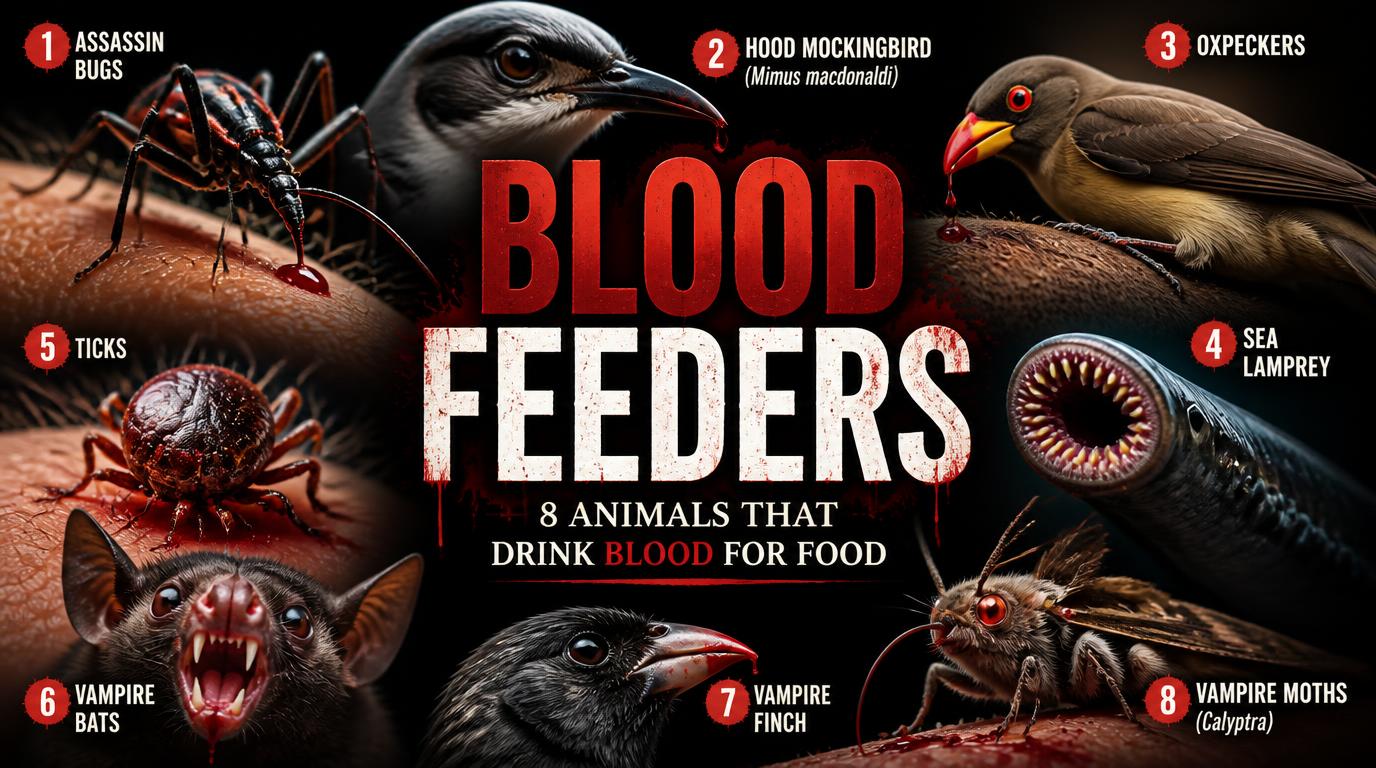
Blood Feeders: 8 Animals That Drink Blood for Food
Blood may seem like one of the least appealing things to eat, but for some animals it is an essential source of nutrients. Across the animal kingdom, several species have evolved specialized ways to obtain blood from other animals.
Blood-feeding animals can be found in forests, deserts, oceans, and even around human homes. Some make tiny wounds and disappear almost unnoticed, while others actively seek out larger animals and remain attached while feeding.
In many blood-feeding insects, females need a blood meal to obtain nutrients required for producing eggs. But not every blood feeder follows this pattern. Some species have evolved blood-feeding behavior for completely different reasons.
Here are eight fascinating animals that include blood in their diet.
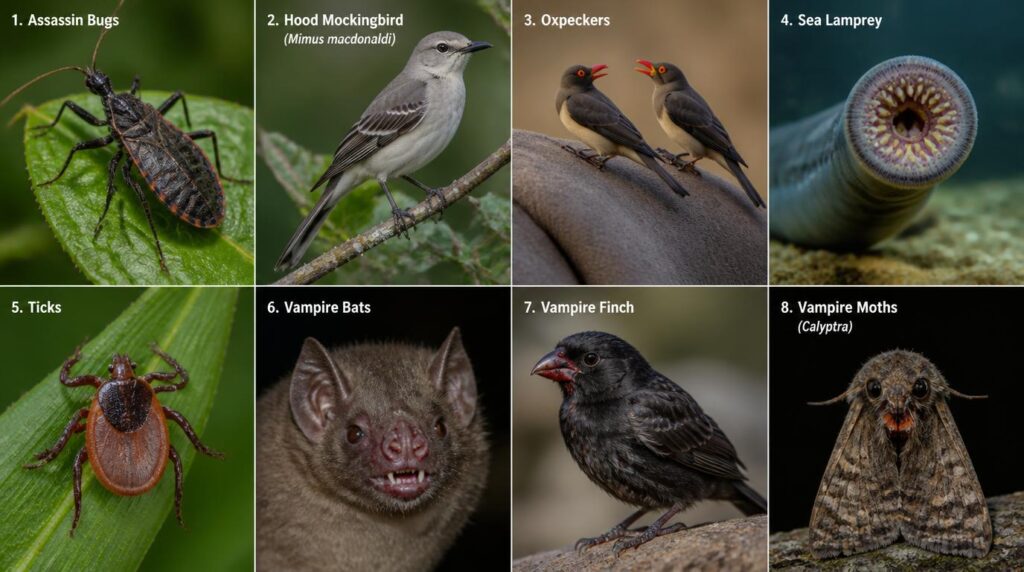
1. Assassin Bugs
Some assassin bugs, particularly the blood-feeding triatomine bugs known as kissing bugs, are specialized parasites of vertebrates. Their common name comes from their tendency to bite people around the face, especially while they are sleeping.
These insects usually hide during the day in dark cracks and sheltered spaces. At night, they emerge to feed. Their elongated mouthparts allow them to pierce skin and draw blood from their host.
Kissing bugs are medically important because some species can transmit Trypanosoma cruzi, the parasite responsible for Chagas disease. Infected people can develop serious long-term complications, including heart and other organ damage.
Their feeding behavior is therefore far more significant than simply being an unpleasant insect bite.
You may also like: Beyond Red: Animals with Blue, Green, and Even Transparent Blood
2. Hood Mockingbird (Mimus macdonaldi)
The Hood mockingbird is one of the most unusual birds in the Galápagos Islands. It is found on Española Island and has developed remarkably opportunistic feeding habits in an environment where food and fresh water can sometimes be scarce.
Among its unusual behaviors is drinking blood from injured seabirds and other animals. It may also feed on parasites found on larger animals and take advantage of food opportunities around human camps.
Blood feeding is not the bird’s only source of food, but it demonstrates how adaptable the species can be when resources are limited.
The Hood mockingbird is also notable for its fearless behavior. Unlike many wild birds, it can show little hesitation around people, especially when food is available.
3. Oxpeckers
Oxpeckers are African birds commonly seen riding on large mammals such as buffalo, zebras, antelope, and other hosts. They are well known for feeding on ticks and other parasites living on the skin of these animals.
However, their relationship with their hosts is more complicated than a simple cleaning service. Oxpeckers may also feed directly from wounds and consume blood and tissue.
Some observations suggest that they can interfere with wound healing, allowing them to continue accessing blood for longer. This means their relationship with large mammals can be beneficial in some circumstances but less beneficial in others.
Oxpeckers also provide an early warning system. When they notice a potential predator, they can become noisy and alert the animals around them.
They even collect hair and other material from their hosts to use when constructing nests.
4. Sea Lamprey
The sea lamprey is one of the strangest blood-feeding animals in the aquatic world. This ancient fish has a circular, sucker-like mouth lined with structures that allow it to attach firmly to another fish.
Once attached, the lamprey uses its rasping mouthparts to damage the host’s skin and feed on its body fluids and blood. Its saliva contains substances that help prevent the blood from clotting while it feeds.
Sea lampreys can live in both marine and freshwater environments during different stages of their life cycle. Their parasitic feeding behavior has made them particularly notorious in regions where they have become invasive.
Lampreys are also evolutionarily ancient. Their lineage predates the dinosaurs, making these bizarre-looking animals living representatives of a very old branch of vertebrate evolution.
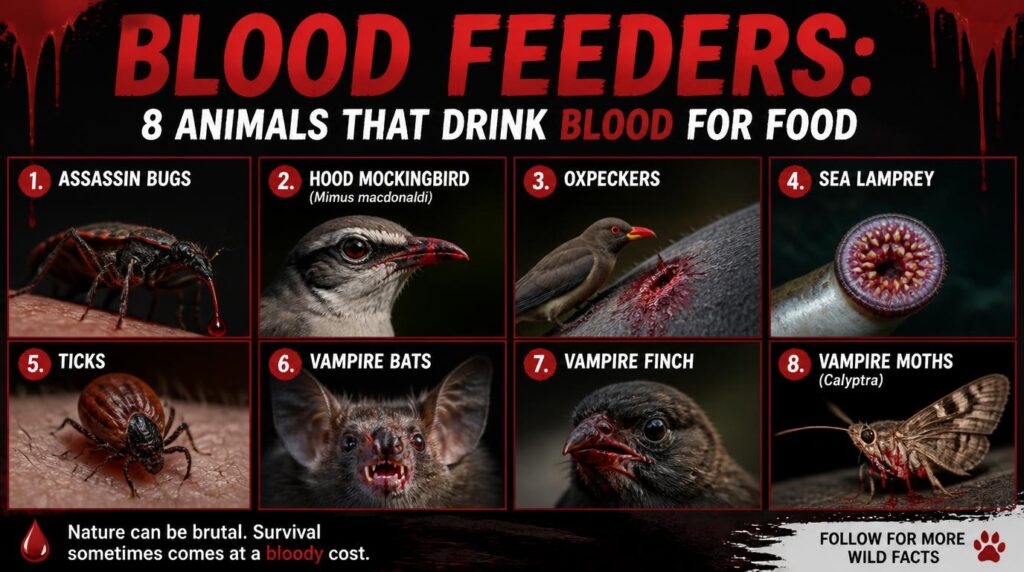
5. Ticks
Ticks are among the best-known blood-feeding parasites. These tiny arachnids attach themselves to mammals, birds, reptiles, and other hosts and can remain attached while taking a large blood meal.
A tick’s feeding process is highly specialized. Its mouthparts anchor into the host’s skin while its body gradually expands as it consumes blood.
The medical importance of ticks goes far beyond the bite itself. Depending on the species and region, ticks can transmit pathogens responsible for diseases such as Lyme disease and several other serious infections.
Because ticks can feed unnoticed for extended periods, they are particularly effective parasites. Their small size also allows them to remain hidden on a host until they have completed their meal.
6. Vampire Bats
Vampire bats are the only mammals known to have evolved a diet consisting primarily of blood. They are native to Central and South America and feed on the blood of other animals.
Rather than attacking their prey in flight, vampire bats can move surprisingly well on the ground. They approach a sleeping or resting host, make a small cut with their sharp teeth, and then lap up the flowing blood.
They have several adaptations for this specialized lifestyle. Their facial heat-sensitive structures help them locate areas where blood vessels are close to the surface of the skin.
Blood is also a nutritionally unusual food because it contains a great deal of liquid but relatively little energy. Vampire bats therefore need to feed regularly. Missing multiple meals can be dangerous for these highly specialized mammals.
7. Vampire Finch
The vampire finch, also known as the sharp-beaked ground finch, is another remarkable Galápagos animal with blood-feeding behavior.
When other food sources become scarce, these finches may obtain blood from seabirds by using their sharp beaks to create small wounds, often around the base of feathers. They have been observed feeding on the blood of birds such as blue-footed boobies.
Blood is only one part of their diet. They also consume insects, seeds, nectar, and other available food. Their unusual feeding strategy appears to be an adaptation to the challenging conditions of their island environment.
Vampire finches can also raid the nests of other birds and feed on eggs when the opportunity arises.
8. Vampire Moths (Calyptra)
The idea of a blood-feeding moth sounds almost unbelievable, but some moths in the Calyptra genus have evolved the ability to pierce the skin of vertebrates and feed on blood.
Unlike many familiar blood-feeding insects, where females are the primary blood feeders, in these moths it is males that have been observed taking blood meals. Their specialized proboscis can penetrate skin and remain in contact with the host while the moth feeds.
Some species are capable of feeding on mammals, and reports include encounters with humans as well as larger animals.
The females generally feed on plant-based resources such as nectar or fruit juices, while the larvae feed on leaves. For males, blood provides additional nutrients, including salts that may potentially be important for reproduction.
A bite from a vampire moth may cause temporary redness or discomfort, but these moths are not considered a major medical threat to humans.