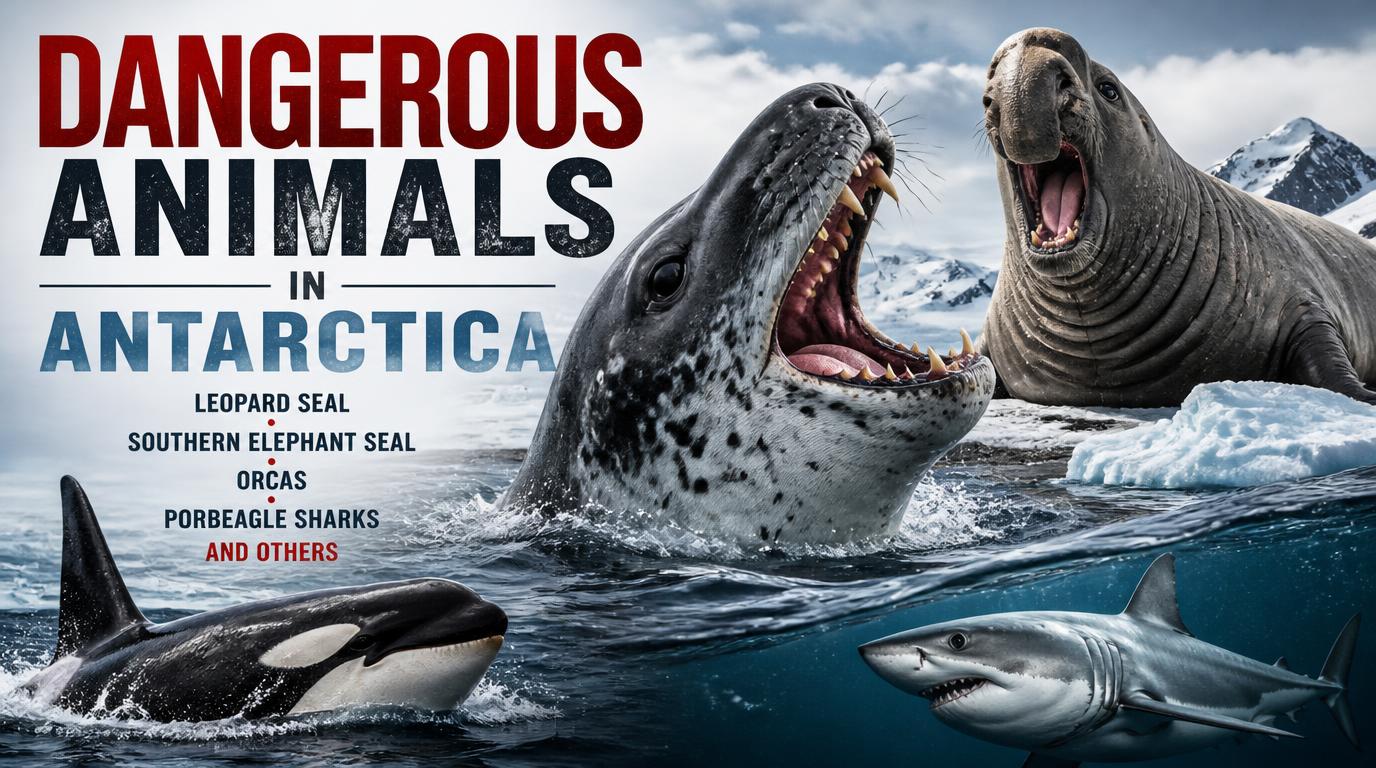
Dangerous Animals in Antarctica
Antarctica is the coldest, driest, and windiest continent on Earth. Around 98% of its landmass is covered by a thick layer of ice, leaving relatively little space for terrestrial wildlife.
The extreme environment also limits the number of animal species that can survive here. However, the waters surrounding Antarctica are home to powerful marine predators, and some of them can pose a genuine danger to people who get too close.
Here are some of the most potentially dangerous animals associated with Antarctica and its surrounding waters.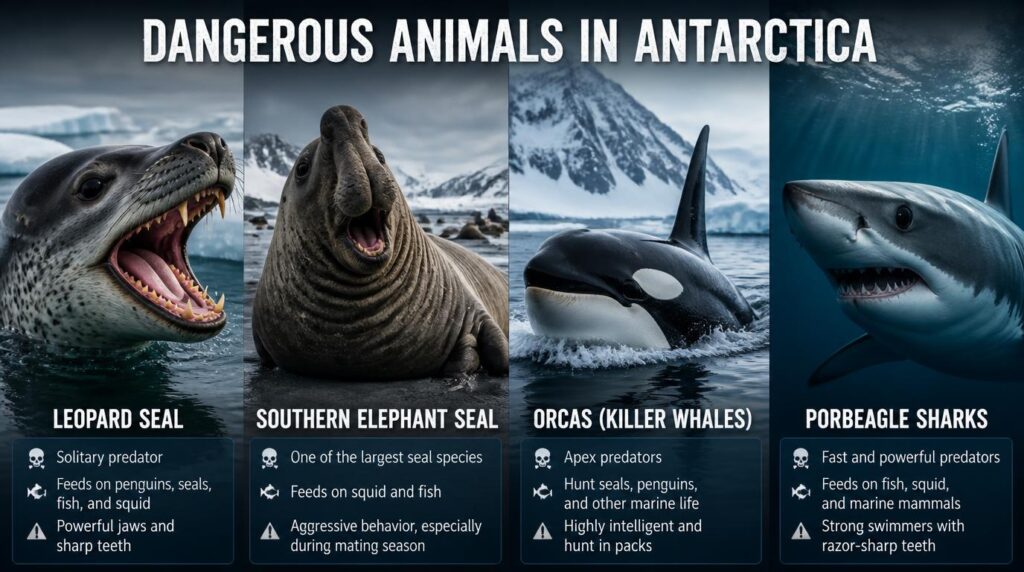
Leopard Seal
The leopard seal is one of Antarctica’s most powerful marine predators and one of the animals that deserves particular caution around humans.
These seals are large, muscular hunters with enormous jaws and sharp teeth. They prey on penguins, fish, squid, and other marine animals. As apex predators in much of their environment, they have relatively few natural enemies.
Leopard seals have occasionally behaved aggressively toward humans. One of the most serious documented incidents involved a marine biologist working for the British Antarctic Survey. A leopard seal grabbed her and pulled her underwater, where she died.
Other encounters with researchers have also involved aggressive behavior, including seals following or approaching people in the water.
Although attacks on humans are extremely rare, their size, strength, and predatory nature mean that leopard seals should never be approached or underestimated.
Southern Elephant Seal
The southern elephant seal is the largest species of seal in the world. Adult males can reach enormous proportions, weighing several tonnes and growing to around 6 meters or more in length.
These animals gather in large colonies, particularly during the breeding season, when males compete for access to females. Dominant males can be highly aggressive toward rivals and may engage in powerful physical confrontations.
Their behavior toward humans is generally not predatory, but their sheer size makes getting too close dangerous. A several-tonne animal can cause severe injuries simply by charging, biting, or moving unpredictably.
Despite their bulky appearance, elephant seals can move surprisingly quickly over short distances. Anyone observing them should maintain a safe distance and avoid blocking their route to the water.
You may also like: The Most Dangerous Animals of the Amazon Rainforest
What About Orcas?
Orcas are among the most powerful predators found in the waters around Antarctica. They hunt a wide range of prey, including fish, penguins, seals, and other marine mammals.
Some Antarctic orca populations have developed specialized hunting techniques. In certain areas, groups work together to create waves that can wash seals from floating ice.
There is no established pattern of Antarctic orcas deliberately hunting humans, and encounters with people are uncommon. Nevertheless, their size, intelligence, speed, and cooperative hunting behavior make them animals that should always be observed with appropriate caution.
Porbeagle Sharks
Porbeagle sharks are cold-water sharks that can tolerate relatively low temperatures and are found in parts of the Southern Hemisphere. However, encounters in Antarctic coastal waters are uncommon.
Like other large predatory sharks, porbeagles are powerful animals capable of attacking prey much larger than themselves. Their presence in the broader Southern Ocean is therefore worth mentioning when discussing potentially dangerous marine wildlife.
However, they should not be presented as a common Antarctic coastal hazard. Encounters with humans in Antarctica are exceptionally unlikely.
Potentially Dangerous Marine Animals
The waters around Antarctica also contain numerous marine invertebrates and other organisms that can cause injury through venom, stings, bites, or defensive reactions.
Jellyfish and other stinging organisms can potentially cause painful reactions, although the risks vary considerably between species. In the cold and isolated Antarctic environment, even a relatively minor injury can become more serious because medical assistance may be far away.
For this reason, wildlife encounters in Antarctica should always be approached with caution. The greatest danger often comes not from an animal actively hunting humans, but from getting too close to a wild animal or entering an environment where escape or medical assistance is difficult.
Antarctica’s Wildlife Is Better Admired From a Distance
Antarctica may have fewer large land animals than many other continents, but its surrounding waters support an extraordinary ecosystem of predators and marine mammals.
Leopard seals and elephant seals are among the animals that can cause serious injuries if approached too closely, while orcas represent some of the most powerful predators in Antarctic waters.
Most Antarctic wildlife has no interest in attacking humans. The safest approach is therefore simple: observe animals from a respectful distance, never attempt to touch or feed them, and follow local wildlife-viewing rules.